
Penn State must respect the democratic will of all graduate student workers to unionize | Opinion
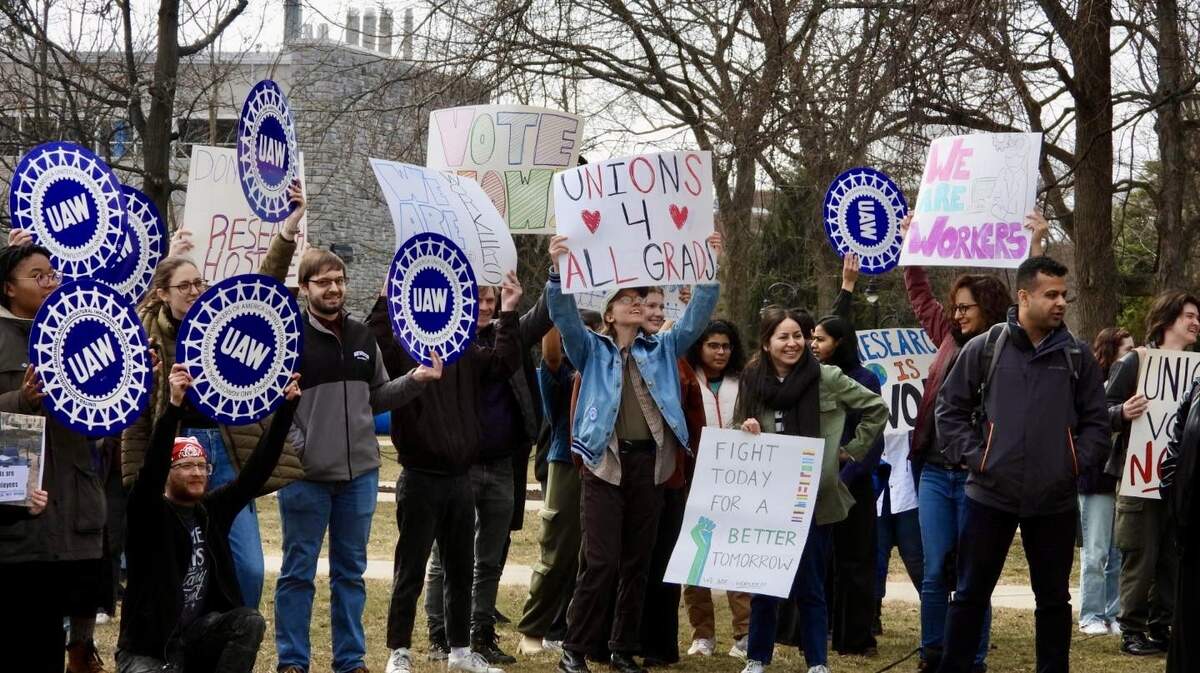
Over the past decade, graduate student workers at colleges and universities across the United States have built equity and power in their workplaces by unionizing. Between 2012 and 2024, the number of unionized graduate student workers rose by 133%. In October 2025, graduate student teaching and research assistants at Penn State joined this growing labor movement, voting by a margin of 90% (1882-Yes, 128-No) to form our union. This resounding victory was the culmination of a three-year process of talking to our co-workers across departments, colleges, and campuses to create a shared vision for our workplace. Workers made a clear choice in support of our union, The Coalition of Graduate Employees-United Auto Workers (CGE-UAW).
However, the Penn State administration has chosen to disregard its employees’ overwhelming democratic will by refusing to respect the results of our vote and arguing that research assistants (RAs), who make up nearly 60% of Penn State graduate student workers, should be excluded from collective bargaining. Penn State claims “that the RA role is unique from other graduate assistant positions because research is an integral part of their academic training and degree requirements.” This is an outdated argument that is deeply out of step with peer institutions and has been rejected multiple times by the Pennsylvania Labor Relations Board. In practice, it will deny basic rights to thousands of critical workers.
Having a union means being able to negotiate as equals with Penn State for better wages, more comprehensive benefits, and protections against workplace discrimination and harassment. It means being able to bargain for improved rights for the international graduate student workers who make up roughly 50% of our bargaining unit and whose status and safety have been increasingly endangered by the Trump administration.
There are already tens of thousands of graduate student research assistants who engage in collective bargaining in unions at public and private universities around the country. This includes other public-sector graduate workers in Pennsylvania at the University of Pittsburgh, as well as at the University of California system, University of Washington, University of Massachusetts, University of Connecticut, University of Vermont, University of Maine, University of New Hampshire, State University of New York system, and many more. These institutions have shown that unions and university administrations can come together to improve the experience of graduate workers, raise workplace standards, and advocate for broader goals like increasing federal research funding.
The work of research assistants at Penn State helps generate over a billion dollars in research grants and contracts every year. This spring, during Penn State’s initial challenge to the inclusion of RAs in our bargaining unit, graduate research assistants highlighted the critical work they do for the university: from maintaining laboratory spaces to coordinating visiting scholars, managing academic journals and creating public-facing content, research assistants are a key part of what drives innovation at Penn State.
At a time when higher education and research funding is under threat and the university has implemented budget cuts and announced the closure of several commonwealth campuses, it is unacceptable that Penn State is choosing to spend precious resources opposing the clear democratic will of its employees. Instead of fighting us, Penn State could be working together with us to resist these threats. Right now, unionized graduate workers in New York and California are working alongside universities to advocate for legislation to establish state-level research funds as part of the larger national movement to challenge federal cuts to research funding and attacks on higher education. Meanwhile, Penn State is challenging the basic rights of its own researchers.
At a moment when our democratic institutions are under attack, universities should hold fast to the principles of fairness, equality and justice that define not only civil society but the pursuit of higher education. We call on Penn State to drop their appeal and respect the democratic will of their own workers. To do otherwise is an affront to all graduate student workers — and to democracy itself.
Tahir Heideri, Chris Pallés and Jess Rafalko are graduate research assistants at Penn State.