
Afield: What to know about Pennsylvania’s gypsy moths and cicadas this summer
Insects are, well, just insects, and most of the time, the multitude of these pint-sized species go unnoticed — that is, unless a mosquito drills your arm or you find “worms” in your broccoli. However, there are two insects that are making their mark on Pennsylvania this summer, and neither species goes unnoticed.
Gypsy moths have returned to Centre County and at least 18 other counties with a vengeance. The hairy black caterpillars, decorated with red and blue spots, are eating their way across large areas of the state. Gypsy moths, a non-native pest, first caused a problem in Pennsylvania in the early 1970s — hitting Centre County later in the decade. I remember well what it was like during their first invasion. It is hard not to notice an insect that makes an entire mountain turn brown in July.
Gypsy moths’ favorite targets are oak trees — one of our most valuable trees, both for their lumber and the acorns that they provide for deer, bears, turkeys and other wildlife. It would not be as bad if the caterpillars stopped with oaks, but they also eat over 100 other species of trees and shrubs. According to the Pennsylvania Department of Conservation and Natural Resources, gypsy moths are the principal agent causing tree mortality in the Keystone State.
Gypsy moth populations usually build slowly, but when conditions are right, their numbers can explode exponentially. During their annual egg mass survey, DCNR noted that many areas of the state were primed for a major onslaught this spring.
“We were getting 2,000 to 10,000-plus egg masses per acre in south central, central, north central and even northwestern Pennsylvania,” said Donald Eggen, forest health manager with DCNR’s Bureau of Forestry. Locally, these high numbers were found in northern Centre County, as well as along the border with Huntingdon and Mifflin counties.
Eggen oversees statewide forest pest management efforts that address gypsy moth, emerald ash borer, hemlock wooly adelgid and other pests.
Beginning in May, DCNR sprayed 146 sites on 203,569 acres of state forests, parks and game lands. This included Centre County sites in Boggs, Burnside, Marion and Rush townships. The other 18 counties that were sprayed are Adams, Bedford, Blair, Cambria, Cameron, Clearfield, Clinton, Cumberland, Elk, Franklin, Huntingdon, Lycoming, McKean, Perry, Potter, Tioga, Warren and Westmoreland.
The department sprays a biological insecticide called b.t., which is a naturally occurring soil bacteria. Although it is not a poison, if ingested by caterpillars, it can kill gypsy moths as well as any species of moths and butterflies.
I have a few gypsy moths on my Taylor Township property. While there’s no defoliation this year, the population could build to damaging levels by next year. I have encountered them in other locations, such as Tyrone’s Reservoir Park, where many oaks are defoliated. On a positive note, I have noticed some larva were dead in the typical upside down “V” position on the sides of oak trees. This is caused by a natural virus that kills the caterpillars and pupae.
Even a destructive pest such as the gypsy moth has an upside. The black-billed and yellow-billed cuckoos, birds that I do not see every year, are in increased numbers. I see or hear them almost everywhere that I go. It is no coincidence that cuckoos’ favorite food is fuzzy caterpillars, such as the gypsy moth.
Avid Centre County birder Nick Bolgiano can even quantify the increase in cuckoo population. That is the purpose of a Breeding Bird Survey.
“Earlier this month during my Breeding Bird Survey routes in the southern part of the Sproul State Forest (Centre and Clinton counties), the number of cuckoos that I counted was consistent with what I counted during the 2006-09 gypsy moth outbreak,” Bolgiano wrote in an email.
He usually counts zero to seven yellow-bills and zero to two black-bills during a normal year. During an outbreak year, he counts four to seven black-bills and 20 to 34 yellow-billed cuckoos on his route.
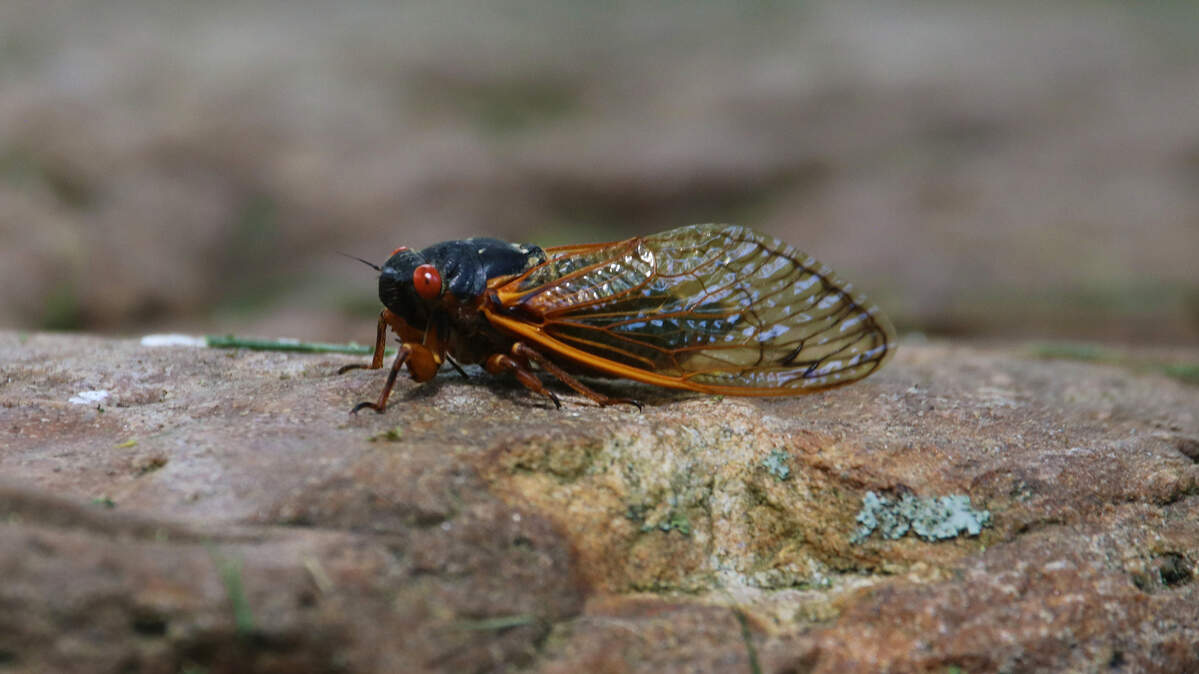
The second insect grabbing a lot of attention this year is the periodical cicada. The red-eyed, large-sized insect only makes an appearance every 17 years. They surface in the spring when soil temperatures reach 64 degrees. During their unique life cycle, they spend about six weeks above ground, and they are active right now. The other 16-plus years is spent underground sucking small amounts of sap from tree roots.
During its brief time above the surface of the soil, this native insect sheds its exoskeleton for the last time, develops wings, attracts a mate, mates, and then the female lays her eggs in the tips of tree branches. They do not eat as adults, they do not bite or sting, but they make a lot of noise.
Pennsylvania is one of the 15 states to host Brood X, the cicadas above ground now. However, if you do not see any cicadas in Centre County, you are not supposed to. There are 15 broods of periodical cicadas recognized in the eastern United States. Brood X is found 25 or more counties south and east of Centre County.
Cicadas (Brood XIV) are expected to emerge in Centre and Clinton counties in 2025. This adds another oddity to an already unique insect. The majority of Brood XIV is found in a disconnected population in southern Ohio, western West Virginia, Kentucky and Tennessee.
If you cannot wait for 2025 and want to see (and hear) cicadas you’d better act quickly. Brood X cicadas have emerged in parts of Adams, Bedford, Berks, Bucks, Chester, Columbia, County, Cumberland, Dauphin, Franklin, Fulton, Huntingdon, Juniata Lancaster, Lehigh, Luzerne, Lycoming, Mercer, Mifflin, Montgomery, Northampton, Perry, Schuylkill, Somerset, and York Counties. Check out forested land rather than farming or urban areas.
Many people do not appreciate cicadas, and that is unfortunate. I talked with a man recently who said that he liked gypsy moths more than cicadas. We were standing there talking and I see dozens of gypsy moth caterpillars crawling down a defoliated oak tree. Me, I will take cicadas any day.
Cicadas cause little damage to trees and are a big benefit as a food supply for many species of birds and other animals. The timing of their emergence is perfect for many species of birds who are trying to find enough food for their nestlings. One only needs to spend 15 minutes in a forest full of cicadas to observe birds feeding on them.
“Periodical cicadas are a natural and vital component of our forest ecosystem,” said Department of Conservation and Natural Resources Secretary Cindy Adams Dunn. “Pennsylvania forests seem to take the impacts of cicadas in stride, having evolved with them for millennia, and the insects are an important food source for forest dwellers like birds and mammals.”
The use of insecticides on cicadas is not recommended because the chemicals will harm many other insects, as well as the animals that eat the cicadas.