
Acrobats balance art with classical music in ‘Opus’
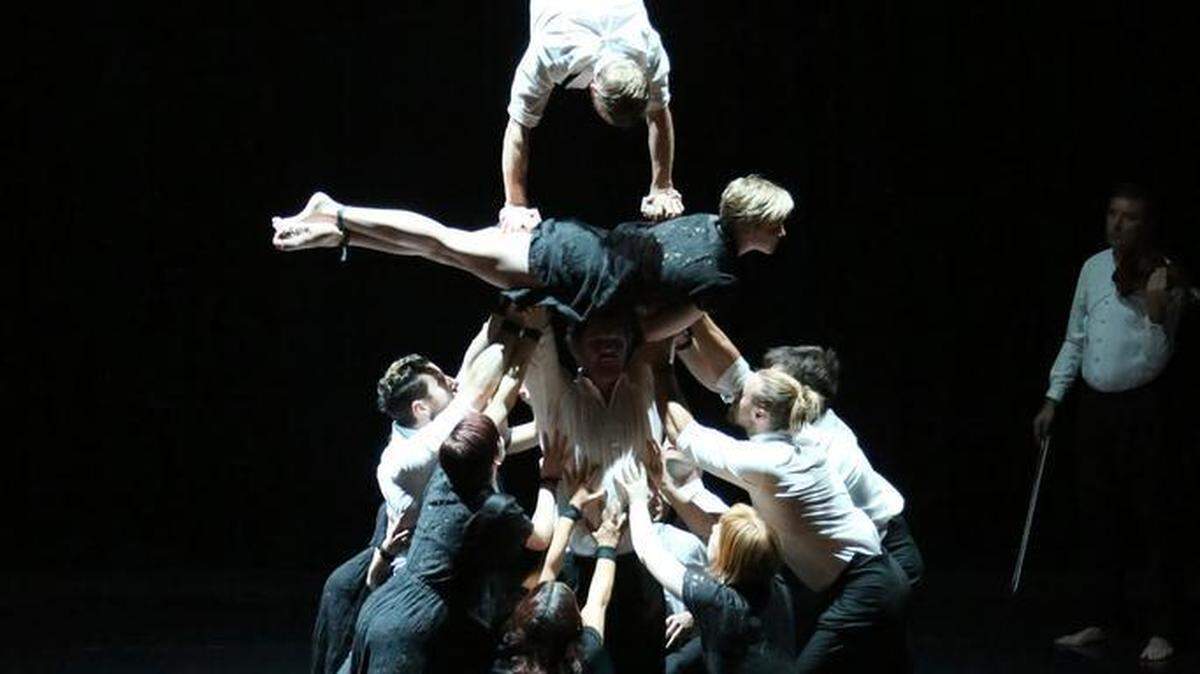
Fourteen extreme acrobats from Australia and live accompaniment by France’s Debussy String Quartet will celebrate the music of Russian composer Dmitri Shostakovich in “Opus” on Nov. 11 at Eisenhower Auditorium.
Since 2004, Circa has been at the frontier of new circus, creating powerful works that move the heart, mind and soul, and challenging audiences with its thrilling, delightful and poetic circus art. Featuring an ensemble of multi-skilled circus artists, Circa has blended bodies, light, sound and skills to achieve its bold vision for contemporary circus.
A critic for the British newspaper The Guardian described their performance of “Opus” as “extraordinarily moving,” and a reviewer for Canada’s “La Presse” calls it “a masterpiece of circus art.” “Opus” delves into the complex relationships between the individual and the group, between the march of history and the dictates of the heart, and between the tragic and the comic.
Created by Circa Artistic Director Yaron Lifschitz and performed by Brisbane, Queensland’s Circa and France’s Debussy String Quartet, “Opus” is a work of power, virtuosity and poetry. Three of Shostakovich’s quartets and an adagio form the musical and dramatic foundation for a fusion of extreme acrobatics, lyrical movement and group choreography.
The Russian composer’s quartets are, by turns, intimate, passionate, lyrical, ironic and moving testimonies by one of the 20th century’s greatest artists. More than just a source of musical accompaniment, the Debussy ensemble performs from memory and is woven into the action.
The company’s daring and award-winning works have been performed in 33 countries on six continents. In that same time, France’s Debussy String Quartet has released more than 25 CDs. The quartet is up to Circa’s challenge, as the musicians meet the flying, twirling and writhing performing artists with the 20th-century composer’s avant-garde themes, brash harmonies and sarcastic idioms.
Based in Lyon, France, the Debussy Quartet garners international praise for its many recordings and live performances. Created in 1990, the ensemble was winner of the Evian International String Quartet Competition.
Coming from the New South Wales coastal city of Newcastle, Circa performer Todd Kilby started doing circus when he was 13 years old.
“My high school had a circus program, and outside of school there was a local community circus, called ‘Circus Avalon,’ ” he said. “So I started doing both when I was 13, and trained throughout my teenage years.”
At age 19, Kilby began to train at the National Institute of Circus Arts in 2008. While there, Kilby worked with the Tangentyre Council in Alice Springs, a remote town in Australia’s Northern Territory, teaching in the local Indigenous Youth Circus Arts Centre.
“I trained there for three years, and then during my third year, I got in contact with Yaron Lifschitz, who is the director of Circa,” he said. “We had several conversations back and forth, myself and three other people I was working with. He hired us and took us on, so I’ve been working with Circa ever since.”
Lifschitz is a graduate of the University of New South Wales, University of Queensland and National Institute of Dramatic Arts, where he was the youngest director ever accepted into its prestigious graduate director’s course. With Circa, Lifschitz has created works such as “CIRCA,” “Wunderkammer,” “How Like an Angel,” “S”, “Beyond,” “Opus,” “Carnival of the Animals” and “Il Ritorno.”
To learn the music and create the choreography for “Opus,” the cast of Circa listened to recordings of the music which the string quartet had done initially — so as they played the music, they created their piece. In addition, the company also developed their work by traveling to France, where they could be with the string quartet and create the pieces together.
“We would go back and forth and do projects with them, and then go away to do more work with the recordings,” Kilby said. “Eventually we all came into the space and did a walk of the show, but with the musicians playing the music the way they play it. First, we would just listen to the way they do it to connect to the music. Then before the show, we would do improvisations with the musicians listening, just to really get in tune and get connected with the music.”
A black belt in Taekwondo, Kilby has both trained and performed with “Circus Avalon” and “Hands Free Physical Theatre” with whom he won a City of Newcastle Drama Award for stunt choreography. While specializing in Chinese Pole and Hoop Diving, he has also been trained in Teeterboard, Adagio, Tumbling and Knockabout. A multifaceted performer with a uniquely Australian style, Kilby combines circus, dance, martial arts and drama, and has a passion and love of performing and entertaining audiences through exploration and raw human energy.
Circa is typically on the road anywhere from eight to 10 months out of the year, so for Kilby and the cast, the job is never boring.
“We’re always in different towns doing different shows and meeting new people, so it’s definitely a challenge,” Kilby said. “There’s a lot of work involved, both physically and mentally.”
Circa has taken this tour through Europe, particularly in France, and has had brilliant receptions with standing ovations in the United States as well.
“But I find that different places in the world receive different pieces of work quite differently,” Kilby said. “It’s quite exciting to see how the U.S. and even different parts of the U.S. respond to this particular work.”
For Kilby, it’s hard to put himself in the shoes of audience members and say how the show may affect them. He just wants people to come and experience it, and anything that they take away from it will make him happy.
“In making this work I would like to move people — I want people to have some emotional connection to the piece and to the music in whatever that means for that individual,” he said. “Shostakovich wrote really heavy, dense, complicated and stunning music, and the circus is often put up in that raw, human energy — that high power, that real aliveness that circus has. It’s that really complex and emotional tapestry that Shostakovich brings to it.”
This story was originally published November 6, 2015 at 12:35 PM with the headline "Acrobats balance art with classical music in ‘Opus’."