
Penn State celebrates 60 years of nuclear reactor research
The Breazeale Nuclear Reactor is a hot spot for sci-fi movie references and comic book superpower suggestions. Put a source of radioactive energy in the backyard and the jokes write themselves.
So can skittishness about exactly what nuclear energy means. That was why Associate Director for Operations Mark Trump said the university was opening the doors to the facility for the public to take a peek at the inner workings of the sometimes mysterious world of atoms.
Trump insists there is no room full of mutant radioactive spiders, but in honor of the 60th anniversary of the research reactor license granted to Penn State by the Atomic Energy Commission, tours of reactor were conducted Tuesday, letting interested observers get a glimpse of labs, hear about Penn State’s nuclear history and see the heart of the facility, the 24-foot-deep royal blue pool where uranium powers a whole world of experimentation.
“One of our first directives is education and education includes the public,” Trump said. “The American public has an irrational fear of radiation.”
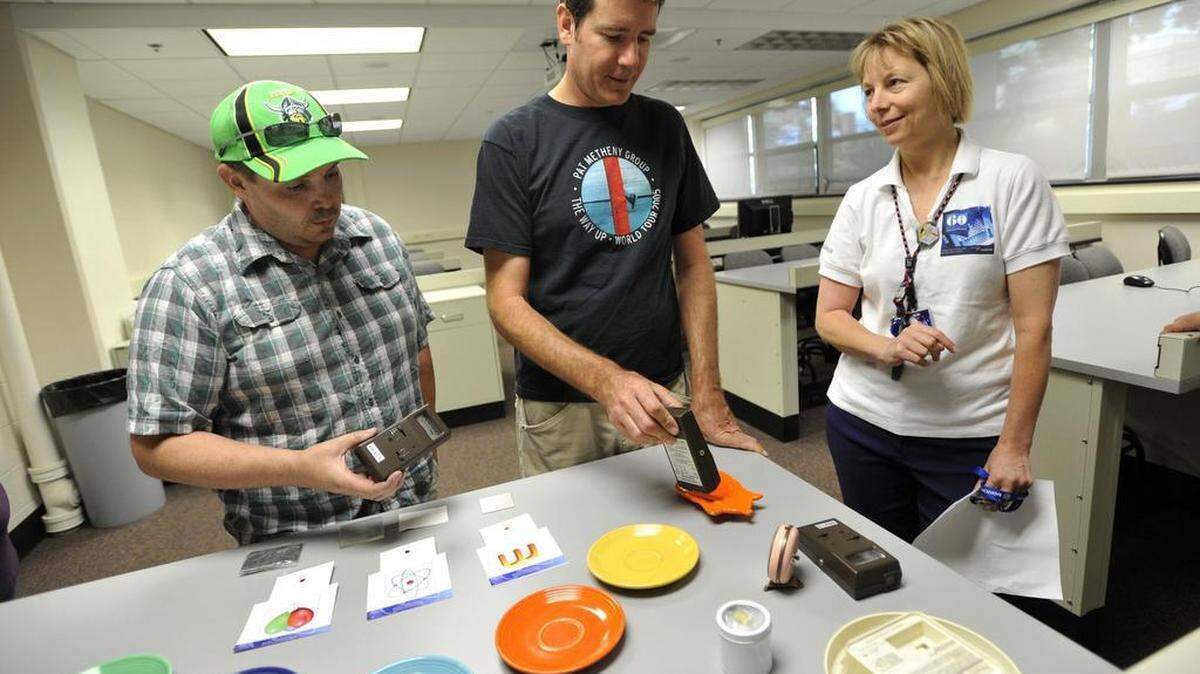
A rich tradition of radioactive plot devices in fiction can lead to an unrealistic idea of what nuclear energy can and can’t do. Opening for the tour, the Penn State researchers hoped to counter that with facts, like demonstrating the radioactivity of some common household items or showing how nuclear research has fueled things people take for granted.
According to senior reactor operator and research and education specialist Candace Davison, one of those things is a staple in every TV cop show. Penn State researchers at the nuclear lab helped develop a gunshot residue detection kit for the state police in the 1970s.
Then there’s the cross-cut of a tree in one lab where other scientists have measured the way different elements are absorbed in a tree when an event like a volcanic eruption takes place. Some work on purifying metal. Others work on studying bone. The variety of research is broad.
Davison, who works with gamma radiation but claims this does not make her large, green and incredible when angry, says the implications of the research are evolving all the time, based on the needs and situations of the time.
Penn State conducted a citizens monitoring program, studying those who may have been impacted by the nuclear incident at the Three Mile Island plant in 1979. Today, they are working on things like activatable tracers that could follow radioactive signatures in the environment, like on wildlife, without releasing radioactive material into the wild.
Looking at the control room for the reactor, you can see the passage of time. Overall, the 1965 bones are still there, leading to a NASA mission control kind of look, but side by side with it are more up-to-date computers and monitoring equipment.
Sequen Williams is about to start his senior year studying energy engineering, but he has already become a certified reactor operator during his tenure as an intern.
“I love that plaque,” he said of his certification. “I have it in my room. When it really matters, I know what to do.”
There are 18 licensed operators for the facility. Overall, about 25 students a year also participate in the reactor programs. The reactor’s licensure has been renewed by the Nuclear Regulatory Commission three times since it opened, the most recent being in 2009. The current license extends to 2029.
Repeatedly stressed on the tour was an emphasis on safety and security. In fact, Penn State developed a graduate nuclear security education program, one of just a handful of similar programs in the country.
“The reactor is very safe,” said Davison, who pointed to the pool as its most visible safety feature. The water, hyper-purified to remove contaminants that might conduct energy, is not just for cooling the uranium that has powered five decades of experimentation. It is also a protective barrier.
“That is a billionfold of shielding,” she said.
Davison said there are less than 30 reactors like Penn State’s in the country.
This story was originally published August 19, 2015 at 12:02 AM with the headline "Penn State celebrates 60 years of nuclear reactor research."