
‘Quilt Friends’: The ties that bind
In today’s world of convenience, there is no argument for making a quilt solely for the sake of physical warmth.
Anymore, quilt-making is almost always about something else: sharing time, experience, beauty or emotion.
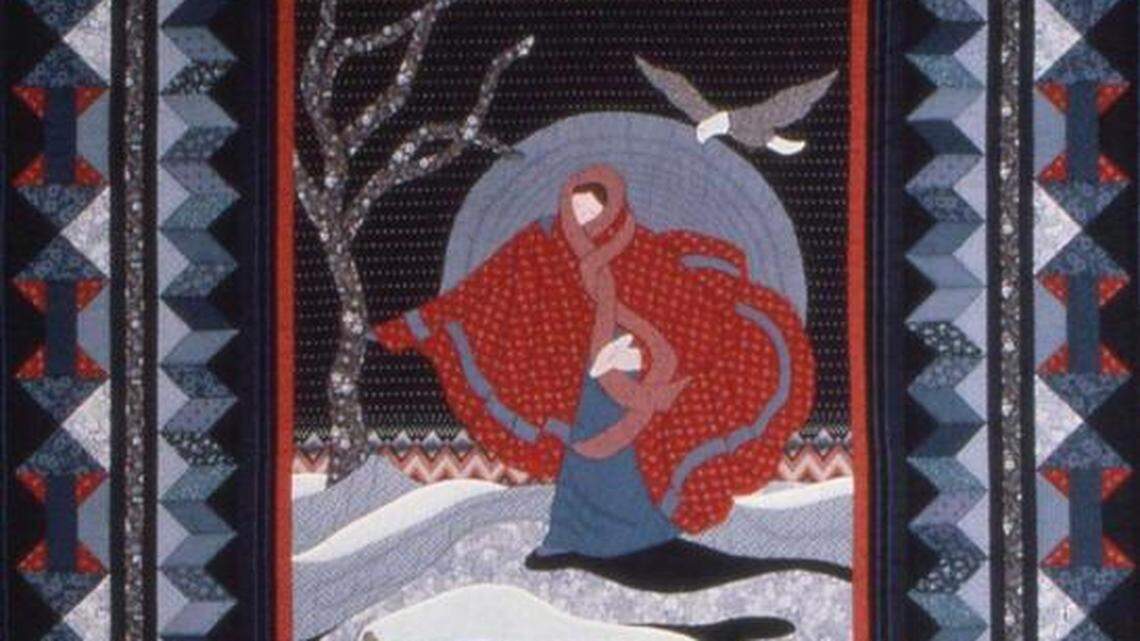
In the case of “Saving the Fawn,” an award-winning piece on exhibit at Foxdale Village Retirement Community, the handiwork was more an act of atonement.
The quilt, jointly designed and executed in 1980 by State College artists Sylvia Apple and Antoinette Holl, is the result of a mishap between a deer and a car the longtime friends were driving on a dark night coming home from a craft show.
“When something like that happens and you don’t expect it, you have to do what is required,” said Holl, who added geometric patterns around a scene Apple designed and appliqued: the visage of woman holding a fawn in the folds of her cape.
“We had to get home, but this big deer — his family had passed in front of us, too. After we hit him, he disappeared into the woods and there was no resolution to that. This quilt shows our feeling for that beautiful organism.”
The quilt will be on display in a second-floor gallery at Foxdale Village until Oct. 6 as part of a fiber arts show, “Quilt Friends.” The show incorporates work from an informal group of 15 local quilters.
Since the two women created “Saving the Fawn” in 1980, the quilt has traveled extensively and has been included in publications nationally and internationally. It also was honored by the National Quilt Association.
The quilt resonated on many levels and for varying reasons, Apple said. As it happened, the quilt was ready in time for a publication that celebrated the bicentennial of the U.S. Constitution in 1987, which included an an entry for colonial-era handiwork. One, “We the Quilters,” called for quilts from the 13 original colonies. A committee for the project chose “Saving the Fawn” as the Pennsylvania quilt.
“I don’t even know all the places it went to,” Apple said. “For some reason, it captured attention. It appeals, maybe, to the fact that women save things. One person said it looked like Eliza saving the baby in ‘Uncle Tom’s Cabin.’ One woman told me she looked at it and cried when she saw it. It has something to do with having this little creature under her cloak. I was just trying to capture how I felt.”
Apple and Holl have worked together for more than 30 years, though they have only created a quilt together five or six times.
“I felt so badly about the deer, not knowing what had happened to it in the dark,” Apple said. “I did a design about a woman saving the fawn, a winter scene. I showed Antoinette and asked her to work on this for me. She made a beautiful surrounding for the scene, a wide, intricate piece border for it.”
Apple, 70, arrived in State College 40 years ago. Though she had embroidered since she was a girl, she never quilted until she worked with Amish women in the area, part of her job with a former craft cooperative, Village Crafts.
“My job was to help people making things with design and color,” she said. “I worked with the Amish in Brush Valley. A lot of them were quilters, and they got me quilting.”
Apple then joined a quilt group of about five women.
“I just called a few people,” she said. “We worked on each other’s quilts, making one at a time. Antoinette joined and we saw her abilities.”
Holl, 83, said she now counts Apple among her closest friends, almost as dear as family.
“Sylvia is very artistic,” she said. “I have art in me as well. My background is science. As you can see, we bring different approaches to things but similar sensitivities. We know when we have it right. It’s something that we have, working together, that neither of us would have separately.”
“I never expected ‘Saving the Fawn’ to draw as much attention as it has or for as long as it has. It’s an old quilt now. You do things because you think they will be a great in your mind.”
Both women continue their artistic pursuits, Holl said.
“Quilt-making is something that is a self-determined activity,” she said. “For us, it’s been a business also. It’s not something that has to stop. I will make quilts until I can’t pick up a needle.
“I think, historically, quilts have been informal gatherings,” Holl said. “Early on, it was family and neighbors. It’s a craft art that has been passed from one person for another. It was not something you could go to school for. When I began quilt-making as a teenager, there was no way to learn except from someone else who knew. When I started, there was no quilting on television, in books or magazines.”
Though the reasons have changed, the outcomes of a shared creative process — lifelong bonds — have not.
“It’s a many hands make light work thing,” Holl said. “I’m sure that will always be there. You could do it by yourself, but it would take longer and not be as much fun.”
This story was originally published August 22, 2014 at 12:00 AM with the headline "‘Quilt Friends’: The ties that bind."