
Building history: Civilian Conservation Corps celebrated with Legacy Day at Poe Valley State Park
Imagine a local state park — or a state forest — without towering pines.
Those white and yellow pines at Poe Valley State Park, and many of the trail systems that wind through them, are the direct handiwork of the Depression-era Civilian Conservation Corps — 80 years after the fact.
Even Poe Valley Lake is work of their hands.
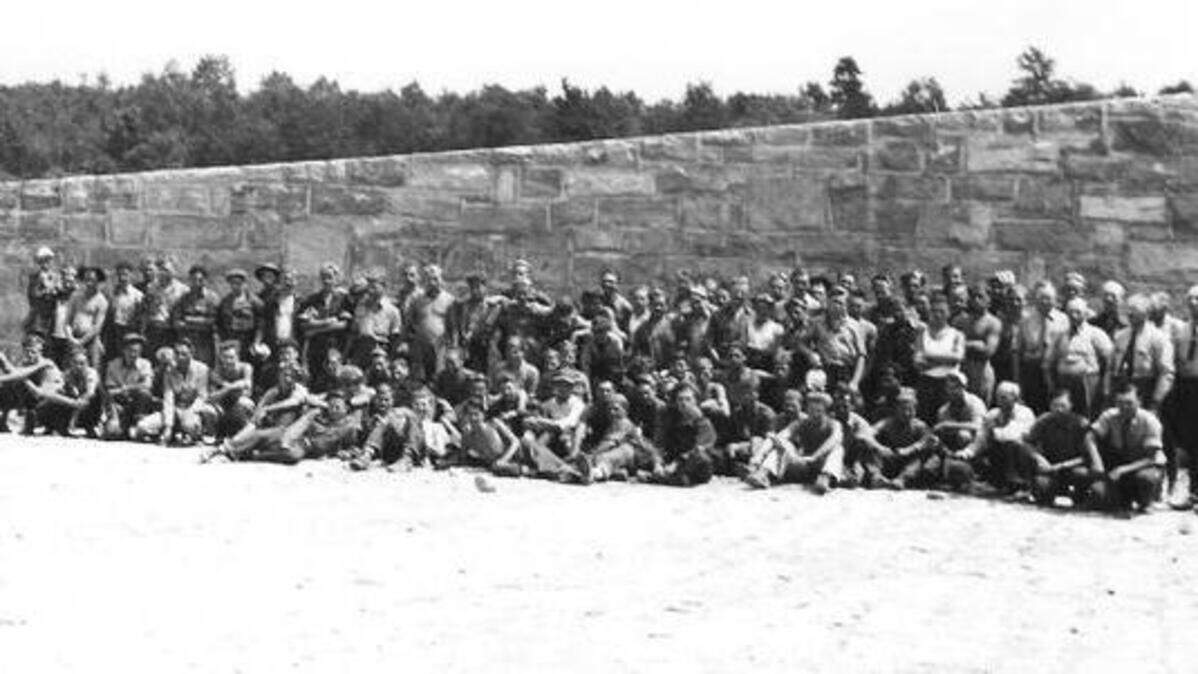
The young men who joined the camp there and were instrumental in building Poe Valley and Poe Paddy state parks also built the earthen dam that creates the lake, according to William Marcum, grandson of a Poe Valley CCC camp foreman.
“Their first mission, throughout all of the states and especially in the east, was to do forest management work,” he said.
“In general, what we had done to that point was to go in and chop and send lumber to sawmills and build, build, build, without any management of the land thereafter. It was a coincidental issue: Young men needed jobs; forests needed to be improved and managed, and that’s what they did.”
Marcum, who gave a presentation — “Life in the Civilian Conservation Corps” — earlier this month at Poe Valley and who will share stories and memorabilia at Civilian Conservation Corps Legacy Day at the park, knows the minutia so well that he can recite the exact moment that water started flowing over the dam’s spillway: 4:15 a.m. Dec. 19, 1937.
“The average person today, 45 years old and younger — they have no idea about the CCC,” Marcum said. “It’s something you get a glimpse of in a high school history class during a review of the New Deal era, because there were so many pieces of that. This was one of the most popular of all the things that came out of the New Deal package.”
At the park’s Legacy Day on Sunday, visitors can learn about what prompted this national initiative, how the young men who joined lived and what effect they had on Pennsylvania’s resources and infrastructure. The event also includes a tour of the site where Civilian Conservation Corps Company 1333 (its military designation) set up barracks and a walk through the officers’ quarters and forestry quarters, which remain much like they were when they were built in December 1936.
Aside from important infrastructure work — such as building dams, forging thousands of miles of roads and erecting fire towers — CCC enrollees were credited with renewing the nation’s forests by planting an estimated three billion trees between 1933 and 1942.
“They did trail work and tree identification work,” Marcum said. “They eradicated all kinds of unwanted vegetation and planted specific types of native trees.”
In Centre County, there are four sites that were either fully prepared by the CCC or were greatly enhanced by the CCC: Poe Valley and Poe Paddy, which were built out of the same camp; Penn-Roosevelt State Park, which was a segregated camp; and McCalls Dam State Park in eastern Centre County.
The state’s Department of Conservation and Natural Resources also lists CCC camps and forestry efforts at Black Moshannon State Park and state forests in the county.
A total of 194,500 Pennsylvania citizens served in the CCC nationwide through the program that President Franklin D. Roosevelt authorized in 1933, according to the department. The CCC was continued until June 30, 1942, shortly after the outbreak of World War II.
Sharing history
Though organizers have held a CCC Legacy Day before, Tracy Zupich, park manager for Reeds Gap, Poe Paddy and Poe Valley state parks, said that Marcum’s second-hand stories offer a look at a time slowly slipping from collective knowledge.
“He brings in a lot of old photographs and history of CCC camp,” she said. “Besides just a day in the park, visitors can learn how the Civilian Conservation Corps was fundamental in building a lot of state parks. A lot of the history hasn’t been lost, but it hasn’t been shared with the upcoming generation.”
The event also may mark the first time the officers’ quarters have been open for a large public audience, she said.
“You don’t realize until you start looking into the history how significant their contributions were,” Zupich said. “There is so much history involved with the Depression era.”
The events include a discussion by Marcum and another local historian, Richard Wycoff, as well as memorabilia exhibits and walking tours of the camp site and remaining buildings, according to Aaron Emick, environmental interpretive technician for the state’s Department of Conservation and Natural Resources, which operates state parks.
“The CCC boys — that’s what they called them — really left their mark on the American landscape in places like Poe Valley,” Emick said. “We get people with all different knowledge bases at the park. Some people come just looking for CCC history. We have some who don’t know much about how the park was built. It’s a very important piece of history for Pennsylvania.”
A time unparalleled
It’s doubtful that many of Pennsylvania’s state parks would exist — at least in any form close to what they now are — without the extraordinary undertaking organized with military strength, public support and civilian muscle, both Emick and Marcum said.
“The state park system that we have in Pennsylvania — as well as many of the eastern states — is a result of the efforts of the CCC,” Marcum said.
Representatives of the U.S. secretaries of War, Labor, Agriculture and Interior served on a CCC Council for the duration of the program, and it was well-received by both sides of the political aisle, according to a history from the organization CCC Legacy.
Though the corps ended in 1942, another version began in 1965 and continues today, on some level, through a youth conservation corps and other programs, according to the organization. In recent years, there has been an increase in federal funding to help grow the conservation corps community in many states, the organization said, and many of today’s corps members have benefited from the support and influence of Civilian Conservation Corps veterans.
A Pennsylvania Conservation Corps grant program, funded through the state, continues to operate through political subdivisions and is focused on developing and educating young people. The program offers work experience, job training and educational opportunities to young people who complete yearlong projects on Pennsylvania’s public lands.
Of course, the scale of these programs does not — and likely cannot — achieve what happened during the New Deal, Marcum said.
Several states have attempted to rebirth a similar program, and California had the most success, he said.
“My opinion is, unless we see something as economically catastrophic as at that time, I don’t think we have a whisper’s chance. Imagine taking a 16- to 19-year-old kid today, putting him deep into the forest of an unknown location with no computer, phone, laptop, iTunes — without every other gadget we now have — and saying ‘I’m going to give you five bucks for the day and I want you to go out and chop down trees and clean out trails.’ ”
The desperation of the time is something most can’t understand, Marcum said.
“It was a time unparalleled,” he said.
“Hopefully it will remain unparalleled. These jobs were for 17- to 25-year-olds who had no job and had been asked to leave home because their parents could not provide for them. No, I don’t think we can have a similar program unless it were well-funded and have way more provided within the program to give any kind of attraction to sign up.”
This story was originally published August 22, 2014 at 12:00 AM with the headline "Building history: Civilian Conservation Corps celebrated with Legacy Day at Poe Valley State Park."