
Penn State film professor Pearl Gluck focuses lens on sex trafficking
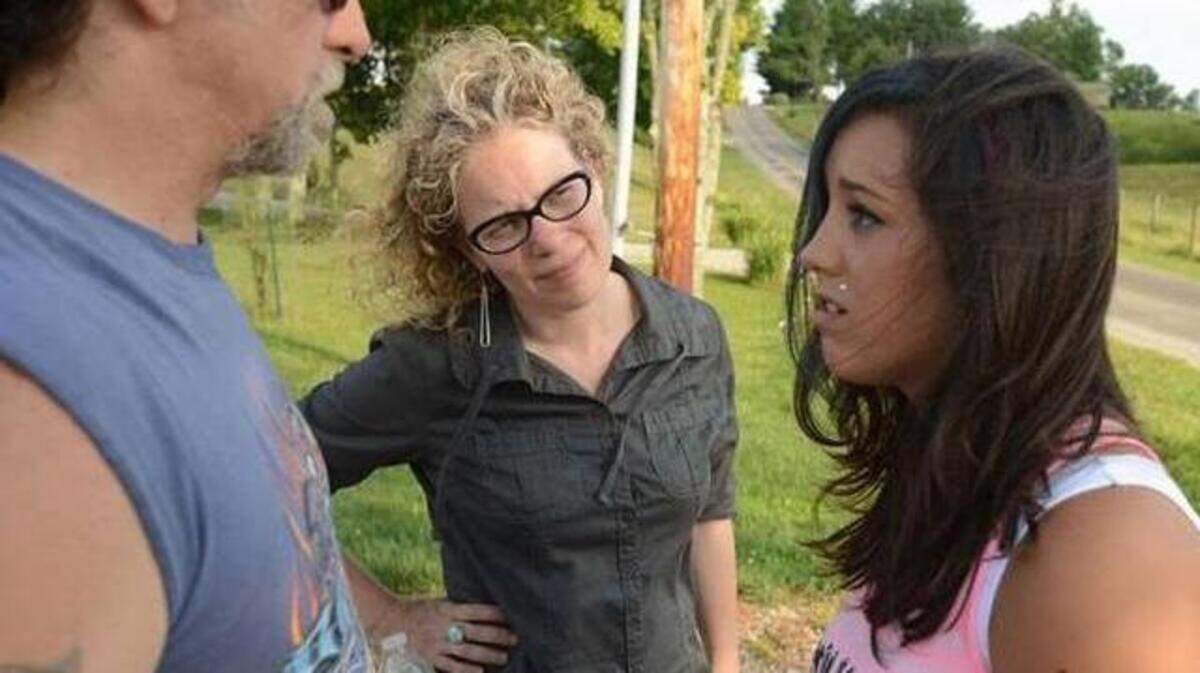
Days after shooting the last take of her first feature-length narrative film in Ohio this summer, Pearl Gluck packed a moving van and headed for her new job at Penn State.
Just months after arriving in the College of Communications, Gluck, an assistant professor in the department of film-video and media studies, was awarded a grant from the Penn State’s Institute for the Arts and Humanities to support post-production of “The Turn Out.”
“I came here with a bunch of footage and now we have to edit the film; this is the start,” Gluck said.
Set in a rural, southern Ohio town, “The Turn Out” focuses on addiction, poverty and abuse in telling the story of trucker Crowbar and teen Nevaeh, who is being trafficked by her own family at a truck stop. While the story is fictional, some scenes are based on real-life experiences gleaned through Gluck’s research and interviews with victims of interfamily trafficking, police officers, social workers and advocates. The idea to look deeper at the issue was borne from conversations with James Gagne Jr., who has worked as a full-time truck driver for 24 years.
“As we worked on it, I even learned more myself,” said Gagne, who co-wrote the film and plays Crowbar. “Girls are enslaved out there.”
“The Turn Out” — a double entendre for trucker lingo and a girl’s first time prostituting — marks Gluck’s first feature narrative, but the Brooklyn, N.Y., native has earned acclaim and accolades for her documentary work and short films. Her first film, the award-winning documentary “Divan,” about her return to the Hasidic community in which she grew up , was screened at the State Theater on Wednesday during a Women Entrepreneurs in Film presentation.
Gluck recently discussed her work and career with the Centre Daily Times.
Q: What inspired “The Turn Out,” and how did you choose drama as your genre?
A: I was inspired because, through Jim, I was learning about the life of a trucker and discovering the organization called Truckers Against Trafficking. I was always interested in questions about sexuality, freedom and those kinds of choices that men and women make and don’t get to make, and I was always interested in films as a way of calling attention to certain issues. ... I decided I really needed to craft a person who needed to learn and change. The more I interviewed people and the more people I met, the more involved I got into the material. So the trucker’s involvement parallels mine; as I got more and more drawn in, I couldn’t turn back.
Q: What does the IAH grant enable you to do?
A: It will go directly toward editing, and it’s just an incredible honor. One of the things that really drew me to (the institute) was the Banned Books film festival (which ran in September). ... I saw those posters when I first got here, day one, and I said ‘I want to be involved with this organization.’
Q: How is “The Turn Out” different from your other work?
A: Most of my work has been based in the Hasidic community, so this is my first one kind of out of that. In some ways, though, I still think it’s very similar; it takes a critical look at the world around us — that’s just the work I do. It’s my first feature narrative, so that was brand new. I used to only work with professional cast and crew; this was the first time that my crew was almost entirely students I worked with (at Ohio University).
Q: What are the common themes in your films?
A: I think they’re all told with a very strong first-person perspective. They’re all informed by true stories and by research, even if they’re fiction. And I’d like to believe that they all give you this kind of intimate access to a world, in this case the trucker’s world. I also don’t think I look for a way to soften the blow, as it were. It’s very ‘in your face,’ that’s generally my style — it’s just apologetically the story, and if it’s too difficult, well, maybe ask why.
Q: How did “Divan” come about?
A: That took five years as a documentary that came about totally by mistake. I thought that I was doing a different film and it was going to be about what’s left of Yiddish story-telling in Hungary, it was based on a Fulbright grant that I got there. Three years into the project and probably a year and a half of working with my editor, she turned to me and said, “This is an autobiographical story, and you have to put yourself in it.”
Q: Who do you make your films for?
A: Every filmmaker will be happy to have their film seen by everyone, so first and foremost I make my films certainly to be watched and hopefully to a general audience. But I have my reasons for doing it secretly. With “Divan,” I really wanted to help build a bridge between parents and kids who don’t talk, so that’s the tiny, tiny percentage audience, it’s not the money-making audience. In this case (with “The Turn Out”), I have a few desires. One of them is I obviously want this to help anybody who is in trouble. I want to call attention to this issue, and I want to maybe encourage people to take action, even if they’re not cut out for it, like Crowbar thinks he’s not cut out for it.
Q: When and where will “The Turn Out” premier?
A: Our hope is that it will make the festival circuits starting in the fall. And then from there, God willing, it gets picked up and gets a theatrical release like “Divan” did.
Q: What do you enjoy about teaching?
A: I think it keeps things fresh for me in some ways. I just love it. I really think it’s about staying in the conversation. I think filmmaking is teaching, so it’s hard for me to separate those two.
This story was originally published November 24, 2014 at 12:00 AM with the headline "Penn State film professor Pearl Gluck focuses lens on sex trafficking."