
‘CCC boys’ to be celebrated
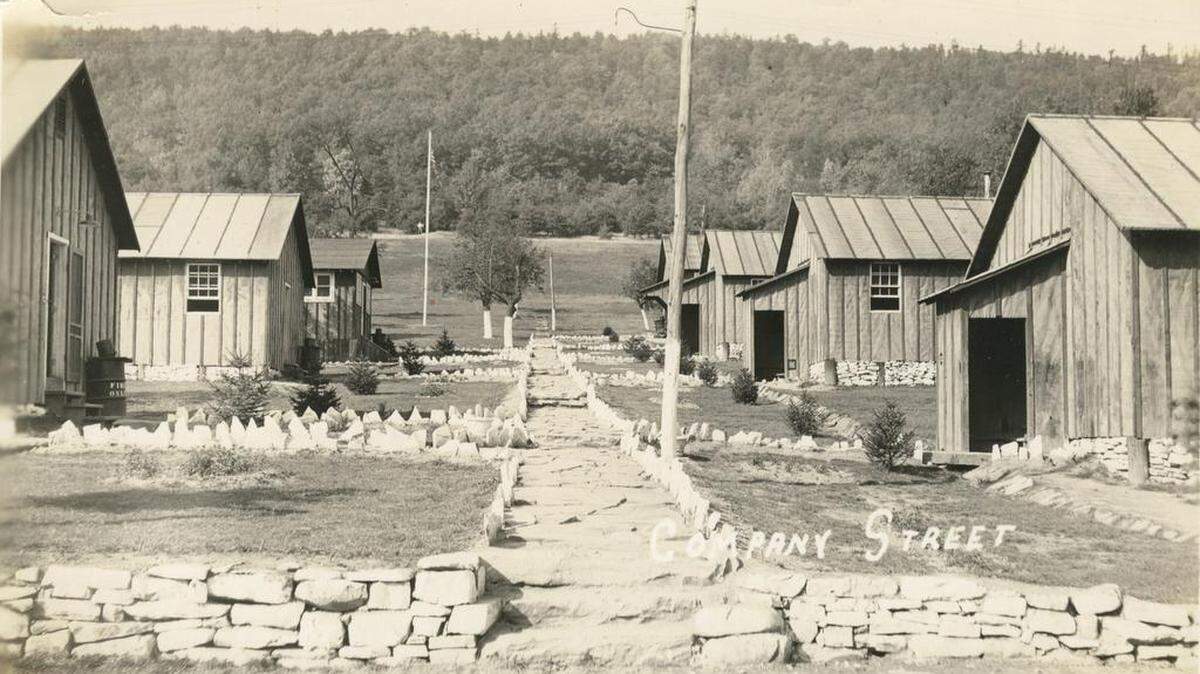
It was 75 years ago, but Randall Boob still remembers being more than a little surprised at his first payday with the Civilian Conservation Corps.
Stationed at the Poe Valley camp, a 17-year-old Boob earned $1 a day building what would become Poe Valley State Park, but he saw $8 at the end of the first month.
“I asked what was going on and they said, ‘well, your parents have to eat, too.’ So I got $8 and they sent the rest home to my family,” Boob said. “Then I felt good about it because I knew my parents had a tough job.”
On Aug. 23, Boob will return to the park he helped create for the annual Civilian Conservation Corps Legacy Day. Last year, the 92-year-old was one of two CCC veterans to attend the event, and he said he wouldn’t miss it for anything.
“There aren’t many of the boys left, but by God, it’s like going back home,” Boob said.
Life in the camps
What started as a reunion for CCC enrollees (“CCC boys,” as they were called) has become a gathering for history buffs and for families who want to learn more about what their fathers, uncles, grandfathers or great-grandfathers were part of, organizer Bill Marcum said.
“My primary purpose here is to keep the legacy going and keep an opportunity out there to learn more about what was done and who did it,” Marcum said.
Conceived during the Great Depression, the CCC put more than three million young men to work in the United States from 1933 to 1942, according to the Pennsylvania Department of Conservation and Natural Resources.
“It was a project President Roosevelt started so that young people could get a job,” said Boob, who grew up in Coburn and now lives with his daughter in Spring Mills. “It was damn hard to get a job then.”
With a goal of getting people out of bread lines and into sustainable work, the New Deal program focused on natural resources and infrastructure, and the results can still be seen across the nation.
Of the 151 CCC camps in Pennsylvania, Marcum said that four were in Centre County. Enrollees had a direct role in Poe Valley, Poe Paddy, Penn-Roosevelt and McCalls Dam state parks.
“A lot of the projects they completed we’re still using today,” said Gerald Hoy, whose grandfather was an enrollee in the CCC Poe Valley camp. “There are roads, vistas, pine plantings that are all still here.”
Boob has a clear memory of his year (1940-1941) at the CCC camp in Poe Valley and speaks about it in a near stream of consciousness. He remembers the mess hall and line of barracks — all razed now — where 40 men stayed in close quarters, 20 bunks on each side. He stayed in barrack number three and worked wherever he was needed. Everything was done the hard way, Boob said, recalling two-man saws that were used to cut down trees to make roads.
He was eventually assigned to drive the dump truck, hauling gravel throughout the day. On Wednesday nights, he’d drive the boys into Millheim, where they’d catch a movie. Some boys would go off on their own, Boob said, but they all had clear instructions to meet up at the luncheonette at a certain time.
“If they missed the truck, they would have to walk,” Boob said, laughing.
Fading history
Today, there are few people left with memories like Boob’s. Marcum, the grandson of a Poe Valley CCC camp foreman, started enrollee reunions in the early 1980s but stopped after 13 years.
“Every year there would be less and less,” he said. “Frankly, it became rough to hear every year about who had passed away.”
Four years ago, he began organizing gatherings primarily for the extended family of enrollees. His goal now is to spread the word about the “boys of the CCC,” who they were and what they were able to accomplish.
“A lot of folks don’t know that their family or anybody in their extended family was part of this,” he said. “A lot of these guys got caught up in World War II, a lot of them didn’t come home ... so the knowledge of it and the history of it is something people need to be made aware of.”
Dora Mae Stover, of Aaronsburg, said that while she knew that her dad, Paul W. Vonada, had been a shovel operator at the Poe Valley CCC camp and helped dig the original dam, attending legacy days helped her learn more.
“I recommend it to anyone, especially if they don’t know about the CCC camps and how it all came to be,” she said.
During the event, visitors will be able to learn about life in a CCC camp by seeing the site where the camp was erected and the original officer’s quarters building that still stands. Photos and camp memorabilia that Marcum inherited from his grandfather will be on display. Hoy, who has attended past Legacy Days, said the event is a way to mingle with others who have CCC history in their family trees.
“They are plenty of people who come to this and find out things they never knew about their father, grandfather or uncle,” Hoy said.
At the event, Hoy usually gravitates toward the remaining CCC boys, who have a celebrity-like status there. Boob said he is glad to talk to anyone about his days within the camp, which he would have like to have had more of. The CCC officially dissolved in June 1942 after the outbreak of World War II, which diverted funding and many enrollees including Boob, who became an aerial gunner in the Army.
“(The CCCs) are just something he never really forgot about,” said Karen Glasgow, Boob’s daughter.
This story was originally published August 15, 2015 at 8:59 PM with the headline "‘CCC boys’ to be celebrated."