
Business Q&A | Callao Cafe owner aims to ‘super serve’
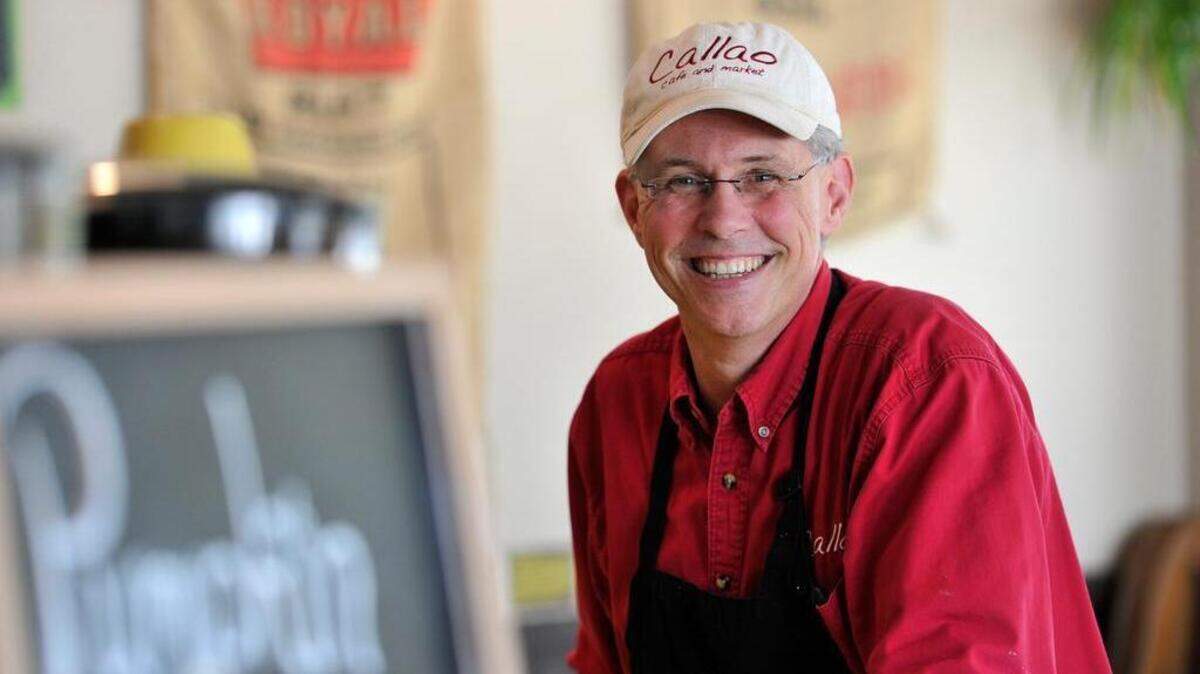
David Price is a businessman and showman wrapped into one.
Maybe that’s what happens when you get someone who started his first business when he was 17 years old and also spent 27 years in TV and radio media.
So, it shouldn’t be any surprise that he refers to himself as Callao Cafe and Market’s ringmaster and to his customers as his audience, but there’s more to him than that, which is easy to see when he’s sitting at one of the picnic tables outside of his small restaurant on West Aaron Drive.
Each customer knows him. He knows each customer.
A man walked out of the eatery with a coffee in hand Thursday.
“Where have you been?” Price joked. “We were going to send a search party.”
“North Carolina,” the man said. “I know, I should have told you before I left.”
Q: What kind of business did you think you wanted to run?
A: Restaurant-wise, I didn’t care what kind it would be, but it needed to be the right restaurant for the space. That’s the most important thing. What does the audience need? What does the audience want? What’s available and how do we “super serve” that? I did not have in my mind that my life’s dream was open an X, Y or Z restaurant. No.
Q: And you felt Callao Cafe is what this area needed?
A: Yeah, I mean you look at what we have here two blocks off of North Atherton Street. It’s a small town ... Park Forest is 600 yards away from us, and it’s one of the biggest subdivisions in the area. We have three or four huge apartment apartment complexes here, so there’s a lot of foot traffic, and it doesn’t have the hustle, bustle (atmosphere). It’s much more calm, and I felt that was missing on this end of town.
Q: Some corporate companies like McDonald’s and Wendy’s aren’t far away from you. When you opened did you feel they were competition?
A: Not at all. When we were 2 years old and Panera Bread was opening, people asked if I was worried about them. Heck no, I’m not worried about them. They don’t do anything like we do. Starbucks doesn’t do anything like we do. They’re fine, and do what they do, which is create an opening for somebody else to do something different. If I came in and tried to emulate Starbucks or Panera, they would destroy me and rightfully so. There are, however, avenues of opportunity, and that’s what we’re trying to capitalize on here by doing things they can’t do just by virtue of what they are.
Q: Places like the Panera Bread and Starbucks are all over the world, but there’s only one of you. How important is the first impression of a small business like yours?
A: I say that people give you one and a half chances. I also say that not everyone is my customer, and that’s fine. I don’t expect everyone to get and like what we do here. Those who do, we’re here for them. When we first opened, some of the people who trickled through the door into the empty cavern that was us at the time said we needed to have a grand opening.
I said, “No, we need to stand back not knowing what we’re doing,” because I didn’t want a rush of people to knock the door down and get a lousy experience. That would have been devastating, so my objective is to grow slower.
There are two ways to run a business, transactionally or relationally. Places that are driven by transactions are just interested in getting your money and sending you out the door. I want to get to know my customers. I want to develop a relationship with them. That is slow and takes a long, long time. That does not bring a rush of business in the first six months, and we would have died if we got crushed with business.
Q: So you learned from things that you didn’t know, which helped you in the long run?
A: Yeah, every day. We’ve learned the most amazingly simple things here every day. It’s sort of shocking. I don’t want to do anything that we can’t do well, which means I have to have an awareness of things that we can’t do well, and we either stop doing those or don’t ever do them.
Q: Does that mean you’ve made changes along the way?
A: Huge changes. If you asked my staff, they’d say I used to change something every half-hour or so. They’re great, though, and put up with that. We probably, right now, have the biggest reputation as the creperie in town. The word crepe does not even show up in my initial business plan. We were going to be a coffee/hoagie shop. It’s really apparent when you walk in and feel the vibe of the place that it doesn’t feel like a hoagie shop. It felt wrong. We threw away a lot of hoagies, because people just weren’t eating it. I also didn’t have anything for breakfast.
So, what am I going to do, put together a better omelet than the Waffle Shop? Are you kidding me? That’s one of the best restaurants I’ve been to in my life. I love the Waffle Shop. There’s no way I’m going to compete against them.
I’m also limited in my lease as to how I can cook here. I can’t have an open flame. It made me ask myself how I could do this. You know, bagels are either awesome or terrible, and I knew nothing about bagels, so that would have been terrible. The crepes, though, they allow us to use electricity. We don’t generate any grease, so we don’t need fire suppression. So, I started doing crepes as a morning curiosity. The customers said you can’t stop (making them) at 10, because some of them couldn’t make it until 11 or 12. We did morning crepes for six months and finally decided to be a creperie, and that was the biggest change.
Q: I’ve heard that finding employees is difficult. Is that right?
A: If you take one thing away from this interview, this is it. I’ve said it in 30 years of management. The single most important thing we do is hire the people we work with. ...You can hire people, because people are out there, but the right people are hard to find.
That said, at this juncture in State College, there is a shortage of applications. We’re good. We’re staffed, but it’s tough. I’ve got some high-schoolers here who are fantastic. Well, you know, they have to do that thing called go to school, which really interferes with their availability during the day. They are great kids, but that put some pressure on us, but we solved that. Finding the right people is hard everywhere, and applications right now are short everywhere. Look at how many places have help wanted signs on their door. It’s everywhere. It’s Penn State. It’s school districts. Everyone is looking.
Q: What do you enjoy about this?
A: Wow. So much. A lot of people say, “I love to cook, so I want to start a restaurant,” to which I say “Don’t, just stay at home and enjoy cooking.” I do love to cook. I love the challenges. I love solving things. Mostly, I love to watch what it is we’re growing here and that it still works.
The underlying premise of this place is I’m the fortunate only child of a Washington, D.C., lawyer, and my mother and father were hillbillies from West Virginia and proud of it. As a kid in D.C., I had a pretty good life, and then we’d go back to the Appalachians where the general store was falling off the side of the mountain.
I didn’t have any filter, so I loved both places. ... I wanted to bring the sense here, and I’ll say this loosely, the sense of gourmet and panache from my Washington, D.C., upbringing with the really general store, small community feeling of my West Virginia upbringing and bring them together.
This story was originally published September 17, 2015 at 8:59 PM with the headline "Business Q&A | Callao Cafe owner aims to ‘super serve’."