
Good Life | Mount Nittany Medical Center CEO Brown discusses health care industry
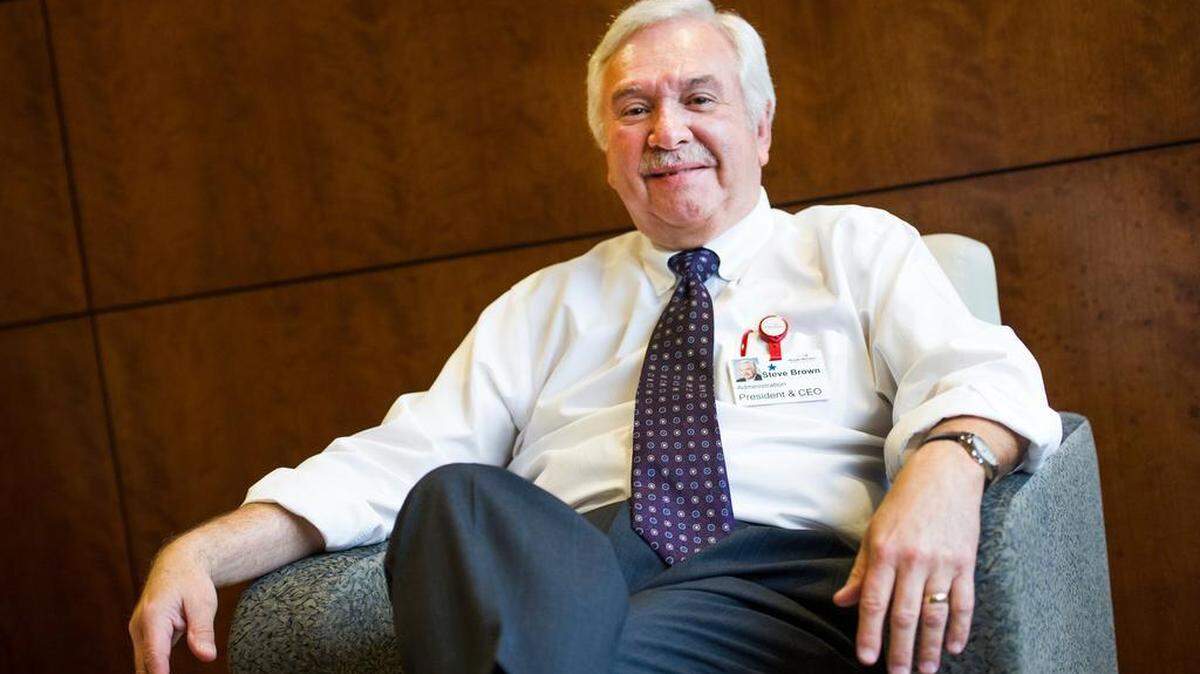
Working in hospitals is all Steve Brown has ever known.
There were the summer days, holiday weekends and visits home from college that he spent as a teenager washing dishes and doing housekeeping for the hospital he was born in, in Mechanicsburg.
He never really left the health care industry either.
Brown, who will receive the 2015 Renaissance Fund honor Thursday, took a break from his long day of meetings to ponder his time in the health care industry, the award he will receive and the challenges he faces.
Q: Why have you stuck with the health care industry?
A: I think it’s the people. This is a people business, and I’m sort of a people person. It’s all about relationships. Frankly, that’s what I enjoy. It has become more of a business, the health care industry has, as it has grown particularly with the shift through the Affordable Care Act. With the ACA it has become more of a business, but it’s still about people. It’s still about the relationships we have with our patients, with our physicians, with our volunteers. Taking care of the people that take care of our patients, too, is what it’s about. I enjoy that a lot. One of my favorite things is when I get tired of sitting in meetings and looking at emails and paperwork and looking at the charts, I’ll go walk around the floor. I’m getting back in touch with why we’re really here. That helps me, and why I’ve stuck with it. Next June will be my 40th year in health care. It’s been a while, and I still love it.
Q: You’ve been with Mount Nittany Health for five years as CEO and president, so what in the world do you do?
A: I remember my youngest son one time, when he was in elementary school, they had to write about what their dad did. I remember he wrote “I don’t know my dad does, but I don’t want to do it.” I’ve never forgotten that.
It’s kind of hard to describe. I’m responsible for the overall operation of the organization. I go to meetings with the board to make sure they’re informed, with the management team to address things. Probably the best way to describe the CEO position is we are responsible to make things run the right way, that the mission is met, that the right people are hired. My philosophy is finding, recruiting and bringing on the brightest and the best people that I can find, removing their barriers, getting out of the way and letting them do their job.
Q: You’ve expanded health care opportunities provided by Mount Nittany Health across the region. Is your expansion based on buying up practices in place, reaching untapped markets or a healthy combination?
A: It’s a combination of things, but probably buying existing practices is the least of it. We go on need. We have a community needs assessment we did two years ago, and we’re refreshing it this year ... What matters is what the community needs. Access is important to us, so when we’re looking to expand our services, access comes first. Where are the people that need access to the service? Blue Course was one area. We’re looking at Philipsburg right now. We’ve expanded to Mifflin County, because there is a need there.
Q: You were named 2015 Renaissance Fund honoree for your leadership in the region’s health care industry and for community service involvement, including things like Pink Zone and Coaches for Cancer. On the latter, why is it important for you to be actively involved in the community?
A: That’s our business. We’re a community trust. People trust their families to us. It’s important that they understand what we do. Like I was saying earlier, and it’s sort of my philosophy, I want people to be comfortable and confident in Mount Nittany Health. The more I’m out there talking to people and the more we bring the community into the facility, the better off the community will be. They won’t come here unless they’re comfortable doing that. For example, anyone that wants to use the auditorium can use it. We have nonprofits that don’t have a better place to meet coming here. The Boy Scouts meet here for their district meetings. People will get comfortable coming here if they know what’s here, and it’s not a big mystery. Without their support we’re nothing.
Q: I want to find out what receiving the award means to you. Are you just the guy on the nameplate that receives the award?
A: It’s not about me. I’m just the one that helps the rest of it happen. I bring in the best people I can and support what they do. Our philosophy is that as complicated as health care can be, it really isn’t that complicated. It’s about the patients and the people who care for them. They should get the award. I guess I’m just the face of the organization. This award belongs to the 2,300 employees here, the 300 or 400 volunteers here, the 300 or 400 doctors here, the board that has the vision to get things done here and the community. Without the community support we wouldn’t be able to do what we do. It’s not my award, but I’m incredibly humbled by it.
Q: Change of speed here, what challenges does the health care industry face?
A: I think just like anybody there’s financial challenges. I’ll refer to the Affordable Care Act. That’s brought with it reimbursement challenges. It’s also brought some good things in terms of getting more people insured. That brings challenges with regulations and so forth, but nothing unique here that other hospitals aren’t dealing with. I think the biggest challenge we have is trying to make sure that we have the kind of care patients deserve and need to have, while providing the best quality technology we can. You have to be able to afford to do that, so I think financial challenges are right up there with everything else.
Q: Some, including employees of Mount Nittany Health, took part in a demonstration Tuesday over the wage of nurses and home care workers. They felt such wages should be $15 per hour. Is that feasible and what impact do you believe would that have on the industry?
A: I think it’s feasible. I didn’t even learn about this, a protest or a demonstration, until last night ... I think it makes some sense. I don’t know how people can live on $7.50 an hour. I think that’s a problem. I don’t think there’s anyone here that makes $7.50 an hour, because it’s our philosophy here to take care of our employees. That means paying them a fair wage. I believe we do that.
We don’t have any nursing home care people here, so I can’t speak to that, but our nurses, our support folks, our housekeeping, we base everything on local and state markets, and we want to pay a little bit better than the middle of the market. My philosophy is we don’t want to be the worst payer by any means, but we don’t want to be the best payer either, because we want to give some room to grow. We pay a little bit better than the median on all categories. I believe we reimburse our employees from top to bottom well.
That said, if the minimum wage changes from $7.50, quite frankly, I feel for those people. If the minimum wage changes, we will adapt to that. The problem we’d have to address with that is an internal equity issue. You can’t just take everyone that’s at $15 and below up to $15 without compressing the rest of the organization ... but you can’t just give everyone $15, walk away and that’s the end of the problem.
Will it affect the health care industry? I don’t think significantly. It’ll cause those problems for all of us to make sure that equity is maintained and that you continue to make sure people are paid fairly. I don’t think it would have a huge national, sweeping effect on health care across the country.
This story was originally published November 13, 2015 at 10:21 AM with the headline "Good Life | Mount Nittany Medical Center CEO Brown discusses health care industry."