
Healthy relationships: ‘Improvement of understanding’ about domestic violence must be ongoing
Enlightenment philosopher John Locke wrote, “The improvement of understanding is for two ends: first, our own increase of knowledge; secondly, to enable us to deliver that knowledge to others.” The recent media firestorm around the disappearance and homicide of Gabby Petito sadly provides us with many opportunities for the “improvement of understanding” as we recognize October as Domestic Violence Awareness Month.
We improve our understanding as we are reminded that even in the tragedy of a domestic violence homicide, if the victim is a young white woman more attention will be paid, while the thousands of indigenous women, women of color and, LGBTQA+ individuals who are victims of domestic and relationship violence too often go unnoticed. We improve our understanding when we are reminded that those who abuse their partners typically look just like everyone else and that even after a domestic violence incident, it is the abuser who looks calm and in control. We improve our understanding when we are reminded that everyone knows someone (#Every1KnowsSome1) whose life has been impacted by domestic violence — a family member, neighbor, friend or co-worker — even if we don’t know who they are or what their story may be.
Every life has meaning and those of us who work in the community to address domestic violence have a commitment to tell the stories of those who have died at the hands of an intimate partner, knowing that their stories deserve to be told. But we also work to dig deeper, to not just increase our own knowledge but to improve our understanding so that we can as Locke put it, “deliver that knowledge to others” in the hope that the next domestic violence homicide might be prevented.
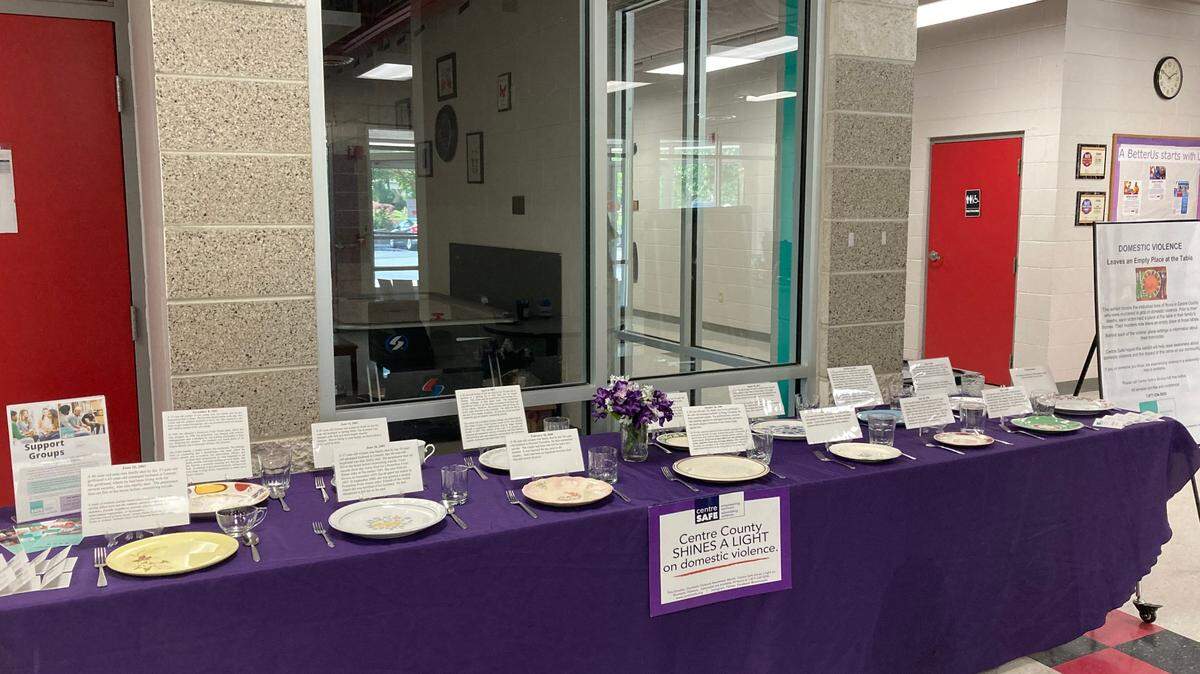
During the month of October, in various locations around Centre County, “The Empty Place at the Table” display will tell the stories of those who died as the result of domestic violence. The individual place settings are a powerful testimony to the empty place left at the dinner table, the empty spaces in the lives of parents and children, neighbors and friends as the result of domestic violence.
As powerful as The Empty Place display is, however, we must always work to improve our understanding of why this violence happened and what might have been done to prevent it. Consequently, the Fatality Review Committee of the Centre County Domestic and Sexual Violence Task Force meets regularly to review each homicide, to see what might be learned from it. The review committee doesn’t assign blame or point fingers, but rather works to see where the systems put in place to protect victims might have broken down, might have failed those victims. And most importantly, the review committee works to identify what needs to change in our community.
Recommendations have included training to workplaces, so co-workers understand how to respond when someone discloses, training for law enforcement so they understand what they are seeing when responding to an incident of domestic violence, the development of the Child Access Center for supervised custody exchange and visitation, and the development of a dedicated Domestic Violence Unit within the State College Police Department.
Our “improvement of understanding” about domestic violence must not just include our own increased knowledge and awareness, important as that is. But it must enable us to do what a healthy community should do, deliver that knowledge to others so that as we hear the stories of domestic violence victims the whole community will learn how to respond more effectively and so create a context of safety for all of us.
Where to find ‘The Empty Place at the Table’ display
State College YMCA — through Sunday
Bellefonte YMCA — Sunday through Oct. 17
Penns Valley YMCA — Oct. 17-24