
In PA, all counties but Juniata have high COVID-19 transmission levels, CDC data show
All but one Pennsylvania county is in the red zone for community transmission of COVID-19, as the coronavirus continued to blaze across the state this week.
On Friday, Juniata County was the only county in the state to remain outside of the “high” category for community transmission of COVID-19, according to the Centers for Disease Control Prevention’s COVID Data Tracker.
That’s a different measure than the CDC’s COVID-19 community level scale, where Centre County moved from the “high” to “medium” level with Thursday’s update. The community level measure takes into account both case counts and stress on the health care system.
The CDC defines “community transmission” both as the total number of new cases per every 100,000 people during the previous seven days and percentage of tests that come back positive within that same time period.
Juniata County itself was in the orange zone Friday, meaning that community transmission of COVID-19 is still substantial there.
As of Tuesday, May 31 — the latest date reported through the CDC’s COVID Data Tracker — there were 24,862 total cases of COVID-19.
Pennsylvania’s positivity rate also remains high, between 15 and 19%, according to the CDC.
So what does all this mean for Pennsylvanians? Read on for a look at the state’s COVID-19 trends and what you need to know to stay healthy.
Pennsylvanians are tepid about vaccine booster shots
In Pennsylvania, some 8.8 million people are fully vaccinated against COVID-19 and a large group — 10.9 million people — have received at least one dose of the vaccine.
The CDC currently recommends anyone, age 5 and up, get at least one booster shot after completing the initial series of the vaccine.
Older adults, particularly those age 50 and older, should receive two boosters, according to CDC guidelines. Additionally, children who are 12 and older and who are moderately or severely immuno-compromised should receive two boosters.
But in Pennsylvania, only about 3.8 million people have followed through and received their first coronavirus vaccine booster shot. That translates to only about 43.2% of the overall population in Pennsylvania.
As with many other diseases, you’re most protected from COVID-19 when you stay up to date with recommended vaccine doses.
In the case of COVID-19, that means you’re far less likely to develop the harshest form of the disease, become hospitalized and ultimately succumb to the virus.
What should I do if I live in a county that’s in the red for community spread of COVID-19?
Statewide, there remains a high level of community transmission, but a look at community levels for COVID-19 reveals a much more mixed picture.
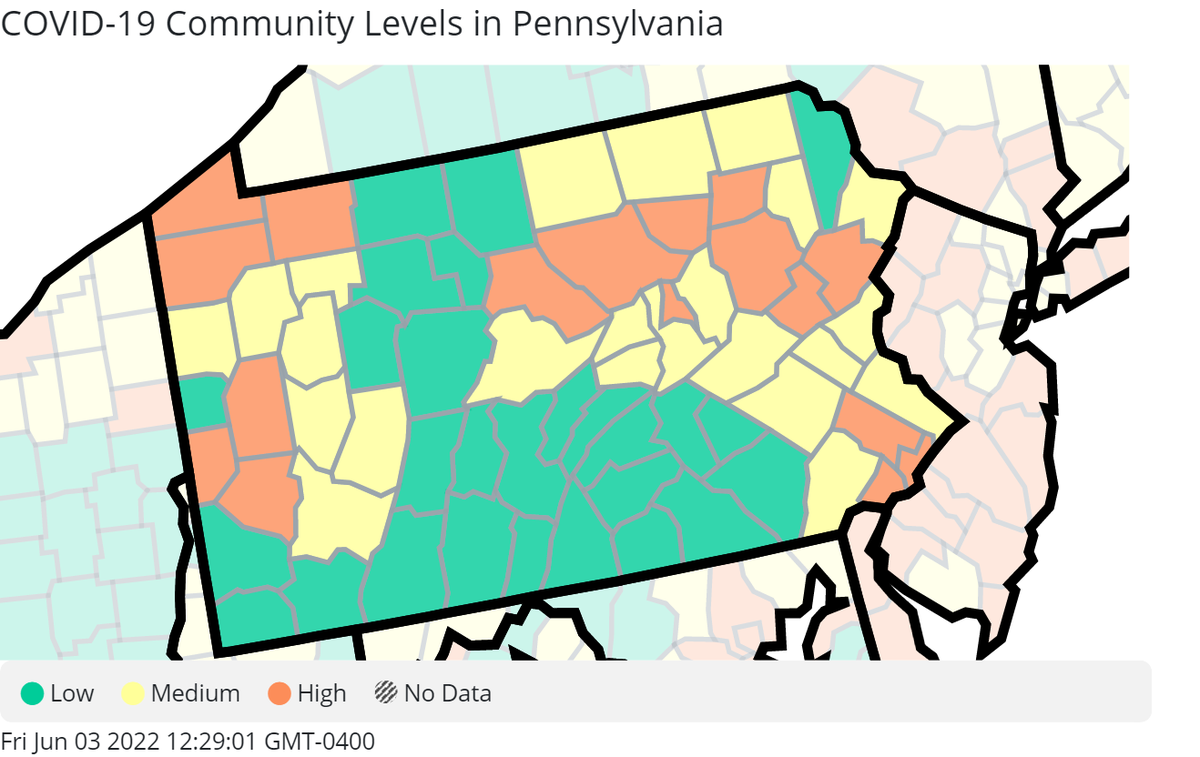
Different from community transmission, community level generally looks at the impact COVID-19 is having at the local level.
The CDC defines a county’s “community level” using three factors:
New COVID-19 cases per 100,000 population in the last 7 days
New COVID-19 hospital admissions per 100,000 population in the last 7 days
The percent of staffed inpatient beds occupied by patients with confirmed COVID-19 (7-day average)
The CDC advises that residents take a different set of precautions depending on whether their community is low, medium or high.
Masking and other health recommendations for individuals are as follows under the community levels:
Low: Stay up to date on vaccinations and boosters, get tested if you have symptoms.
Medium: If you are considered high risk, consider masking in public, stay up to date on vaccinations and boosters, get tested if you have symptoms.
High: Wear a mask in indoor, public places, stay up to date on vaccinations and boosters, get tested if you have symptoms, take extra precautions around high-risk individuals.
Of course, you can also wear masks at any time, regardless of their county’s community level.
People with COVID-19 symptoms, those who have tested positive or have been exposed, should mask in public at all times.
You can find additional data from the Pennsylvania Department of Health online.
This story was originally published June 3, 2022 at 2:39 PM.