
State College’s Sarah Koenig talks ‘Serial,’ possible Happy Valley podcast and more
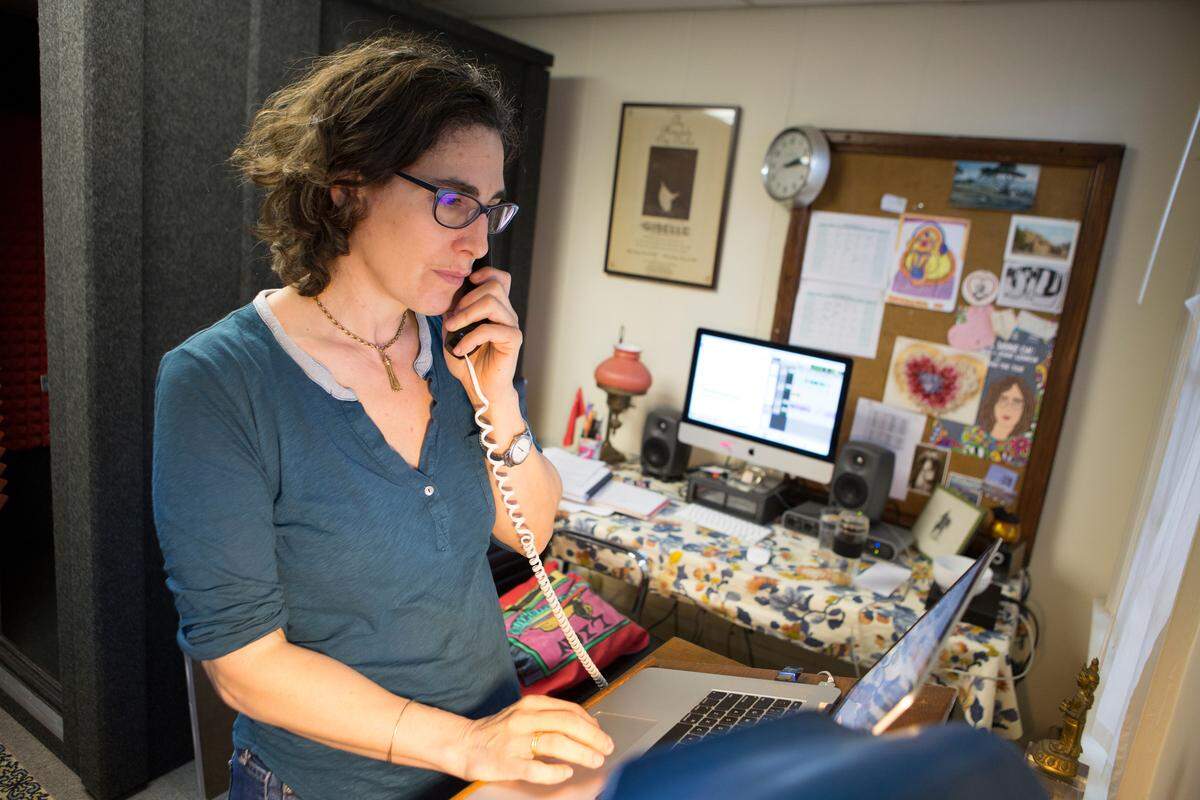
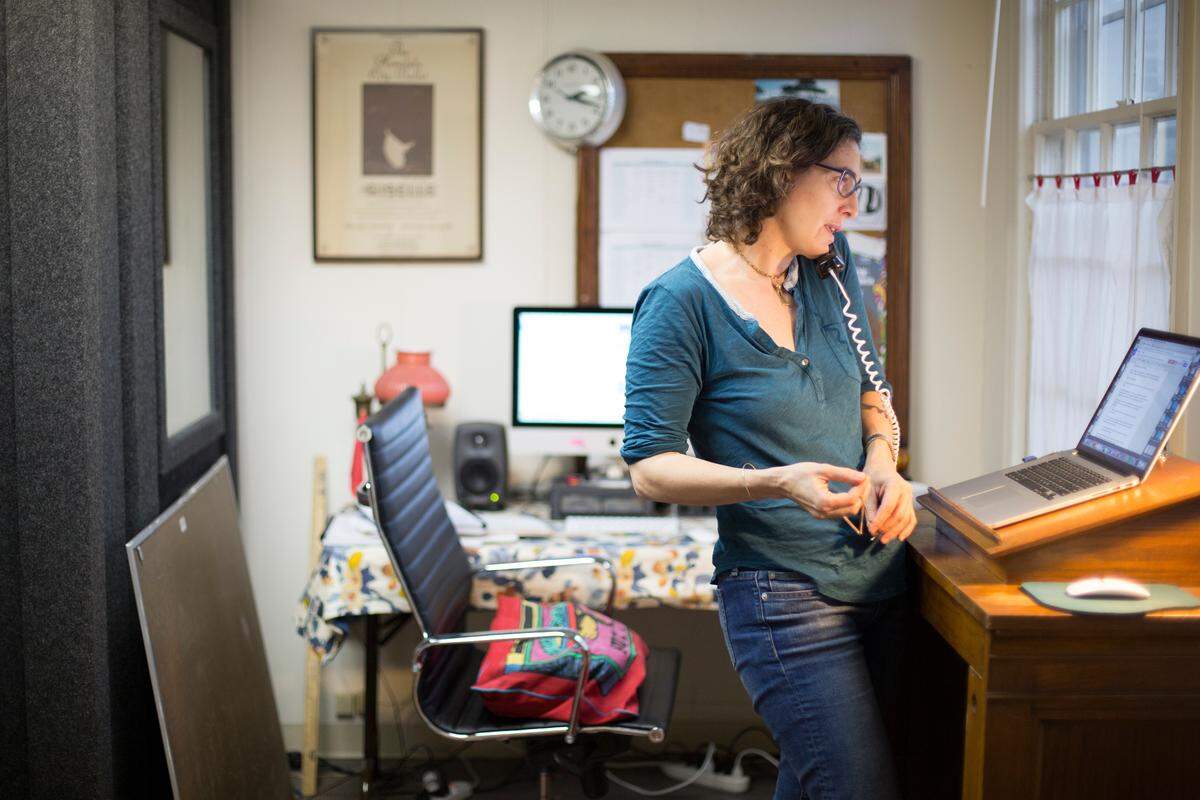
When Sarah Koenig isn’t traveling for her “Serial” podcast, she can be found in a rectangular office in an unassuming building in downtown State College, peppered with papers, books and a friendly dog named Bruno.
Since “Serial” season 1 — which took a critical look at the trial and conviction of Adnan Syed for a 1999 murder — aired in 2014, Koenig has emerged into the spotlight, her show widely seen as a blueprint for the podcast era.
The notoriety means Koenig is much more recognizable in public, a “super weird” development for the relatively private journalist, she told the Centre Daily Times in a detailed interview this month. Many of her “Serial” fans didn’t know she and her family have lived in State College since 2008, she said.
“I feel like I have to be more careful sometimes in public in case somebody recognizes me. ... I have to make sure I’m being a good tipper,” she said with a laugh.
But the popularity of “Serial” had some upsides, she said. It has inspired organizations to put money behind podcasts, and “a lot of good journalism has come out of it.”
Koenig and her producing partner Julie Snyder recently wrapped the third season of the Peabody Award-winning podcast, which chronicled one year inside the Justice Center Complex in Cleveland, Ohio.
She is scheduled to give a talk Friday at Penn State about that season. Organized through the McCourtney Institute for Democracy in the College of the Liberal Arts, the talk at 5 p.m. in Thomas Building is part of a conference on race and criminal justice, institute spokeswoman Jenna Spinelle said.
“It’s one thing to study criminal justice from an empirical perspective, but something else entirely to be embedded in the system for a whole year,” wrote Spinelle in an email. “We think that the conference’s attendees and the general public can benefit from hearing firsthand about the people and problems Sarah and her team encountered while reporting the third season.”
Path to ‘Serial’
Koenig came to radio by way of a 10-year stint as a beat reporter at various print news outlets.
“I had this weird path where I started at my local weekly (in Long Island) and went to Russia for three years,” she said. While in Russia, she worked as a reporter for ABC News and researcher for the New York Times. After returning to the United States, she covered statehouse politics and the courts for the Concord Monitor and the Baltimore Sun.
But her interest as a daily beat reporter waned over the years.
“I was too new at it and I lacked the imagination to kind of figure out a way forward that didn’t feel like I was just doing the thing I was supposed to be doing and, like, sort of often feigning interest,” she said.
Landing at “This American Life” in 2004 meant she could pursue a unique brand of storytelling that would later put her on the map with “Serial.”
The making of season 3
Though each season of “Serial” probes a large, existential question about justice, some of Koenig’s reporting style and process has changed over the course of the show.
The third season, said Koenig, explores the question: “How does the justice system infiltrate people’s lives, in a usually really horrible way?”
While the first season had a clear story arc, Koenig said that in season three, “we had to really extract any narratives we sort of created.”
Koenig and fellow reporter Emmanuel Dzotsi had “no organized method” when they began their roughly 18 months of reporting. Koenig said she told Dzotsi, who moved to Cleveland for the show, to sit in the courtrooms and talk to interesting people. Through hundreds of hours of recording, characters and storylines started to emerge, she said.
In particular, Koenig said, stories would emerge by virtue of the journalists’ being there. One day, Koenig was talking to an attorney for a man named Erimius Spencer about an unrelated case when the attorney received a text message with photos of Spencer’s beaten, swollen face. Those photos formed the basis of a key storyline about police brutality in “Serial.”
“That just seemed like a great opportunity,” she said. “Like, ‘Oh, here I am at the inception of a thing; this has just happened. Now I can watch how is the system going to deal with this.’ ”
Once all the interviews were conducted and the main court cases finished up, the production team had to structure the narrative around the overarching questions. While they weren’t reporting stories week by week, they were still producing stories while airing finished episodes in September 2018.
“I never really know the story I’m telling until I’ve made it,” said Koenig of the process. “... Until I write it, I don’t know what it is. Or what I even think about it.”
What makes a compelling podcast?
For Koenig, any story she pursues has to be interesting to her, she said. “Otherwise, it’s just not going to work.”
As a producer for “This American Life” and co-owner of Serial Productions, Koenig travels frequently “to live inside whatever world (I) choose for a while,” she said.
“I like being in a world where I’m learning a lot and where I have genuine questions that I think can be answered,” she said.
The components that make up a really good podcast to her, said Koenig, are a good plot, surprises and interesting or idiosyncratic characters. And “being delighted is really helpful,” she added.
“By and large I would say, I tend to develop a real fondness for the people that I’m interviewing, even when I cannot stand the things that are coming out of their mouth,” she said.
Storytelling in Happy Valley
Although she has lived in State College for 11 years, Koenig has yet to do a podcast based in the area.
However, after Penn State was named the No. 1 party school by the Princeton Review in 2009, she and several other producers produced an hour-long special on “This American Life” called “#1 Party School.” That profiled a weekend at Penn State.
When the Sandusky child sexual abuse scandal broke in 2011, Koenig reprised part of the party school episode and produced a segment on life in State College during that time.
She has also reported on the Marcellus Shale discovery and subsequent gas drilling industry, which has affected parts of central Pennsylvania.
“I would love to (do a project based in State College), because I would love to not be traveling all the time and just be home more,” she said. “Because it’s bad; I leave home too often.”
When the story about Penn State student Timothy Piazza’s hazing-related death broke in 2017, during production of season three, Koenig said she thought about dropping everything to cover it.
Right now, the “Serial” team has several projects in the works, one of which will probably turn into season four, said Koenig.
Digging beneath the surface
With “Serial” season one’s premier five years behind her, Koenig said looking back at the story of Adnan Syed sometimes feels like a part of the past that doesn’t belong to her.
“This weird thing happened where it became so big and popular that ... it feels very surreal to me, that it’s not real, that it’s not something I did,” she said.
Koenig hasn’t watched the new HBO documentary series “The Case Against Adnan Syed.” She said it was “not a shocker” that it came out when it did, considering that season one spawned dozens of spin-off podcasts about Syed’s case and “Serial” itself.
Each season of “Serial” has improved upon the last one, she said, with the team building on its knowledge and tackling bigger questions.
And even though some listeners may have thought they were starting a true-crime podcast with Season 1, Koenig said that was not quite her intention.
She wanted “to have people take a second and just be like, wait, is our (criminal justice) system working ... is this how we want it to be working? Is this level of scrutiny on a murder charge enough to convict someone and send him to prison for the rest of his life?” she said.
Koenig and her fellow producers have carried that brand of questioning through seasons two and three. As a former beat reporter, Koenig said she hopes people think critically about arrests and sentencings in the news.
“I just want us all to take a moment and start thinking about these cases in a deeper way ... and just consider that there’s stuff going on that we don’t know,” she said.
“So little of our system is about finding out the truth of what happened. It’s just not what the system is set up to do ... for a long time I didn’t understand that about our system,” she said. “If we’re all OK with that, if we voters are all fine with that, fair enough ... but what’s upsetting is I think most people just don’t know.”
This story was originally published March 28, 2019 at 2:25 PM.