Governor Tom Wolf’s redistricting advisory council brings listening sessions to Centre County
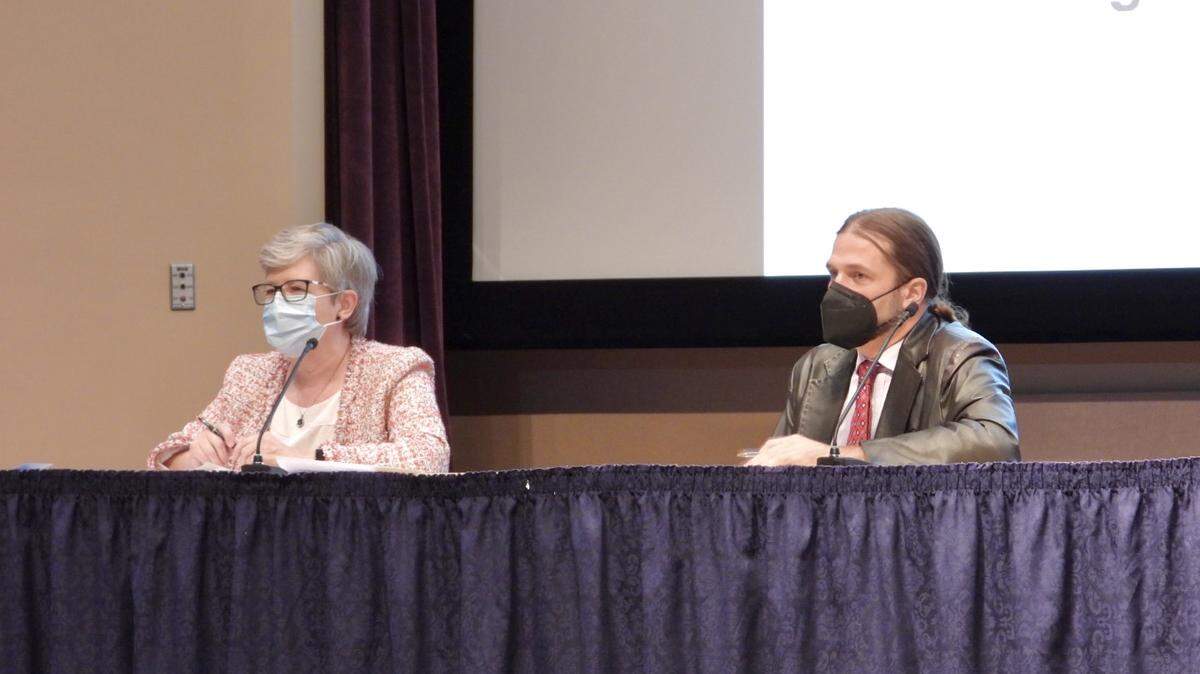
Members of Governor Tom Wolf’s redistricting advisory council heard Monday from several Centre County residents, Penn State students and others about what they’d like to see taken into consideration as Pennsylvania undergoes the redistricting process.
Following the U.S. Census that is conducted every 10 years, new district lines are drawn. Pennsylvania currently has 18 congressional districts, but due to the 2020 census numbers, it will lose one of those for the next 10 years. The state legislature passes a bill defining congressional district boundaries, which is then considered by the governor. The maps will need to be in place by next year’s primary election.
As part of an executive order in September, Wolf established a redistricting advisory council to provide guidance to assist his review of the congressional redistricting plan, according to a press release.
The council “will review processes in other states that reduce gerrymandering, develop factors to determine if a plan improves the integrity and fairness and prevents the dilution of a person’s vote and offer recommendations to ensure that districts are compact and contiguous to keep communities together and ensure people are proportionally represented,” a press release states.
Of the six members of the council, two are affiliated with Penn State — Lee Ann Banaszak is head of the department of political science and professor of political science and women’s, gender and sexuality studies and Christopher Fowler is associate professor of geography and director of the Peter R. Gould Center for Geography Education and Outreach. They, along with other members of the council, have been holding listening sessions to gather public input on congressional redistricting, with Monday’s stop marking the sixth session since mid-October.
“The process of drawing congressional districts is going to be central to how our voices are heard in Washington over the next step,” Banaszak said.
Fowler explained that the draft redistricting principles are legal principles, principles of representation and principles of process. Legal principles include maintaining an equal population, assuring contiguity and maintaining compactness while remaining in compliance with the Voting Rights Act. Representation includes preserving communities of interest and ensuring partisan fairness and proportionality. Process includes ensuring a strong engagement with the public and creating a narrative and record of why decisions were made.
Centre County is currently split between two congressional districts — Districts 12 and 15. Ron Williams, of Pennsylvania Furnace, said that most of the county is in District 15, but because of how the lines are drawn, a portion of District 12 cuts through a community and “surgically separates” two large urban areas, Williams said.
“District 12 captures State College, while leaving Bellefonte in District 15. ... The State College/Bellefonte area is a good example of a local community which should not be divided between congressional districts,” he said.
Debbie Trudeau, Centre County coordinator for Fair Districts PA, echoed that. She said the 2018 Supreme Court redrawn map was a “big improvement” for many regions while creating a balance across the state. But, she said it was a “severe blow” to State College when it was split between districts.
“Because small towns in Pennsylvania aren’t allowed to incorporate their expanding boundaries, State College appears on a map as just a tiny borough. In fact, our community is considered an urban area and has grown tremendously over the years,” Trudeau said.
She said geographic continuity was needed. The new boundaries should be put where the population is sparse, looking closely at precinct lines and keeping dense areas intact, she added.
Michael Garza, a Penn State student and a Redistricting Fellow with Campus Vote Project, told the advisory council he wants to see the Penn State community together, as it’s split now at both the state and congressional level. Specifically he said the residential neighborhood between North Atherton Street and West Clearview Avenue, and Vairo Boulevard are in Congressional District 15, whereas the rest of the Penn State community is in Congressional District 12.
“By dividing the State College community, our congressional and state leaders have placed barriers on our voices. And this is an issue that many of my fellow Penn State students are unaware of. This reality puts Penn State students at a disadvantage and keeps it from having a powerful voice in a democracy,” Garza said. “It is important to have adequate representation for Penn State students. If we are able to properly represent the State College community then every student’s voice can be heard and we can be represented by those who are able to understand and advocate for our unique needs.”
Anyone can visit www.governor.pa.gov/redistricting-feedback to give feedback on Pennsylvania’s redistricting and to learn more.