
Central Pennsylvania Mushroom Club creates community for local foragers
When wild mushroom harvesters — or mushroom hunters or foragers, whatever your preferred term — take to the central Pennsylvania woods or forests, or even their own backyards, seeking out elusive fungi, they do so for many reasons. While, during the spring morel season, many foodies may associate such a hobby merely with its culinary benefits, mushroom hunting and its purposes extend much further.
Eric Burkhart, teaching professor at Penn State, and senior author of “Mushroom Harvests and Harvester Practices in the Mid-Atlantic Region of the United States and the Emergence of Digital Community Mycology,” published last year in “Economic Botany,” has been an amateur mushroom hunter for more than 20 years.
Across his research, he’s found that foragers collect mushrooms largely as a way to connect with nature, but other reasons include harvesting them for medicinal uses; incorporating them into artwork; or even engaging in sustainability-focused practices that promote the growth of local mushroom populations. For some, meanwhile, the hobby is about community.
Throughout both his education and work at the university, Burkhart realized that mushroom hunting and gathering has its own culture, with passioned individuals passing down information via word of mouth and, more recently, digital communication.
Unfortunately, it is worth noting that this digital communication comes with some issues. For example, apps used to identify mushrooms, Burkhart said, can be inaccurate as much as half of the time.
“What I encourage people to do is get to know [more experienced mushroom hunters] ... It can be easier than you might think,” Burkhart said, pointing to clubs that meet regularly.
“There are these groups of professionals and amateurs that you can join and share a lot of information and learn relatively quickly about some of ... the common mushrooms that are easily confused with poisonous lookalikes and so on. There’s no replacement even in the digital age for that person-to-person interaction and experience.”
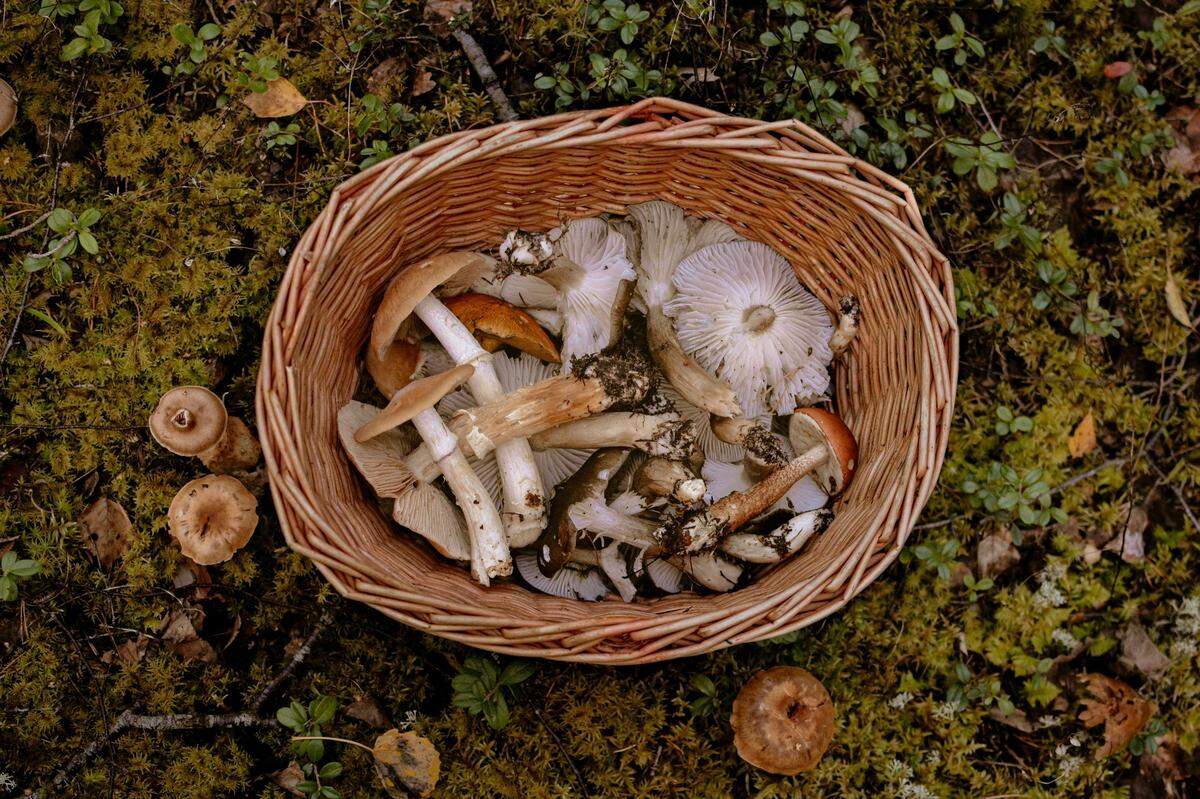
One such place where interested hobbyists can find those connections is the Central Pennsylvania Mushroom Club.
Tyler Daniels has been a member of the club for about seven years and is currently the acting treasurer. The club has been around for about 15 or so years, he said, and started very casually, with members getting together to go on group walks, with interest growing gradually over time, including a spike in participation during the COVID-19 pandemic. The group attracts about 150-250 members annually, with regular events seeing attendance of anywhere from 20 to 80-plus individuals, depending on the season and proximity to State College.
As for how Daniels became involved in the hobby, he described how his family always ate what he referenced as the little white button mushrooms that show up in your yard. When he asked his father how he knew they were safe to eat, he simply replied that the family had always eaten them. When Daniels began researching that mushroom, he found it was quite similar to a very toxic variety, the destroying angel.
He further pressed his father as to how he knew the differences, and the two ended up going to a Bill Russell event (Russell is one of the club’s founding members and author of “Field Guide to Wild Mushrooms of Pennsylvania and the Mid-Atlantic”).
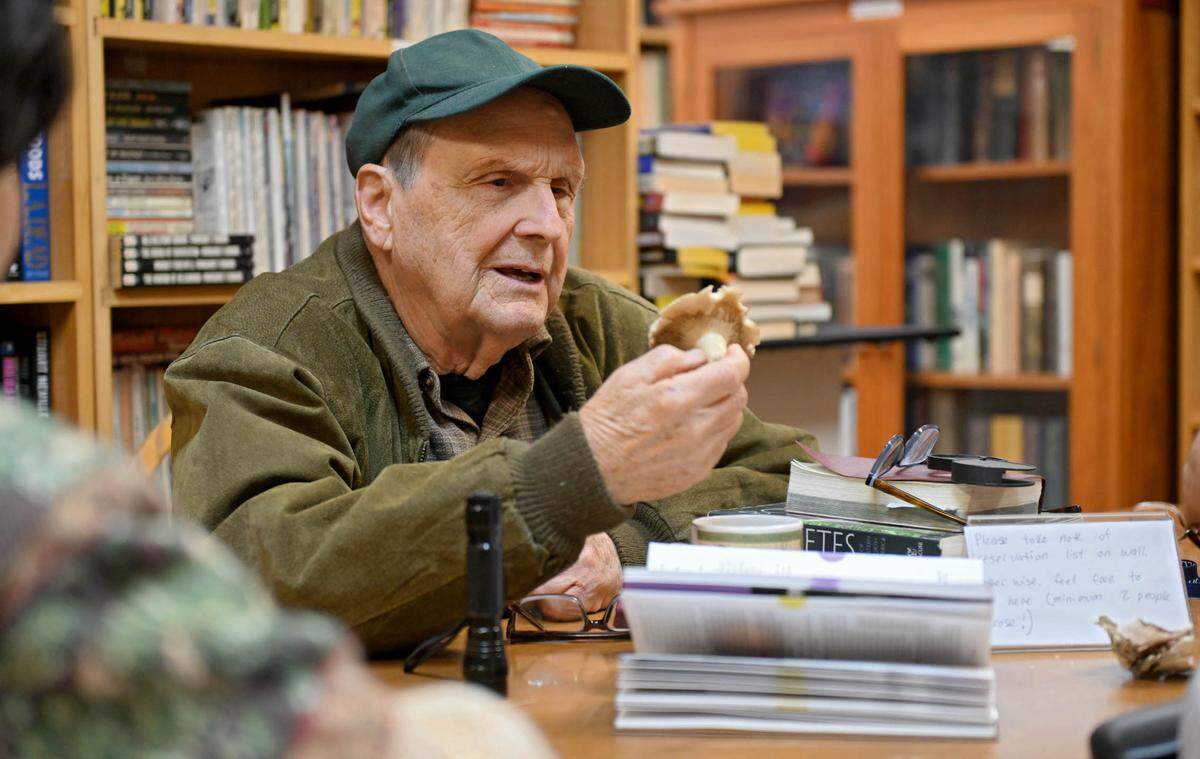
“We found out that there was a lot more to mushrooms and thought we’d keep going,” Daniels said. “We liked the people, kept going some more, started learning more about mushrooms, eating a few more, finding some, and it spiraled from there.”
Daniels mirrored Burkhart’s recommendation, saying for those intrigued by the activity, “Find like-minded people. Most people that go out, they know one or two mushrooms that their grandparents taught them, their parents taught them. They go to mushroom clubs and they start seeing more and more. You start learning hundreds of them. That’s the best way.”
The club typically meets on weekend afternoons at state park pavilions. Members go on a foraging walk for a few hours and then reconvene, laying out their hauls for observation. Members work together to identify the mushrooms and what their potential culinary or medicinal uses might be. Sometimes, the mushrooms are returned to the woods; other times, they’re taken home.
Daniels also recommended first-timers read Russell’s work and offered a closing piece of valuable advice: “Always be 100% sure what you’re eating. Be overly precautious. If you have to throw away a mushroom because you can’t eat it, and it happened to be something like a morel, because you weren’t 100% sure, it’s better than eating something ... and being sick or dying because of it.”
The Central Pennsylvania Mushroom Club’s upcoming events are listed at centralpamushroom.club, with the next, upcoming event occurring May 9 at Canoe Creek State Park. Future events are planned for Centre County locales, including Black Moshannon State Park and Penn-Roosevelt State Park.
Holly Riddle is a freelance food, travel and lifestyle writer. She can be reached at holly.ridd@gmail.com.