
‘Everybody feels an emptiness.’ Impact of quiet Blue-White weekend to be felt across Centre County
At this time last year, Happy Valley was buzzing with activity ahead of Penn State football’s annual Blue-White Game.
College Avenue in downtown State College was lined with cars as groups of the thousands of alumni and fans who descend on the town each year walked the sidewalks, browsing through racks of blue-and-white apparel and returning to their favorite college watering holes.
Students, taking a break from studying, could be seen tossing a Frisbee on the Old Main lawn, or on the patio at Cafe 210 West, trying to get their names engraved in history.
This year, the streets will be quiet. The bars will be closed and nobody will be eating in restaurants.
Beaver Stadium will be empty, and the grass fields outside the stadium will be bare as fans tailgate virtually.
As the novel coronavirus pandemic has turned every aspect of life on its head for millions across the globe, Blue-White weekend is a stark reminder of just how much has changed in Centre County.
While the full impact of the pandemic and efforts to contain it have yet to be fully realized, we spoke to people from Penn State Athletics, local hotels and restaurants and more to get an idea of how much things have changed since this time last year.
Penn State football
Usually, Penn State football coach James Franklin isn’t always able to kiss his daughters good night or hug his family in the afternoon.
The global pandemic has allowed for more family time but, with it, comes an extra set of concerns and work-related issues. Franklin’s youngest daughter, for instance, suffers from sickle cell anemia — a blood disease and auto-immune disorder — that puts her at greater risk of complications should she contract COVID-19.
“This is much bigger than sports, obviously,” Franklin told reporters last month. “This is something the entire world is dealing with. And sports obviously takes a backseat to that, so it seems kind of strange to be talking about sports when we’re dealing with such a more difficult challenge.”
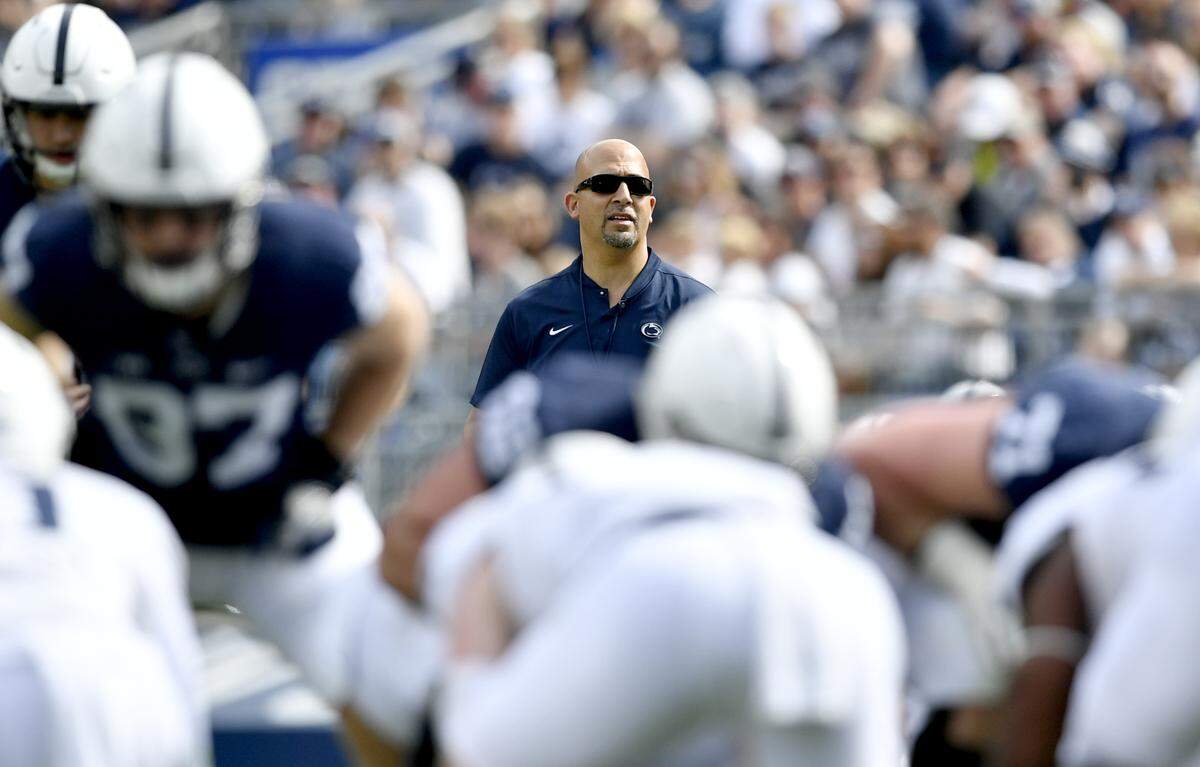
At this time last season, Franklin was meeting with his coaches almost every day while overseeing his players during practices and weight-lifting sessions. Now, he holds team meetings online, and his staff has tried its best to monitor players’ nutrition and training regimens despite equipment availability varying from player to player.
It’s been a difficult, and unusual, balance. Some players have adjusted to life amid the global pandemic; others are struggling. Franklin still hasn’t returned to Happy Valley and, last month, was staying in one of his condos outside the area.
He’s watching Netflix more than usual — he watched “Mindhunter” with his wife — and he’s reiterated that sports shouldn’t come first right now.
“No. 1 is health and safety, and No. 2 is making sure we can do things from a financial responsibility and from an economic perspective for our community, for our state and then specifically for our university,” he said.
Steve Jones
Steve Jones is used to spending his days leading up to the Blue-White game digging for information. The longtime radio voice of the Nittany Lions attends practices to get a feel for the players and find out what he can about the Penn State football roster in his preparation for the annual intrasquad scrimmage.
“In that two hours during the Blue-White Game you’re not only describing the game and describing the action,” Jones said. “You’re also trying to tell the fans who’s been getting better along the way and some people that they can watch for the next season.”

With the game canceled this year, Jones has found himself feeling out of place, searching for a way to navigate the new reality.
“I think everybody feels an emptiness,” he said. “Everybody feels lost right now as to what’s going on. … It’s just completely different. We all feel like we’re out of our element but we’re all doing the best we can with it.”
Fortunately for Jones, he’ll still find himself with a tiny piece of his usual Blue-White week routine. He’ll have Penn State head coach James Franklin on his radio show Saturday afternoon at 1:30 p.m., along with another guest yet to be determined, in place of his usual Thursday night conversation with the coach during the scrimmage week.
Jones is eager for a chance to get back to speaking to the Penn State faithful every Saturday.
“The most important thing,” Jones said, “is that we all stay safe so that on Sept. 5 we can all come together again.”
Penn State Athletics communications
The Blue-White Game preparation would usually be coming to a head now for Penn State Athletics’ strategic communications department.
Associate Athletics Director for Strategic Communications Kris Petersen would be leading the efforts down the stretch to ensure her department has everything available for the media in attendance, including rosters, stat files and game information, while working with the television partner for the game, Fox Sports 1, to line up guests for in-game interviews.
The spring game’s cancellation has forced Petersen and her department to pivot to new avenues to keep the Penn State fan base engaged with the team during the coronavirus pandemic.
“(It) made us pivot our content plans to be more of a combination of reviewing last year,” Petersen said, “or finding new and different points of engagement, like alumni interviews, podcasts and interviews with current players, (along with) TV show rewinds.”
While the game has altered the department’s course in how it’s engaging with the fan base, football coaches are still being made available to the media on a weekly basis through teleconferences on Zoom, a video-conferencing app. Those points of engagement are a continuation of the interviews that would usually be conducted during spring practice, according to Petersen, but she still notices the difference with the lack of in-person interaction.
“Like everyone, we are missing the face-to-face contact and those personal relationships we have with our student-athletes, coaches, staff and media,” she said. “We continue to communicate with those folks, but it is not the same when you go from seeing people on a daily basis to (seeing them on) a computer or phone screen.”
State College police
The Blue-White game has drawn more than 70,000 people to Beaver Stadium in four of the past five years, and with the crowd comes a swell in calls fielded by borough police officers.
Officers expect to receive fewer calls, which has been the department’s operating procedure for much of the spring after the university canceled all in-person classes.
Call volume data was not available, but borough police Lt. Greg Brauser said the department’s call volume is “drastically below typical spring numbers.”
Officers are also preparing for a loss of overtime income. Penn State typically pays borough police officers to perform traffic and security details for the game.
Several overtime night shifts for Friday and Saturday are also typically available, but those spots will not be posted this year, Brauser said. The overtime is typically paid by the borough.
And with fewer calls, there are often fewer arrests and less revenue. The reductions, however, will likely be offset by fewer officers receiving overtime to testify in court, Brauser said.
“This is not something that will be easily measurable and may take some time to accurately calculate once this pandemic emergency is lifted,” Brauser said.
Hotel State College
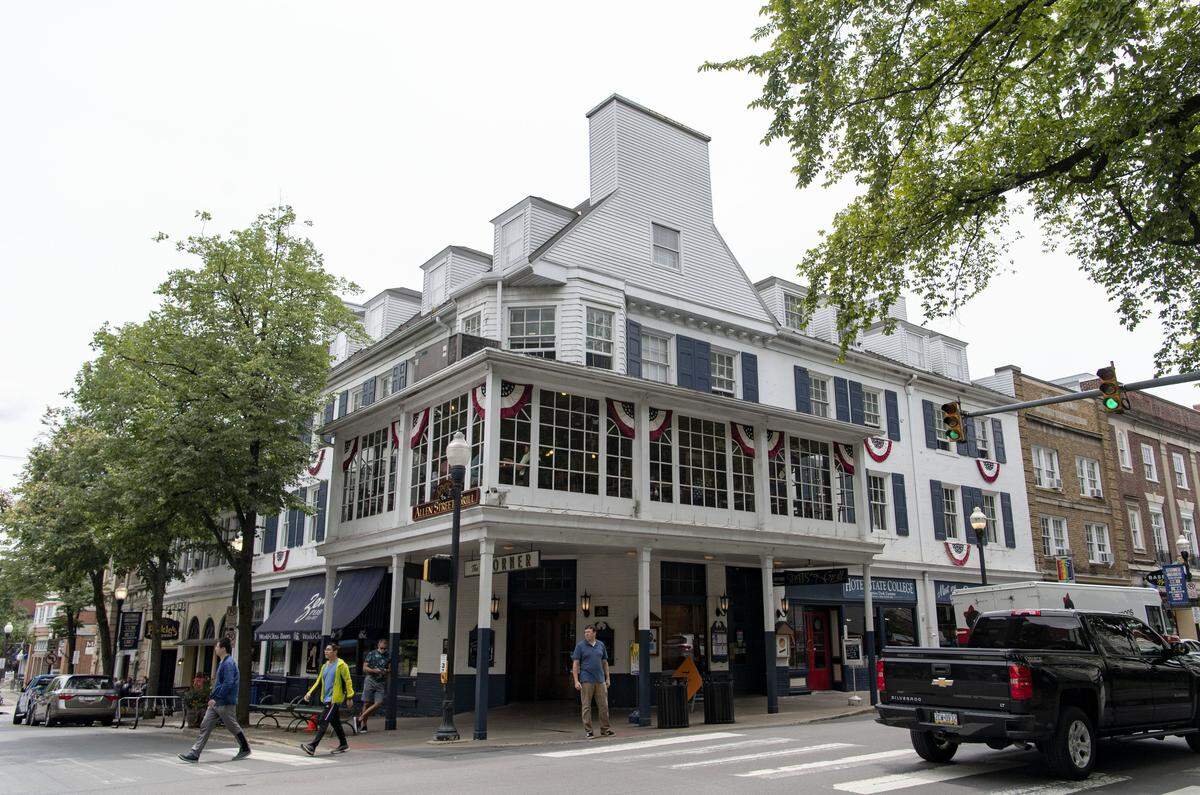
Hotel State College & Company brings in about twice as much revenue during the week of the Nittany Lions’ Blue-White Game when compared to a typical week, Operations Director Curtis Shulman said.
The company that operates The Corner Room, Spat’s at the Grill, Bill Pickle’s Tap Room, The Basement Nightspot, Zeno’s Pub and Chumley’s is now at “net zero,” Shulman said.
“Weekends like this are critical. You have a company that’s trying to survive and balance their cash flows through a time — summer — when you’re losing money hand over fist,” Shulman said. “Blue-White isn’t just a big weekend where we make a bunch of money. It’s what allows us to survive through summer, in conjunction with things like the Arts Festival.”
Rather than lament what could have been, Shulman said the business is trying to figure out what the “suitable approach” is for when businesses and the university resume normal operations.
Customers may not immediately be comfortable in a crowded club, but may feel safe in a booth at The Corner Room, Shulman said.
“We need to put our heads together and evaluate what’s gonna be comfortable for the consumer, what’s best for the town as a whole and then kind of adjust to whatever that new normal is,” Shulman said. “There’s a huge social responsibility beyond the business that we have to evaluate and take into account as we look at our new business model.”
High school athletics
Bald Eagle Area’s Doug Dyke, the athletic director, could barely find a free minute at this time last year.
Between all the spring sports such as baseball, softball and track and field, 12-hour days spent hopping between games and practices was the norm. Now? With sports canceled and schools moving to online-only, there’s quiet. Lots and lots of quiet.
But Dyke wouldn’t exactly characterize it as relaxing.
“I’ve pretty much gone stir crazy,” he said with a laugh.
Nowadays, he’s made it his mission to walk between 30,000 and 40,000 steps a day to keep himself busy. He’s pacing while watching TV, digging 3-foot holes in his backyard to build a stoop and even volunteering to deliver meals to local families in need.
District 6 recently told Dyke and others that coaches cannot allow their players to resume workouts until at least July 1. So Dyke knows this will likely be his new normal for a while.
“I guess I’m not ready to retire yet,” Dyke said, when asked what he’s learned during the pandemic. “We take for granted too much our everyday activities. It’s probably like a lot of people are saying: I’d just kill to be able to go out to dinner somewhere.”
Centre County Recycling & Refuse Authority
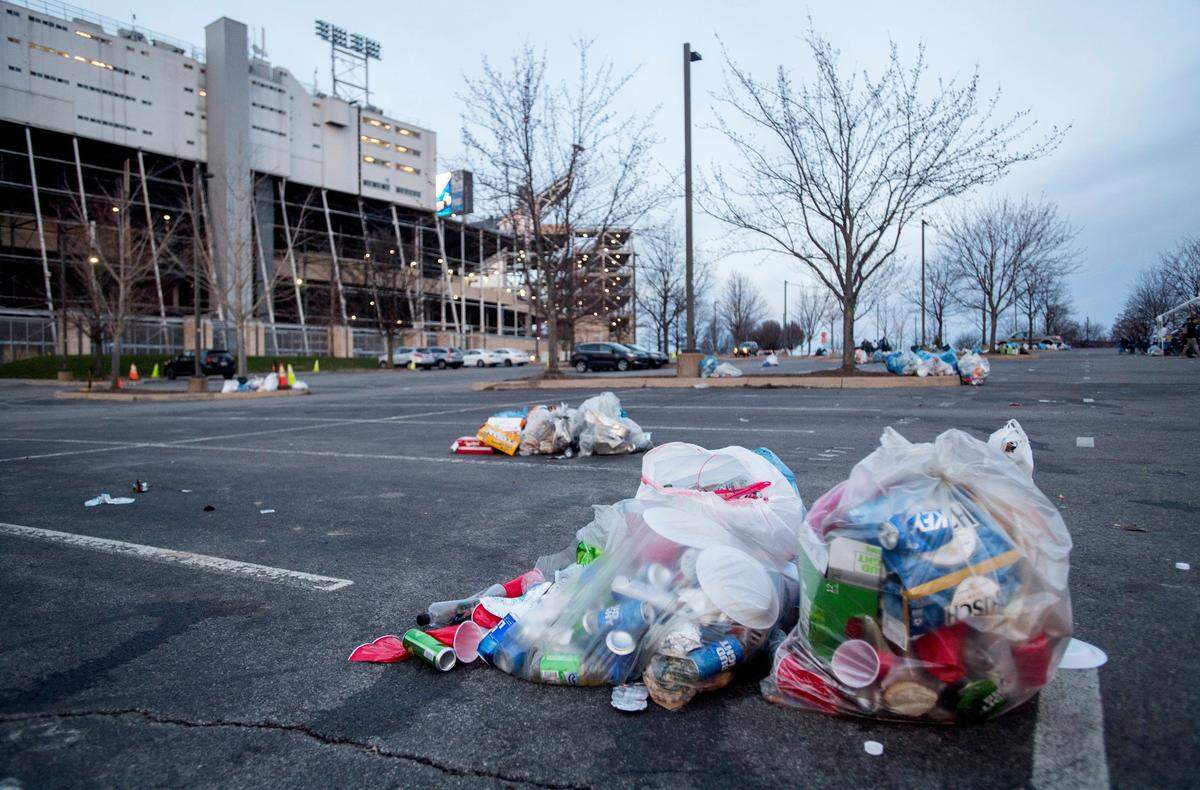
The first tailgating day of the year at Beaver Stadium usually means reminders from Centre County Recycling & Refuse Authority about how to clean up correctly before leaving the lots. The morning after the game, the grounds crew begins collecting blue and clear bags, bringing clear bags to the landfill and blue bags to the CCRRA, where the contents are sorted and recycled.
Amid the coronavirus pandemic, CCRRA employees may not have tailgates to worry about, but they’re still hard at work as essential employees working to keep their communities clean.
With curbside recycling suspended, CCRRA has over 125 drop-off recycling bins throughout the county. Joanne Shafer, CCRRA recycling coordinator and deputy director, said that although COVID-19 has resulted in less collecting from commercial establishments, CCRRA has actually seen more recycling through its drop-off program.
“(Trash haulers) are part of the essential workforce, just like health care workers and mail carriers,” Shafer said. “People are recognizing health care workers as heroes, but we should include our trash haulers as part of that.”
Social distancing measures have also meant postponing the authority’s annual Household Hazardous Waste Collection event, which was originally supposed to take place the weekend of April 24. It has been moved to the weekend of Nov. 20.
“We have anywhere from 1,000 to 1,200 cars come through during the course of a Household Hazardous Waste Collection event,” Shafer said. “Obviously with people bringing things, there has to be social interaction, so there’s no way logistically to hold the event and maintain social distancing.”
More information on drop-off locations can be found on CCRRA’s website.
We Are Inn
Initially prepared for a “packed house,” the recently renovated We Are Inn will sit vacant on what should have been one of its busiest weekends.
Pat Romano and his wife Jennifer purchased the former Mallard Motel at 1535 Port Matilda Highway in Philipsburg in September. Determined to bring the property back to life after sitting vacant for decades, Romano was looking forward to hosting guests for Penn State sporting events and graduation.
“We have been closed for weeks at a time when we really needed to start seeing revenue from swim meets and parents’ weekend to Olympic trials and gymnastics championships, all the way through graduation,” Romano said. “We had high hopes as our dreams were coming to fruition.”
Set to open this spring, the inn started taking reservations in January, but all guests received a 100% refund after Penn State announced many of its staple spring events were canceled due to the coronavirus.
“Unfortunately, our business is new and has no numbers to show from last year to be able to apply for help, so we will fall through the cracks as far as aid or grants go,” Romano said. “But if we survive this, we will appreciate everything that much more.”
This story was originally published April 17, 2020 at 7:00 AM.