‘Districts belong to the voters.’ How one man is raising awareness ahead of Pa. redistricting
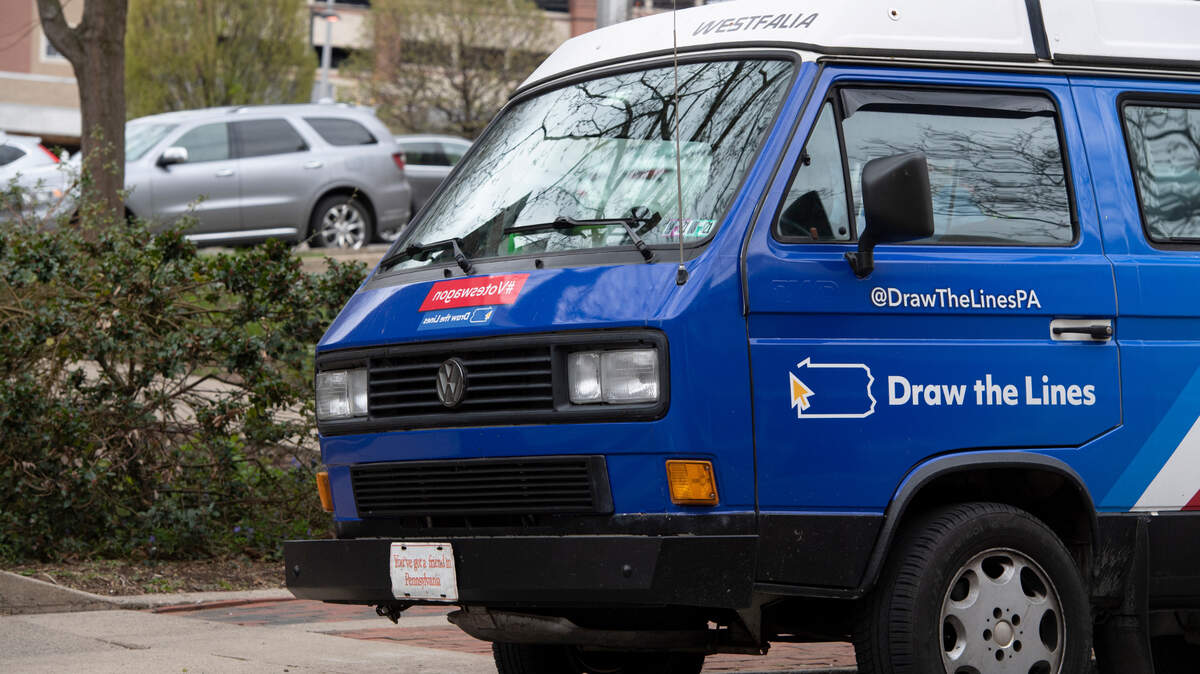
For David Thornburgh, raising awareness means getting behind the wheel of a red, white and blue 1991 Volkswagen camper. With 206,000 miles on it, the “Voteswagon” is — for the most part — running strong and helping educate Pennsylvanians on redistricting.
Thornburgh, president and CEO of the Committee of Seventy and son of former Gov. Dick Thornburgh, stopped in Centre County on Thursday to call for transparency in the state redistricting process, as well as to encourage residents to draw their own legislative maps. The Committee of Seventy is a nonpartisan civic leadership organization that advances representative, ethical and effective government through engagement and advocacy; it also leads Draw the Lines PA, a public education initiative that encourages residents to engage in redistricting by drawing their district maps.
As Pennsylvania prepares to redraw its U.S. House and General Assembly voting district lines — which happens every 10 years — Thornburgh hopes the process will be fair and transparent because those lines define who represents a specific population at the state and federal levels of government.
“We all believe in the value of competitive elections,” Thornburgh said during a stop at the State College Municipal Building. “Districts belong to the voters. That’s the principle that we have to work for.”
Pennsylvania is considered one of the most gerrymandered states, meaning electoral boundaries have been manipulated. Gerrymandering has been contested at the local, state and national levels for years, and it’s been done by both political parties.
In 2018, the Pennsylvania Supreme Court ruled that the 2011 congressional district map — drawn by Republicans and signed into law in 2011 by then Republican Gov. Tom Corbett — violated the state constitution, so the court redrew the map and issued a new one. With this change, Centre County was redrawn into the 15th and 12th districts, with the majority of the area falling into the 15th, but much of State College and the southeastern part of the county reside in the 12th District, which includes Clinton, Mifflin and Juniata counties.
But this year, residents are paying attention, and like Thornburgh, they’re hoping for a transparent process.
The Legislative Reapportionment Commission, the body that will be drawing the state House and Senate maps, is set to hold its first public meetings on April 26 and 27. The LRC is a five-member panel that is responsible for redrawing the boundaries to reflect population changes as measured by the U.S. Census. House Majority Leader Kerry Benninghoff, R-Bellefonte, Senate Majority Leader Kim Ward, R-Hempfield, House Minority Leader Joanna McClinton, D-Philadelphia, and Senate Minority Leader Jay Costa, D-Forest Hills, will serve on this year’s commission.
In March, state leaders announced that they were seeking applicants from citizens interested in serving on the 2021 commission. The constitution requires that the LRC chair be a citizen of Pennsylvania, and they must not hold a paid elected office. According to the state, more than 60 people submitted their names for consideration.
If floor leaders cannot reach an agreement on who will serve as LRC chair, the Pennsylvania Supreme Court will make the appointment no later than May 30.
Drawing maps isn’t hard, Kyle Hynes — a two-time Fair Districts winner and State College Area School District senior — said Thursday. For him, the most difficult part was realizing mapping software is readily available for constituents to try their hand at redistricting.
“Anyone can do it,” he said. “And yet, the process was still being done in secret.”
When drawing on his own, Hynes said the goal was to design competitive maps. He sees redistricting in 2021 as an opportunity to start over and hopes more people will submit their own maps to show state leaders that redistricting can and should include public input.
“I definitely intend on drawing some and sending them in and putting them on the pile that they have there, and I hope lots of people do as well,” Hynes added. “I think the more they know that really, the everyday person can draw maps like this, the less likely they’re going to be to pull off another gerrymandering.”
This story was originally published April 23, 2021 at 12:05 PM.