
Afield: Have you noticed trees turning brown in central PA this summer? Blame the leafminer
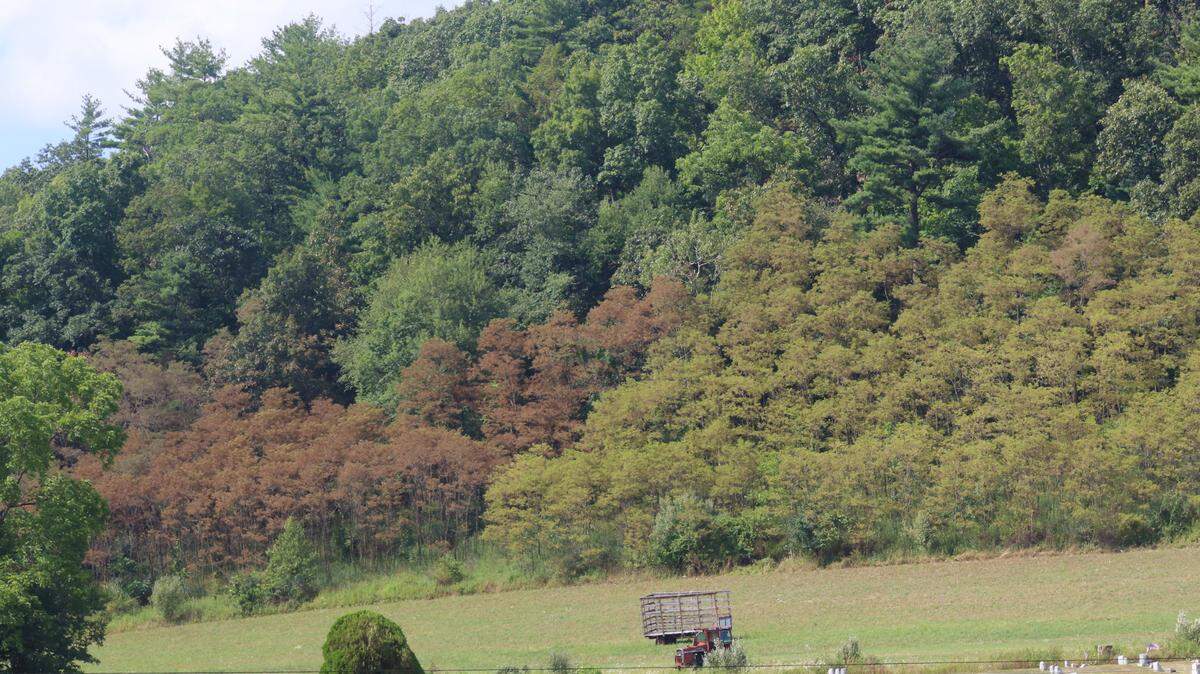
I have received several inquiries from readers about the many roadside trees turning brown this summer. The question is usually, “What is killing all of those trees?”
The trees in question are likely black locust — particularly if you are observing entire groups of trees, all turning brown. The good news is that although it is not pretty, it is very unlikely that any of these trees will die. They will return healthy next May with their distinctive blueish-green foliage.
Each summer, most black locust trees are attacked by a tiny insect larva called a leafminer. There are many species of leafminers, but this one is the larvae of the black and yellow locust leafminer beetle.
Locust leaflets are not much thicker than a piece of paper, so it is difficult to imagine that this insect lives between the upper and lower leaf surfaces. They do live there, feeding on the inner parenchyma layers — the parts of the leaf that make food through photosynthesis.
The larva — the stage that mines leaves — is well adapted to its place in the forest ecology. They have flattened cream-colored bodies with dark, wedge-shaped heads. Tiny protrusions pass for their legs.
As they “mine” the green part of the inner leaf, they make translucent trails through the leaflets, which eventually turn brown. If enough leafminers are present, the entire tree takes on a brown appearance. Although this is an annual occurrence, some trees turned brown earlier this year, and in some areas, the trees are browner than what is usual. This could be because of central Pennsylvania’s late summer drought, or possibly, there are just more leafminers this year.
Locust leafminers only feed on several leaflets each, so it takes thousands of the tiny leafminers to turn an entire tree brown. When the larva is mature and about a quarter inch in length, it pupates within the leaf. Adult beetles emerge in August and feed on the remaining locust leaves.
Black locust was not found in central Pennsylvania 200 years ago. However, it is native to the Ohio River Valley, which includes the western part of the state. It is now common throughout Pennsylvania.
We have lost American chestnut and now white ash. It would be a shame to add black locust to the funeral list. Although considered a ”weed tree” by many, black locust has many values. For starters, it is the only fast-growing tree that is also an excellent firewood. Second only to cedar and American chestnut, black locust wood is very rot resistant, and it was a favorite choice for fence posts.
Since it is a legume, it will grow on poor soils and the bacteria attached to its roots actually add nitrogen to the soil by chemically changing atmospheric nitrogen gas into ammonium nitrogen that gets released into the surrounding soil. For this reason, black locust is often used in strip mine reclamation.
Black locust was important in coal mining long before the term reclamation gained popular support. Strong, rot-resistant, fast-growing and readily available, black locust was the choice of deep miners for mine props — the upright timbers and crossbeams used to prevent coal mines from caving in. Contracts were let by mining companies for locust props of designated lengths depending on the thickness of the coal seam being mined.
Locust mine props were gradually replaced by roof bolts during the 1950s, and more recently, by hydraulic mobile roof supports. However, the qualities of black locust live on.
Black locust is also important to pollinating insects. In the spring, entire valleys can be flooded with the sweet aroma given off by black locust flowers. Pollinating insects, such as honeybees, swarm to black locust when it is in bloom.
The tree has beautiful creamy-yellow fall foliage, but thanks to the leafminer, it is rarely observed. Fortunately for the locust, leafminer damage is not extensive until late summer — giving the trees time to make enough food for continued growth.
At some point later this summer or early fall, the adult beetles will burrow into the leaf litter where they will spend the winter. They emerge in May to feed on new locust growth before mating and laying their eggs on locust leaflets. Look for various stages of leafminer damage next summer.