Centre County had a bad year for spongy moths. Here’s how you can prepare for next year
Spongy moth — formerly known as gypsy moth — is a forest pest that has killed millions of oak trees and other species across Pennsylvania, according to the Pennsylvania Department of Conservation and Natural Resources.
Centre County had a big spongy moth outbreak this year, DCNR Forest Health Manager and Chief of the Division of Forest Health Donald A. Eggen.
“It’s a bad year. It’ll probably be — in certain areas of Centre County — bad again next year,” Eggen said in July.
In late spring, College Township was made aware of a growing spongy moth infestation in certain portions of the township, according to its website. No spraying program was budgeted for 2022, but consideration for a program will be given as part of the 2023 budget process, it states.
Spongy moths have four stages of life: egg, larva or caterpillar, pupa and adult moth. Spongy moth caterpillars feed on hundreds of tree and shrub species, though oak species are preferred, defoliating them. It typically takes more than one year of defoliation before trees die.
“If you got a really healthy tree, it can probably withstand a year of defoliation but unfortunately, there’s a lot of other things that even if you remove spongy moth from the equation, there’s a lot of other stress factors out there,” Eggen said. “Weather patterns have changed. Drought or too much moisture. Any time a tree is stressed, especially an oak tree, there’s a root rot disease that can start to come into play. There’s also a small beetle that attacks weakened trees, stressed trees.”
The trees that were defoliated either last year or this year can refoliate if it is healthy, Eggen said.
“That’s kind of a good thing, but it’s also a bad thing at the same time because those new leaves aren’t as efficient at photosynthesizing. ... That tree is then under stress because it had to use its energy reserves to make those new leaves. So now anything else that comes along — or if it gets defoliated next year? Not a good thing,” he said.
What can you do?
The damage is already done this year, according to Penn State Extension, as Pennsylvania forests have passed the moment of “peak defoliation.” But there are things people can do to prepare for next year.
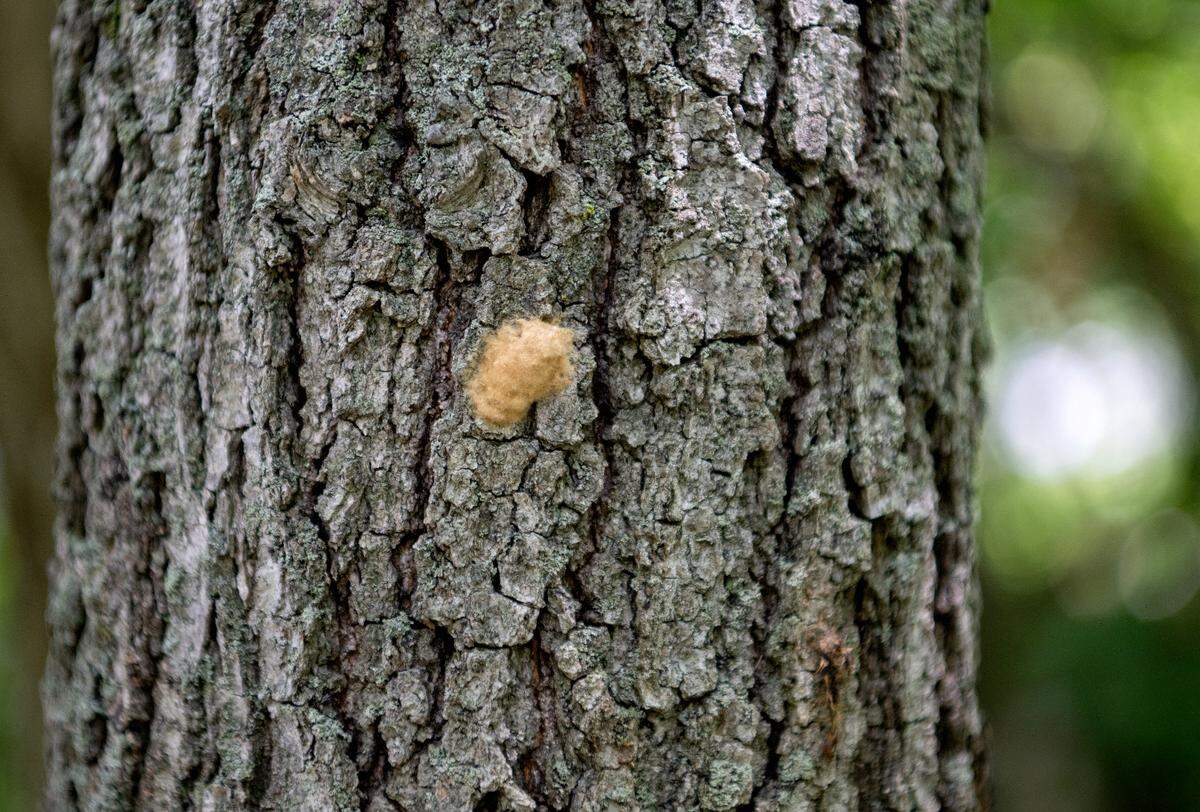
Homeowners can survey their property for egg masses in the summer and fall, according to DCNR. Females lay their eggs as light tan egg masses on trees, stones and other substrates during June and July, according to DCNR. There can be anywhere between 100 and 1,500 eggs in a mass.
“By October, you should be able to begin assessing how many egg masses are present in your forest, which will help you predict the likelihood of spongy moth causing high defoliation damage next spring. There are direct correlations between the density of egg masses per acre and the level of damage that is expected in that area,” Penn State Extension’s website states.
Eggs hatch from mid-April to early May the following spring.
Mechanic removal of spongy moth egg masses can be effective for individual yard trees. Methods include removing egg masses before they hatch and removing unnecessary things where egg masses can be hidden in yards, like piles of wood, building materials, dead branches and firewood, according to DCNR’s website.
Egg masses should then be scraped into a sealed container or bag and disposed of, the website states.
In the larva stage, wrapping burlap around the trunks of trees where spongy moth larvae can hide is another tactic, DCNR states. The larvae hiding under burlap can be scraped into a can of soapy water, which will kill the larvae.
A spongy moth egg scrape event was held at Bald Eagle State Park in early August. Volunteers and staff from DCNR scrapped 2,642 spongy moth egg masses, according to a post on the state park’s Facebook page.
“If we assume that the average amount of eggs per mass is about 200, that would mean that we successfully removed 528,400 caterpillars from next year’s population,” a Facebook post on the state park’s page states. “That amount of caterpillars could have destroyed about 25,891,600 square feet of leaves throughout their caterpillar stage.”
Bald Eagle State Park is planning another volunteer “Spongy (gypsy) Moth Scrape” from 2-3:30 p.m. Friday, Sept. 2 at the Skyline Trailhead, beginning at the gravel parking lot along Skyline Drive.
Aerial spraying
This year the DCNR had a 210,000 acre spray program. On top of that, the Pennsylvania Game Commission had a separate spray program that treated around 63,000 acres of PA game land. The DCNR treated state forest, state parks, and parts of the Allegheny National Forest.
DCNR doesn’t do private, residential spraying. But homeowners can set up their own private spray program.
Treatments typically begin in May, when 50% of the caterpillars are in their second development stage, DCNR states.
“If you believe that you have a need for a spongy moth suppression treatment, you should begin making plans during the fall and winter months preceding the year of treatment,” the website states.
“If you want to do a private spraying, please contact an aerial applicator, call around, get some pricing, get your neighbors together. (Aerial applicators) don’t do yard trees. You can contact an arborist if you just want a tree sprayed,” Eggen said. “We always tell people to shoot for a 50 acre minimum spray block, because you got to make it worth their while to show up and spraying just a few acres, you’re gonna get reinfested from the sides. The bigger the block, the better and also, the better the cost.”