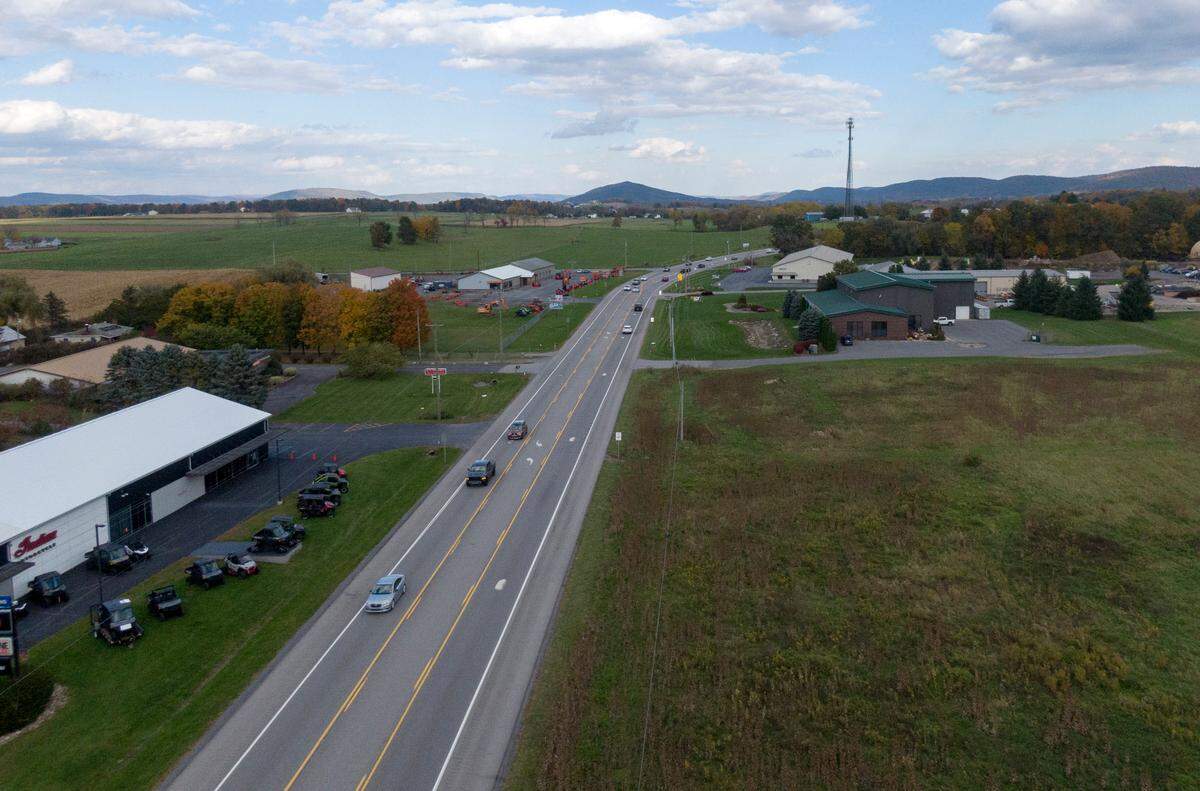
‘A waiting game.’ Harris Township pushes back against State College connector project
Harris Township’s decision-makers openly questioned Monday the foundation of a major highway project planned for rural Centre County, ranging from its design to methodology to timeline.
With a nearly 600-word letter, the township’s board of supervisors rejoined the chorus of those who oppose various aspects of the State College Area Connector project.
The township’s five supervisors wrote they “fail to see how the proposed super highway will accomplish any of the stated safety goals for this project.”
“As it stands now, there are no winners with the three alignments that are moving forward,” the supervisors wrote. “Residents will lose their homes and their livelihoods. Farms will be lost. The unique rural character of our area will be forever altered.”
The state Department of Transportation identified in September the three routes it believes should move forward for further study, ruling out two-thirds of its starting options.
All three would bring the highway through the U.S. Route 322 corridor in Potter and Harris townships. All alternatives in the state Route 144 corridor were not recommended.
The letter echoed a refrain from dozens of people whose homes, farms or businesses sit in the potential path of the highway: Improvements are needed to make the existing highway more safe and efficient, but few want to be uprooted to make that happen.
Harris Township advocated for PennDOT to design a “context sensitive” highway, one with minimal medians, roundabouts and left turns. The supervisors also urged planners to make a decision as soon as possible.
Farmers have been left in limbo, questioning what investments they should make if their fertile farmland could be replaced by concrete or asphalt. Some homeowners told the Centre Daily Times they either bought or constructed their homes without knowing about the project.
“Property values are being impacted while PennDOT makes everyone play a waiting game,” the supervisors wrote. “For the good of our community, we urge you to be transparent, to communicate with impacted residents and to move forward in a timely fashion.”
That’s unlikely, project manager Dean Ball said last month during a Centre County Metropolitan Planning Organization technical committee meeting.
“We’re going to do our best to move it along as quickly as it can, but unfortunately — like you said — it is a process and we have to stay within the regulations,” Ball said in response to a committee member’s question. “I’d love to tell people it’s going to be a year, but that’s just not possible.”
Harris and Potter township supervisors heard from residents for more than two hours earlier this month during a joint meeting. Nearly 20 people spoke.
The townships, however, don’t appear to be in lockstep.
Potter Township generally supports the three basic alignments that are set to move forward, board of supervisors Chairman Dick Decker said Monday.
The board hopes the project’s footprint will be kept as small as possible and believes any connection with state Route 45 should not be considered. Speaking on his own, Decker added he does not fully support Harris Township’s letter.
“You can’t have everything,” Decker said. “You have to compromise.”
PennDOT, spokeswoman Marla Fannin wrote in a statement Tuesday, was “appreciative of the comments” from the township.
She added the highway agency expects to receive similar comments during the public meetings scheduled for 5-8:30 p.m. Wednesday and Thursday at Mount Nittany Middle School.
“Harris and Potter townships have been active and participating partners throughout the past two years of the entire (planning and environmental linkage) study. Input from external partners and the public has been used to refine the study and address concerns,” Fannin wrote. “As any new or updated information has been compiled, it has been brought forward and shared with the cooperating agencies and the public.”
The planning and environmental linkage study is one of the first steps in a process that could take more than a decade from start to finish. The goal of the study was to “determine the least impactful and most prudent alternatives” that can be carried into the next phase, Fannin wrote.
It’s set to be followed by preliminary engineering and environmental studies, final engineering design, right-of-way acquisition and construction.
The three proposed routes have an estimated price tag that ranges from $432 million to $517 million. Construction is slated to begin in 2028 and finish by 2033.
Updates are expected to be provided at this week’s public meetings on data collection, traffic analyses and the recommended alternatives. A question-and-answer session is also planned.