Want to walk a sandhill crane named Jane? Here’s what it’s like — and how you can do it
Maybe it’s her natural orange highlights or her graceful walk — or maybe even her friendly disposition, one where her friends have her eating from the palms of their hands.
Whatever the reason, plenty of staff and visitors have been eager to meet the newest tenant at Shaver’s Creek Environmental Center: Jane the sandhill crane.
“She’s really sweet and wonderful, and we think children will especially connect with her in a real meaningful way,” said marketing and engagement program director Lisa Hayes, who choked up while discussing Jane’s unique demeanor. “We’re thrilled to have her.”
This “walking species” of bird, which is rare east of the Mississippi, recently found a new permanent home in the Klingsberg Aviary at Shaver’s Creek. Jane was found abandoned in a Wisconsin family’s backyard, where she munched on dog food — and by the time the family found a rescue center willing to take her, Jane had already imprinted on humans and couldn’t be released back into the wild.
So, for about two months now, Jane has called Happy Valley home. She remains in her enclosure for most of the day, but she’s a social bird, one who tends to walk up to visitors staring at her from outside the enclosure. So, because she needs exercise and because she’s social, Shaver’s Creek is planning to soon allow visitors to take a closer look at Jane — by accompanying her on “flock walks.”
Walking with Jane
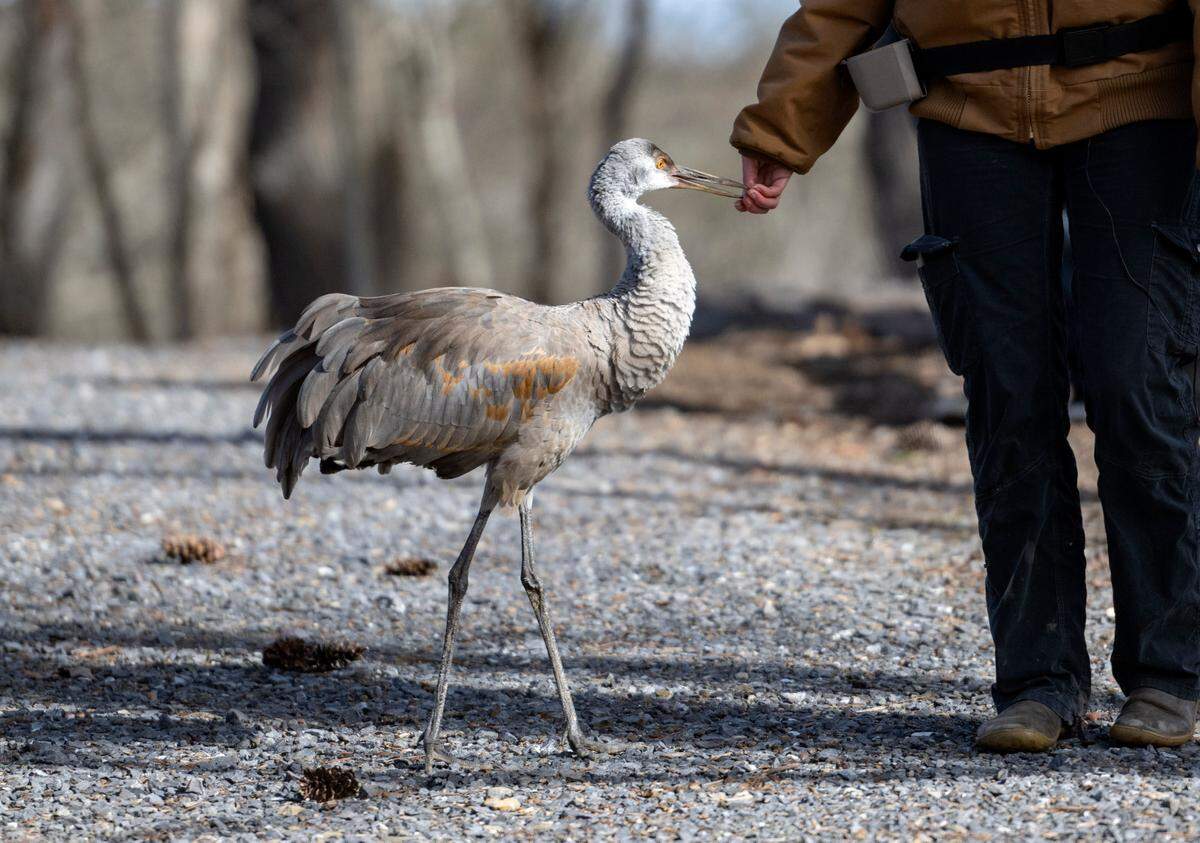
Jane, who will turn 2 years old in May, goes on several walks a week with some of her caretakers. And, starting in late March, Shaver’s Creek plans to extend some of those walks to the general public. Not all of them, of course, but maybe one every other week or so.
“We’re in the final stages of fine-tuning the plan,” wildlife education program director Paige Sutherland said. “We’re still playing around with the frequency. We want enough people to feel satisfied it’s accessible, but we also don’t want to burn out our staff.”
Based on the tentative plans, staff would meet a handful of visitors at a wooden gate just beyond the aviary. From there, Jane’s caretakers would escort Jane and Co. about 150 yards down a gravel path to a bench — where photo-ops would take place — before returning. The walk would take between 20 and 30 minutes, and the potential cost, or honorarium, is still being discussed.
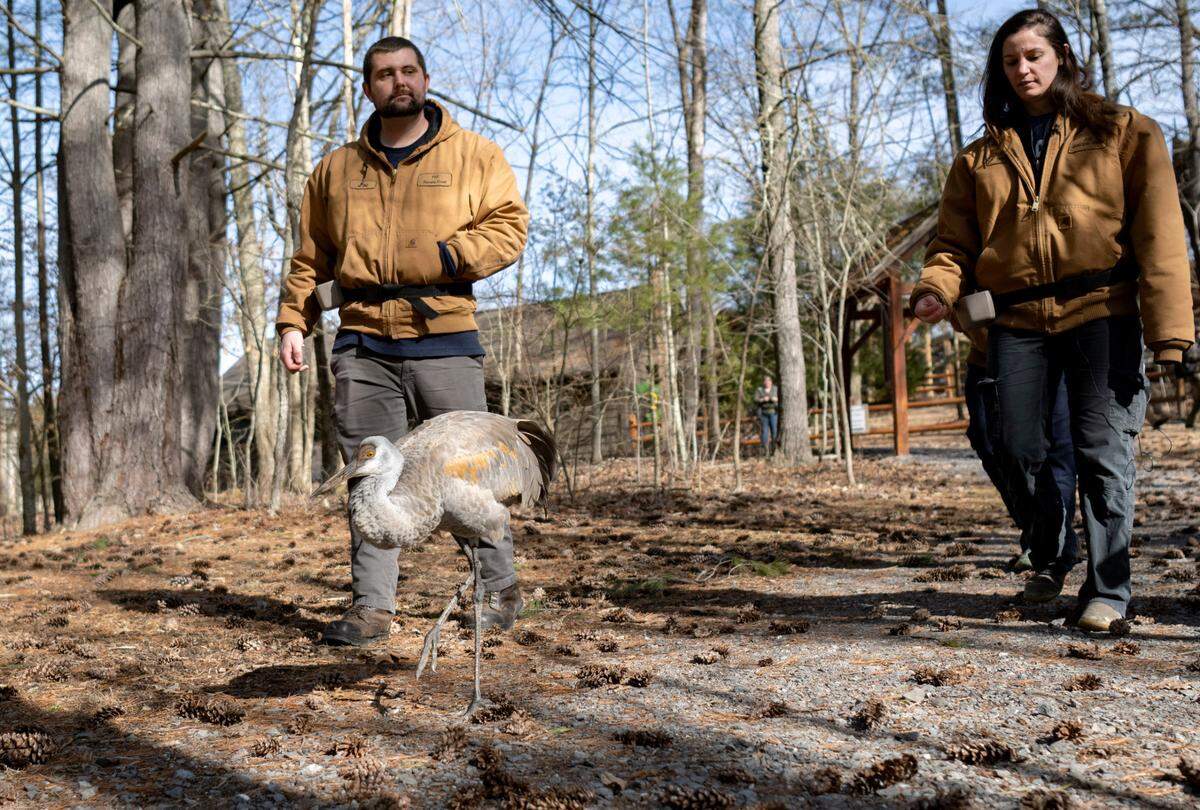
Late Wednesday morning, three caretakers and three media members accompanied Jane on one of her “flock walks.” Jane kept a slow-but-steady pace, walking alongside her caretakers who tossed kernels of corn on the path to keep her focused.
Jane didn’t appear bothered by her new visitors, approaching close enough that one asked if Jane could be pet. (She cannot. Not only is she still a wild animal, but cranes rarely initiate physical contact with other cranes.) The most striking part of the walk might’ve just been how comfortable Jane appeared; she never seemed startled, shook off a pine cone that stuck to her webbed feet and emitted a satisfied sound similar to a cross between a purring cat and a squeaky wheel.
She was more well-behaved than some dogs.
“She’s easier than my cattle dog,” Sutherland said with a laugh, while discussing animal training. “It’s all the same philosophies and same principles. Maybe it’s a little bit more nuanced than dogs since (cranes) are not domesticated and don’t quite orient toward people, although imprinting is kind of the bridge to that.”
A role in Shaver’s Creek’s mission
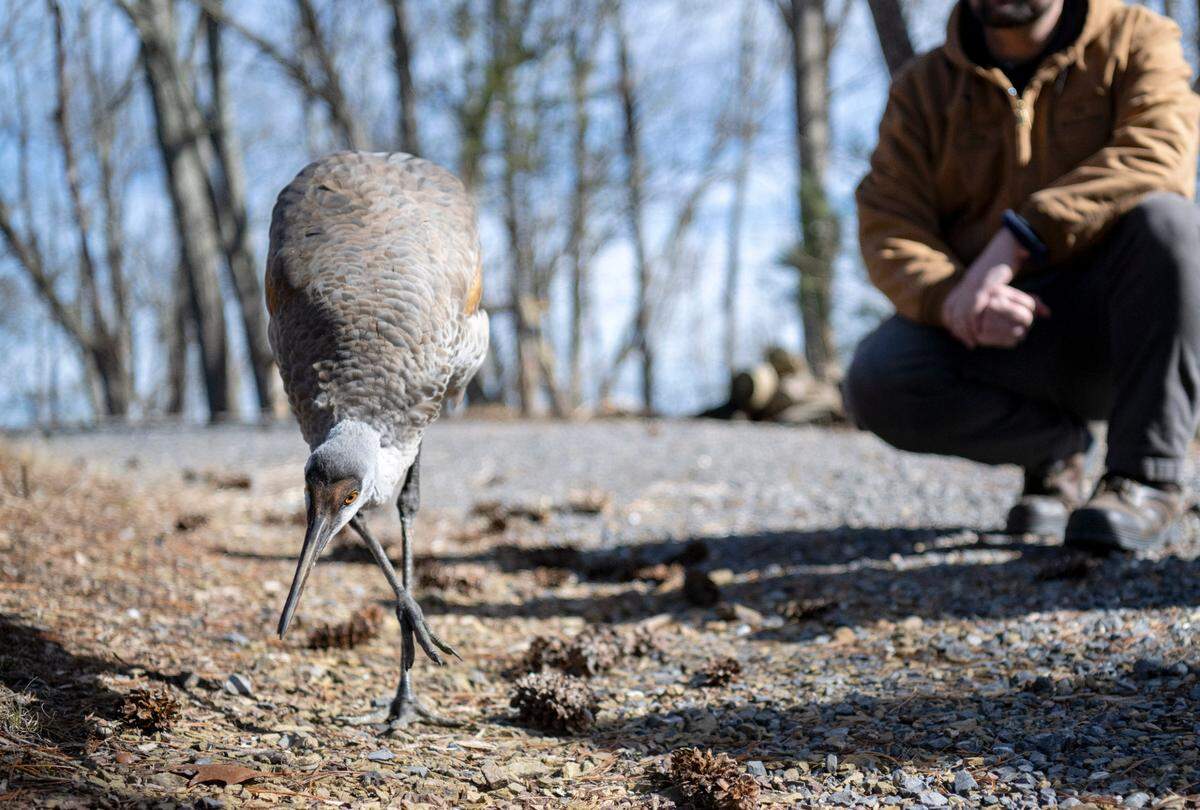
Shaver’s Creek is hoping a well-behaved Jane might develop into an ambassador of sorts — for her species, the aviary and even beyond.
Sandhill cranes east of the Mississippi were nearly eliminated 100 years ago due to overhunting and overdevelopment, but their regional population is making a comeback thanks to the restoration of their wetlands habitat. By seeing Jane up close, Shaver’s Creek staff hope people here can connect with one of the reasons for saving marshes and similar environments. That overlaps with one of the missions of Shaver’s Creek — conservation — that staff members believe might be more palatable with Jane.
After all, saving the wetlands is important. But visitors might be less-inclined to help Chip the western massasauga — a venomous snake — compared to Jane the elegant crane, even though they share similar habitats.
“Cranes are an open-space bird, and we’ve been prioritizing those spaces and drawing attention to those spaces, so we should see more sandhill cranes in the future,” aviary coordinator Joe Whitehead said. “So, with people noticing them more often, we thought it was a neat opportunity with her to kind of introduce this recovering species and keep protecting those open spaces.”
Sandhill cranes can live into their 30s and, because Jane can’t be released back into the wild, Shaver’s Creek will be her forever home. Her wings were clipped at the rescue center but, even if they weren’t, Sutherland said Jane would almost certainly stay put. Sandhill cranes do often migrate, but they’re willing to stay in one place — even in Pennsylvania — when they find the right resources.
“And, because they’re all here, she doesn’t have reason to leave,” Sutherland added.
About 20 minutes after the walk had ended, two school-age children came running up to Jane’s enclosure, zipping past the exhibit featuring a large bald eagle without offering it a second glance.
“Look! Look! There’s the new bird,” said the boy, Brock, from Pennsylvania Furnace.
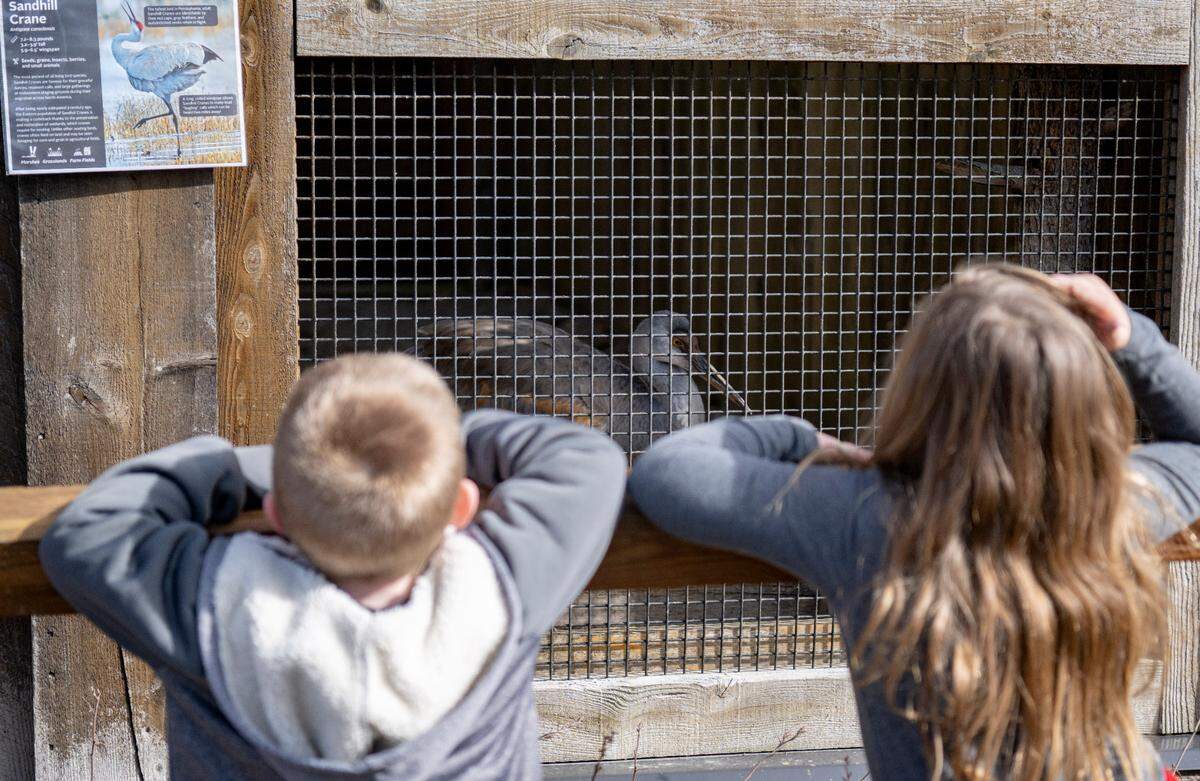
When asked what he thought of Jane, Brock offered a thumbs-up and said he loved the orange colors spread throughout her gray plumage. The girl near him, Klara from Pittsburgh, pointed and adored the way Jane’s neck looked like an “S.”
Brock wasn’t much for words. But his mother smiled at his reaction when asked if he would be interested in a future “flock walk.” His eyes grew large, and his head began shaking yes — repeatedly — like a bobblehead doll.
His excitement was understandable; there’s never been a bird at Shaver’s Creek quite like Jane. After all, the aviary was once a raptor center with birds solely like falcons and eagles, and Jane is the aviary’s first “walking species.” Although she’s technically still a bird of prey, since she’s an omnivore that also eats insects and amphibians, she’s unlike any other bird there.
Because of that distinction, the staff at Shaver’s Creek hopes that families boast a unique experience when they visit Jane — especially those who opt to join her for a walk.
“It’s really good exercise, it’s really good mental stimulation, and it really satisfies that social component of her species,” Sutherland said. “And, beyond meeting her needs and our enjoyment as her caretakers, we believe it’ll really help her do her mission here for conservation impact.”
For more information on Jane and Shaver’s Creek, in addition to future info on the “flock walks,” visit shaverscreek.org.