
What services should CATA improve? Residents offer suggestions, ideas at public input meeting
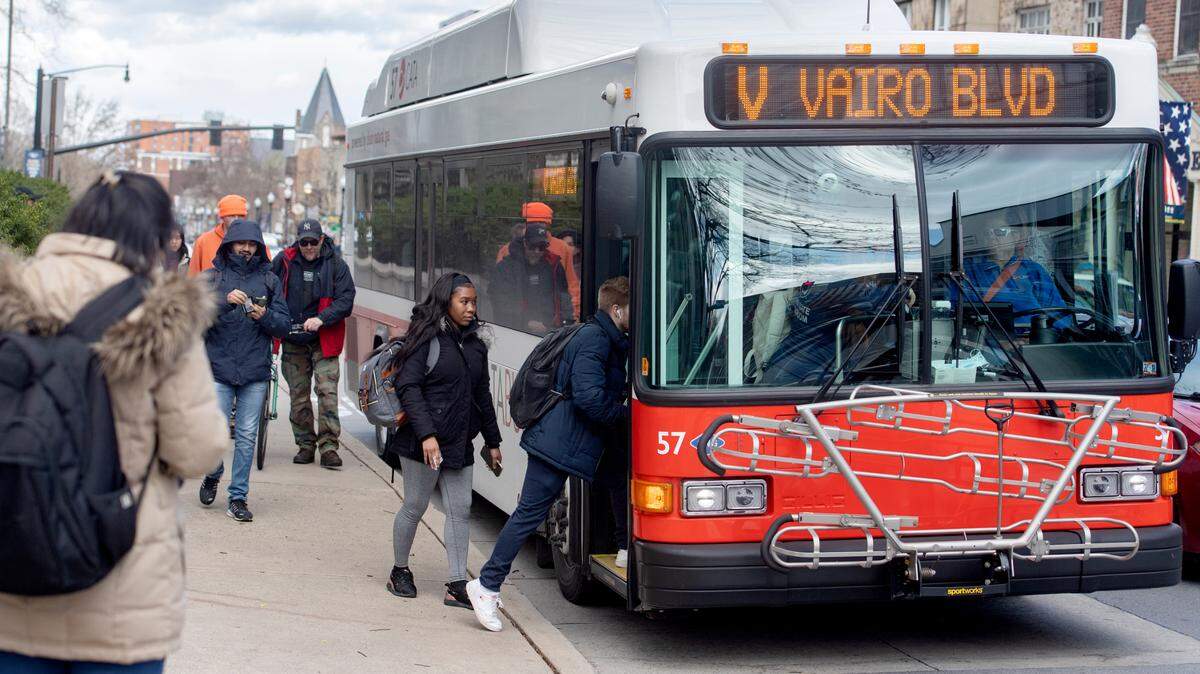
More services in Bellefonte? The return of the Red Link to Mount Nittany Medical Center? A potential Amtrak connection? These were just a few of the topics that Centre County residents raised at Wednesday’s CATA community input meeting.
CATA hosted the first of two community input meetings at the Schlow Centre Region Library to hear and respond to feedback, critiques or suggestions about the transportation authority’s services in 2024, and what should be changed in the future.
CATA has faced a number of challenges in recent years, from having to cut services in Benner and Spring townships and Bellefonte Borough, to post-pandemic staffing shortages leading to route shifts.
“The past year has certainly been an eventful year for CATA, especially for CATA’s fixed route bus operations,” said Marin Yang, CATA’s transportation planner. “At the start of last year we had some unfortunate staffing shortages, which forced us to make some difficult changes and adjustments to our system. With all of our changes post-COVID, we are always grateful for the community’s understanding and support as we work through those problems and get our systems better.”
Yang and Derek Sherman, CATA’s fixed route operations manager, gave a presentation on some of the authority’s stats from 2024 and its timeline for yearly planning in 2025, with Sherman sharing that CATA had given over 500,000 rides on their fixed routes alone, not including CATARide, CATAGo and CATA’s ride share services.
Ridership has grown by 17% and 20% in the Martin Street and Atherton Street corridors respectively, according to the presentation. And in December — a typically slow month for ridership — overall ridership had increased by about 40% compared to 2023’s numbers.
A mid-summer shake-up in the authority’s priorities helped contribute to CATA’s improved stats across the board, Yang and Sherman said, with improved ridership on CATA’s micro-transit options and a higher average on-time arrival percentage for all buses also being observed.
According to the pair, CATA stopped offering a flat line of services to each route, and instead, began to tailor each route for the levels of demand. Because of that, CATA increased services to routes that had experienced high levels of ridership, and decreased services to routes with lower levels.
What’s the future of services in the Bellefonte area?
But one of CATA’s biggest recent changes came last spring, which led to several questions and criticisms Wednesday from community members.
Bellefonte Borough and Benner Township were once serviced by a fixed CATA bus route, but now is only serviced by CATA’s limited Bellefonte-Benner B-Line due to scuffles over the authority’s funding in the municipalities.
Last January, CATA announced that services in Benner and Spring townships and Bellefonte Borough were running at a significant deficit — one that the authority could not absorb. In response, Spring Township decided to withdraw from CATA’s services, while Benner Township and the borough tried to work on a solution that would allow the authority to service the area, while also not having to increase the funding the municipalities provided to CATA. The end product of those discussions was the B-Line.
Using the service, residents in Bellefonte and Benner Township can schedule to be picked up from an assigned point in either municipality and be taken to the Nittany Mall. From there, any patron who arrives at the mall can connect to other CATA services such as CATAGo and any other fixed routes that stop at the mall.
Across the two municipalities, there are 20 total pickup spots; 13 in Bellefonte and seven in Benner Township. Rides can only be scheduled through phone call, and the service now runs from 7 a.m. to 6 p.m. after expanding its hours in November.
While the B-Line may work for some — like Joan Stover, who spoke at Wednesday’s meeting through Zoom and praised the service’s expanded hours — others want to see a more-consistent option return to Bellefonte.
“I currently live in Bellefonte and I work in State College, and I need affordable, reasonable and convenient public transportation,” Elizabeth Reynolds told CATA officials over a video call. “Right now, I rely on my friends, my family and Uber, but Uber takes a large chunk of money from my paycheck.”
CATA Executive Director and CEO David Rishel said that while he also wants the “built-to-grow” B-Line to expand, any service expansions in that area are dependent on whether the two municipalities are willing to contribute more funds to CATA.
As it stands, both municipalities are expected to withdraw from the CATA system on June 30, which would put an end to the B-Line. But a transit task force in Bellefonte, led by borough council members Joanne Tosti-Vasey and Deborah Cleeton, is working on finding potential solutions.
“(The task force) is still focusing on possible options for public transit in the Bellefonte Area, but have nothing definite yet,” Tosti-Vasey wrote in an email.
Return of the Mount Nittany route and more
Others at the meeting asked about the possible re-introduction a bus line to Mount Nittany Medical Center.
The Red Link — a bus route that once ran from Penn State’s West Parking Deck, through campus and over to Innovation Park, the medical center and back — used to provide that service, but the line’s trip to Innovation Park and the medical center were axed in 2022 due to staffing shortages and ridership studies. The line now only goes as far as CATA’s Lubrano Park stop.
Hugh Mose, who was CATA’s general manager for 19 years and stepped down in 2014, said CATA’s current solution to the problem “not a very workable situation,” and called CATA’s inability to service Mount Nittany Medical Center “indefensible.”
As it stands, anyone looking to get to the hospital using public transportation has to to utilize CATAGo to get a ride to downtown State College or Penn State’s campus, and from there would have to take a university shuttle to the hospital, Mose said.
With construction going on at the hospital, Sherman said it has been a “logistics nightmare” to get a bus there right now.
“We do want to get back to the hospital, there’s no doubt about it — we know it’s imperative...” Sherman said. “We’re working on multiple things. We’re working with Penn State and getting on that, and we’re looking at different possibilities for better service there. So we do hear you, it is an important thing.”
Another local resident asked about CATA possibly linking up with the Amtrak station in Tyrone, saying it would have a big impact on the Centre Region’s student population.
Yang agreed on the importance of inter-city transportation, saying that CATA would like to capitalize on it.
“We’re working closely with the (Centre County Metropolitan Planning Organization) and local partners on those topics,” Yang said. “The CCMPO is actually conducting its own study on a corridor for the Centre Region that could either look at a direct rail connection — which really is unlikely — or a fixed transit or bus connection to an adjacent station on the Amtrak line. So I think those are good opportunities, and I do think that’s something we’d definitely love to look at more.”
Other feedback brought up by the meeting’s attendees included increased service hours early in the morning, at nighttime and on Sundays, increased service to the Easterly Parkway, University Drive and Science Park Road corridors, improvements to signage and rain shelter at bus stops, better marketing and advertising strategies and more-specific comments involving riders’ personal experiences riding with CATA.
CATA’s next community input meeting will be held from 1-2 p.m. on Wednesday, Jan. 29, at the Transportation Services Office at Penn State’s Eisenhower Parking Deck.
More information on CATA and its future updates can be found on the transit authorities website, and its Facebook and Instagram pages.