
How will USDA cuts affect Centre County? Food bank, others brace for unclear future
A Centre County school district, food bank and food provider are among those preparing for uncertain impacts after the Trump administration announced it will cut two federal food assistance programs.
In early March, the U.S. Department of Agriculture said it would cut more than $1 billion in funding for two programs: the Local Food Purchase Assistance Cooperative Agreement Program, which allows states to purchase and distribute locally sourced food to feeding programs like food banks and pantries, and the Local Food for Schools Cooperative Agreement Program, which provides federal funding to school districts to purchase food directly from local sources such as farmers and other suppliers.
The pandemic-era programs were implemented by the USDA under the Biden administration with the goal of providing local, healthy food to those who needed it, and to build and bolster resilient local food and agricultural supply chains, according to the programs’ websites.
USDA has said the programs are a legacy of the pandemic, as the Trump administration and Elon Musk’s Department of Government Efficiency say they’re slashing federal spending to reduce waste.
The USDA gave a 60-day notification period after announcing the cuts, which would mean the programs would end May 6.
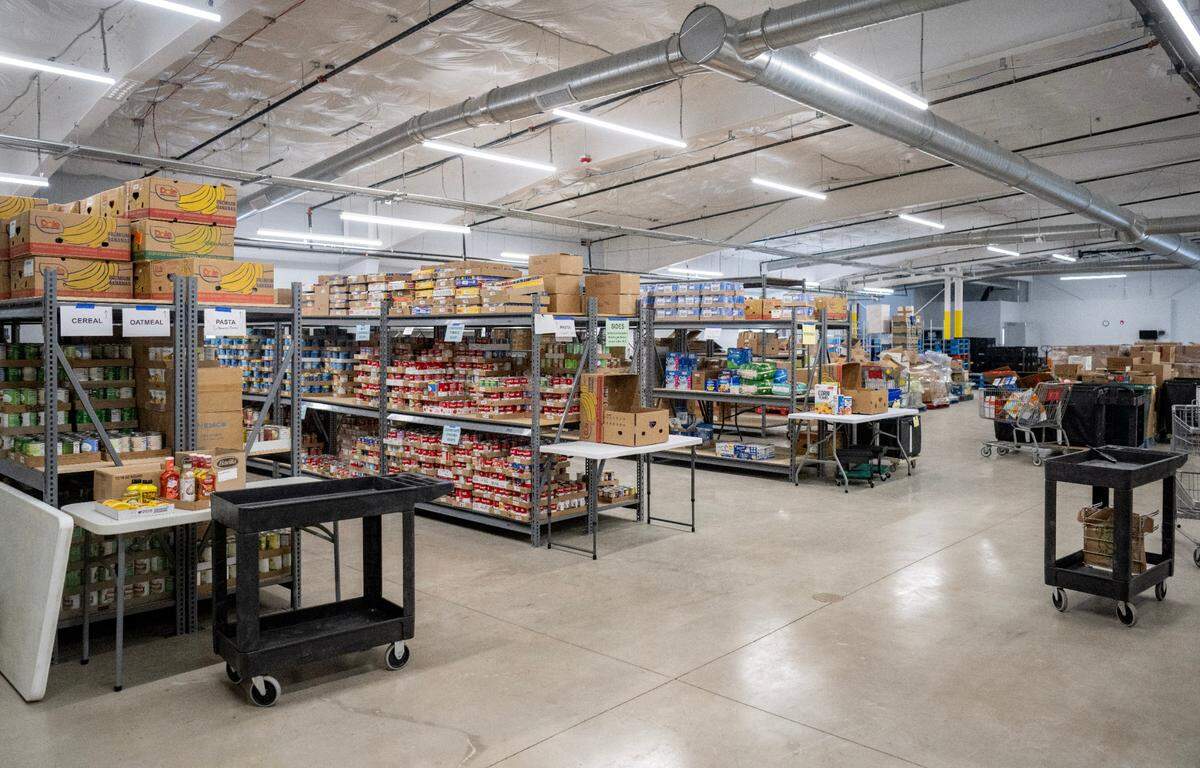
Allayn Beck, the State College Food Bank’s executive director, said that while the food bank doesn’t directly receive funding from the USDA programs being cut, she fears the potential ripple effects in the community.
“I am anticipating that when the (Local Food Purchase Assistance Cooperative Agreement) program ceases to exist, the current options for fresh and local produce, dairy, meats — they’re just not going to be available anymore,” Beck said. “And that effect is going to trickle down too. I think that’s going to be the case for any pantry that is purchasing local produce, meats and dairies.”
A call for more community support
As a result of the cuts, Beck expects less food will be readily available to distribute at the food bank. More food and monetary donations from the public will likely be required to meet the needs in the community.
The State College Food Bank served a record number of individuals and families in 2024, and Beck only expects that to continue.
“Grocery stores are still going to be serving the same produce, dairy and meats that they always do, but as prices rise not everyone will be able to afford to get their goods there,” Beck said. “While we can’t say for sure yet, I’d ... think that we’ll be seeing more and more people coming to the food bank for their goods.”
During the pandemic, the community rallied around the food bank, Beck said, providing help when it needed it most.
She’s hoping for a similar, if not greater, level of support now.
“Because of the amazing community support we received back in 2020 we were able to keep our doors open, but I’d say that what we’re dealing with right now is harder than back then,” Beck said. “We’re serving more people, food is more expensive, even running electricity to our coolers is more expensive. ... It’s more expensive for everybody. I think that we need more help now than ever, especially with determining what’s yet to come.”
She aims to secure fresh and local produce, dairy and meat products from other sources if need be, although it has yet to be determined what that would look like.
The effects of the cuts and concerns was a topic at a quarterly meeting with the directors of Centre County’s other food banks and pantries, Beck said.
Joe Arthur, the CEO of the Central Pennsylvania Food Bank — an organization that purchases and distributes fresh, local food other Pennsylvania food banks — said that with the Local Food for Schools Cooperative Agreement cut, the organization is missing out on $1.8 million through 15 months, an amount that could supply 500,000 meals.
“We’ve been deeply concerned about the funding cut to the (Local Food Purchasing Assistance Cooperative Program),” Arthur said. “It also means fewer resources for our local farmers, who supply the fresh, nutritious food that makes this program so impactful. This isn’t just about meals — it’s about families, communities, and our local economy.”
Potential school district impacts
Much like Centre County’s food banks, State College Area School District Food Service Director Megan Schaper said that so far, the school district hasn’t been directly impacted by the cuts. But when they take effect, she’s unsure about the amount of fresh, local foods the district will be able to provide.
“To be fair, I guess (the program’s funding) was extra money. Prior to the pandemic we never had those type of funds,” Schaper said. “With the current reimbursement rates and what parents pay for meals, I’ll still be able to buy food and have meals for students, but will I be able to have local food though? Maybe not so much. Buying from big factory farms is less expensive than buying from local — it stinks but that’s how it is.”
Moving forward, Schaper also anticipates the Trump administration making it “significantly harder” for children to get access to free and reduced-cost lunches.
Proposed spending cuts to fund Republican’s tax bill include changes to how schools provide free and reduced lunch. The Community Eligibility Provision, which provides a school district’s students with free lunches based on the percentage of the school’s population that’s deemed eligible for free meals through participation in programs like SNAP, is currently set at 25% but a Republican proposal would raise it to 60%.
While SCASD does not currently participate in the Community Eligibility Provision, a school that does would see the cost of their students’ lunches reimbursed by USDA through a reimbursement formula.
“That’s definitely one of the hammers that we’re waiting to see fall, and when it does, it’s going to have a big effect on a lot of schools,” Schaper said. “I mean, if you read Project 2025, they are not particularly interested in making school meals easily accessible to all students, which I find to be concerning and disappointing.”
One of her other main concerns with the canceling of the two USDA programs is the havoc it could wreak among farmers, small businesses and other local food providers.
“I fear they might be on the worst end of these cuts,” Schaper said.
Left with ‘serious questions’
The Happy Valley Meat Company, a large meat supplier to SCASD and around 150 other Pennsylvania schools, will likely be one of the businesses impacted by the cuts, although owner Dan Honig said he’s not sure exactly how yet.
“Honestly, my business would not be feasible if it weren’t for schools buying our product, primarily our ground beef,” Honig said. “We’re left with a few serious questions: What do we do to adapt to potentially less income? How do we prepare? I’d like to think that we provide an good enough service that the schools will still come to us without the additional funding, but we aren’t even sure of that.”
To retain relationships with some of his most important customers, Honig may start readjusting the delivery deals he’s made with school districts to a rate that they can afford, with weekly deliveries potentially turning into monthly, and so on.
Regardless of possible future delivery adjustments though, Honig said that the cuts alone deserve a call to action.
“If this is an issue you’re truly concerned about, I’d say get up, reach out to your child’s school district and tell them that you believe local is important,” Honig said. “Tell them you want local, even if you recognize that there are cuts. Now is your chance say to your school district, ‘this is what’s important to me and my kids.’ They should have better food — it’s the fuel of their lives.”
Late last month Gov. Josh Shapiro announced that his administration objects to, and would be filing a direct administrative challenge against, the “unlawful” decision to cancel Pennsylvania’s agreement with the federal government under the Local Food Purchasing Assistance Program.
“Earlier this month, we received notice from the U.S. Department of Agriculture that the Trump administration had decided to cancel our agreement,” Shapiro said in a written statement. “I’ve directed Secretary [Russell] Redding to immediately appeal the USDA’s decision to unlawfully terminate this agreement and demand that the federal government honor their obligations under the agreement we signed just four months ago.”
According to a news release, Pennsylvania’s $13 million contract for the LFPA program supports 189 Pennsylvania farms and 14 food banks across the commonwealth.
Shapiro is proposing a combined $8 million bump to crucial in-state food programs to be added to the 2025-26 state budget — $4 million to Pennsylvania Agricultural Surplus System and $4 million to the State Food Purchase Program.
The increases would see the total funding for the two programs sit at $34.6 million.