
Looking back: How the Aaronsburg Story thrust Centre County into the spotlight 73 years ago
This column has been updated from a version first published in 1997 in the Centre Daily Times.
History provides connections and contexts so we can understand why things are the way they are.
Too often we only come together and patch up tattered senses of community when we confront disaster and misfortune.
But the Aaronsburg Story was entirely different, for this was one of the first events to thrust Penn State and Centre County onto the world stage.
Looking back on it 73 years later, we also get a glimpse into Penns Valley’s mindset.
Many towns west of the Susquehanna derived their names and locations from their water-powered mills.
Aaronsburg — the first town founded this far north and west between Sunbury and Pittsburgh — had no reason to exist.
There was no nearby stream to run mills, flood the town, or encourage termite populations. The village was purely a political creation by an 18th century land speculator named Aaron Levy.
Within nine years after his 1760 arrival from Amsterdam, Levy had become a leading merchant in the frontier town of Northumberland.
He also eventually became involved in the post-Revolutionary land boom, acting either for himself or as an agent for well-connected friends.
Today, though, we tend to emphasize the notion of “planned” at the expense of “community.”
Levy believed one 300-acre Penns Valley tract known as Whitethorn Grove could become a future county seat, so he promoted the sale of lots through a state-wide lottery. His site plan provided extra-wide streets for conducting public business.
Using another common marketing technique of the day, Levy reserved lots for schools, churches and public buildings.
One investor who purchased a few lots in town was Timothy Matlack, the professional scribe whose penmanship we can see on the Declaration of Independence
In the spring of 1949, Arthur Lewis, Governor Duff’s press secretary, was traveling through Penns Valley when he noticed a sign: “Aaronsburg, founded in 1786 by Aaron Levy.”
He was curious about the seeming incongruousness of a town founded by a fellow Jew and situated in the middle of Pennsylvania German farmland.
But when Lewis stopped to talk with some of the townspeople, he learned about Levy’s unique legacy of presenting a community of Protestants with their ritual centerpiece, a communion set crafted by William Will, Philadelphia’s premier pewter smith.
We have no record of any ceremony or speeches that day over two centuries ago.
There’s only a plain statement in German inscribed on each of the four pieces: “This gift to the German congregations in Arensburg from Aron Levy.” This simple ecumenical gesture countered two thousand years of tragic misperceptions and misunderstanding.
Lewis then realized that this could resonate with the temper of the time.
We have only to recall the post-war anguish, the horrors of the Holocaust, and the promise of a United Nations, as well as a grudging — yet nascent — respect for racial and religious differences.
But Levy’s act is not so counterintuitive.
Recent scholarly studies indicate that a centuries-old tradition of tolerance and mutual gift-giving once existed between rural German Jews and Protestants struggling with everyday survival.
This Pietist faith persisted throughout the 19th century as substantial numbers of ethnic Germans aided enslaved African Americans in their flights through central Pennsylvania, and it still flourishes today among the Amish, Dunkard and Mennonite communities.
True revolutions only last when the conscience of the middle class is aroused.
Throughout that summer, Lewis, Rev. James Shannon, and others across the county, state and nation quickly orchestrated what became known as the Aaronsburg Story.
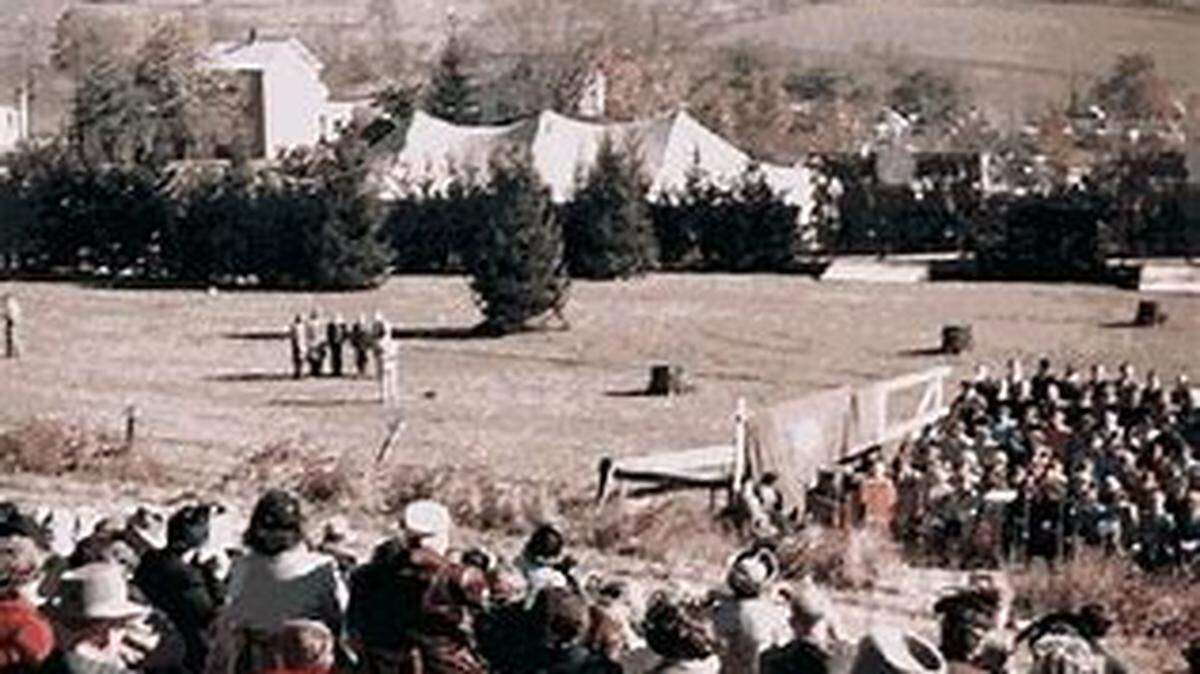
Levy’s gift became the inspiration for an enormous outdoor historical pageant, one of Middle America’s earliest mass expressions supporting social justice.
The idea quickly gained county, state and nationwide support.
On Oct. 23, 1949, leading representatives from every economic and political group — including Supreme Court Justice Felix Frankfurter and U.N. negotiator Ralph Bunche — joined more than 30,000 people in one of Middle America’s first mass demonstrations against racial and religious intolerance.
A series of discussions of social and economic issues, largely unprecedented, were certainly preferable to lynching and state-sponsored genocide.
Seating arrangements at the roundtables ensured that numerous distinguished guests — from politicians to labor and religious leaders — alternated with local citizens.
The New York Times proclaimed Aaronsburg “Tolerence Town” (one of the rare times a misspelled word appeared on their front page).
Jerry Weinstein, editor of the Centre Daily Times, wrote a piece on the event for the first issue of “American Heritage” magazine.
Centre County soon entered the national spotlight again, with President Eisenhower’s brother, Milton, becoming Penn State’s president and with Ronald Reagan arriving to narrate the 1953 Aaronsburg Assembly.
In 1997, the Pennsylvania Historical and Museum Commission dedicated a roadside marker commemorating the Aaronsburg Story and its ideals.
The Centre County citizens who participated in the Aaronsburg Story passed on a quality standard of neighborliness. They embodied the values that flowed from this valley to spread across and permeate this nation’s moral conscience.
Aaronsburg was never just some “Brigadoon of Brotherhood.”
To Pennsylvania’s ethnic Germans, “neighboring” is a given, the cornerstone of human decency.
Any town can be, as Albert Einstein once called Aaronsburg, “a meeting place for all people of good intent,” but only if we remain vigilant against the forces threatening our democracy.
We are the harvest of our collective pasts.
To understand ourselves, our values, and our communities, we must know what came before.
The lure of Penns Valley is in its resistance to mindless change.
It’s a place to learn about returns: a return to the values of land, work, and community; a return to living relatives and long-departed ancestors; a return to the welcoming tradition of neighborliness; and a return to a pace of life as it should be.
The forces that bind our communities together are as strong as the rock beneath our feet.
Both, however, can be undermined when we take them for granted.