
Penns Valley teachers part of global initiative during trip to Ghana
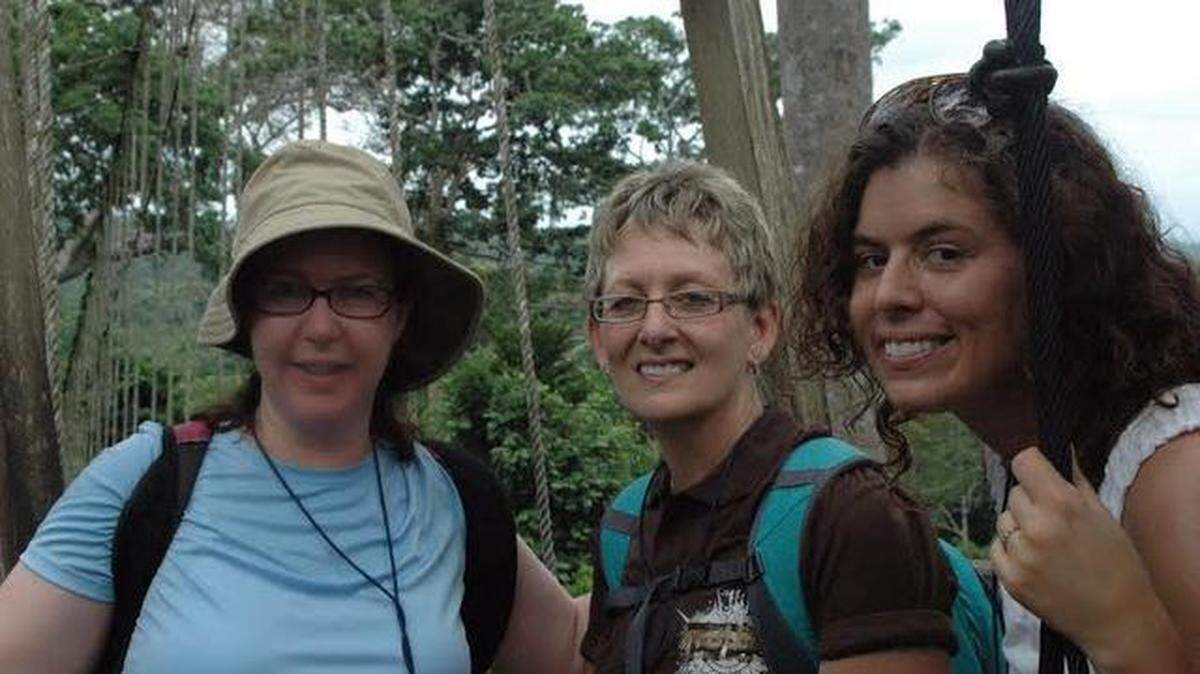
A service trip to Ghana last month put education in a whole new light for three Penns Valley Area teachers.
From May 31 to June 16, Kristen Albright, Steph Ripka, and Jacqui Wagner, flew to Ghana as part of the ReBUild team — Research and Education on Buruli Ulcer, Inundations and Land Disturbance.
“It gives you a different perspective,” said Albright, instructional media specialist and technology coach. “You go there with a goal to help others and end up learning more than you can ever give back.”
Their mission was to hold workshops with Ghanaian teachers on new education methods and to bridge the gap between rural Pennsylvania and rural Ghana. And a team of researchers studied the Buruli ulcer outbreak in central Ghana.
Buruli ulcer is a skin infection that can lead to permanent disfigurement and disability.
Researchers, teachers and students tested water, soil and other environmental factors, and then educated Ghanaian children and teachers about the findings, Albright said.
“They know what the microbe is that spreads it, but they’re not sure why,” Albright said.
The trip was funded by the National Science Foundation under the Coupled Natural and Human Systems Program, said principal investigator Petra Tschakert, associate professor of geography at Penn State.
It was made in partnership from a multiyear and multimission effort by Penn State, Penns Valley Area School District, Colorado School of Mines, the University of Iowa, University of Mines and Technology in Ghana, University of North Texas, and elementary and high schools in western Africa.
Tschakert’s team believes that land disturbances, like gold mining and deforestation, combined with flooding, “create ideal environmental conditions for Mycobacterium ulcerans” — the bacteria that cause the disease, according to the ReBUild website.
Researchers hope to learn how people can better protect themselves from the bacteria, Tschakert said.
“The project has an explicit educational component in which researchers and practitioners from the U.S. and Ghana collaborate with elementary to high school teachers in both countries to design open-inquiry learning activities to analyze and solve complex real-world problems using methods of scientific investigation,” Tschakert said. “The goal was to help K-12 students understand how scientists do real science, not boring textbook science.”
The Penns Valley teachers were guest speakers at a two-day teacher symposium in Dunkwa-on-Offin, Ghana, where about 50 educators from around the nation listened to presentations about the ReBUild project.
They taught lessons on teaching models used at Penns Valley by using the “complex systems science” approach, and incorporated higher-level questioning techniques that can be used in Ghanaian schools, Albright said.
Complex systems science is a teaching approach to science that studies relationship impacts — in this case, how environmental factors might cause Buruli ulcer in humans.
“There are a lot of different factors that go into complex system science like environmental factors (and) disease that can relate to one another,” Albright said. “We talked about humans, the environment and diseases, and how that works together. We talked about animals and how they spread disease, and used technology to map where hazards could be.”
These lessons included Ghanaian poems, traditional dances, Pennsylvania’s weather and animals, and the use of geographic information systems for mapping land disturbances.
According to the ReBUild website, the group is working to develop sister-school relationships between rural schools in Ghana and Pennsylvania.
Albright said this would help students understand human and environmental factors that cause diseases.
Students in Penns Valley will study the spread of West Nile virus in central Pennsylvania from a complex systems aspect, Albright said.
Similarly, students in Ghana will examine the cause behind Buruli ulcer outbreaks in their communities.
“It’s a way to bounce ideas off each other and learn from each other from another part of the world, and find similarities of diseases and its causes,” Albright said.
Based on things they learn, students also will create disease prevention materials to share in their communities.
But the trip may be a once-in-a-lifetime opportunity for Penns Valley teachers, Albright said.
“It was just amazing,” Albright said.
“So many incredible things came from it and we have never met a group of people who were as welcoming and hospitable as the Ghanaians. … We’re not sure if we’ll ever have the opportunity to go there again, but it will forever change the way I teach.”
This story was originally published July 23, 2014 at 7:06 PM with the headline "Penns Valley teachers part of global initiative during trip to Ghana."