
Fundraiser to help twin P-O grads gain ‘more freedom’ by adding a seizure response dog to family
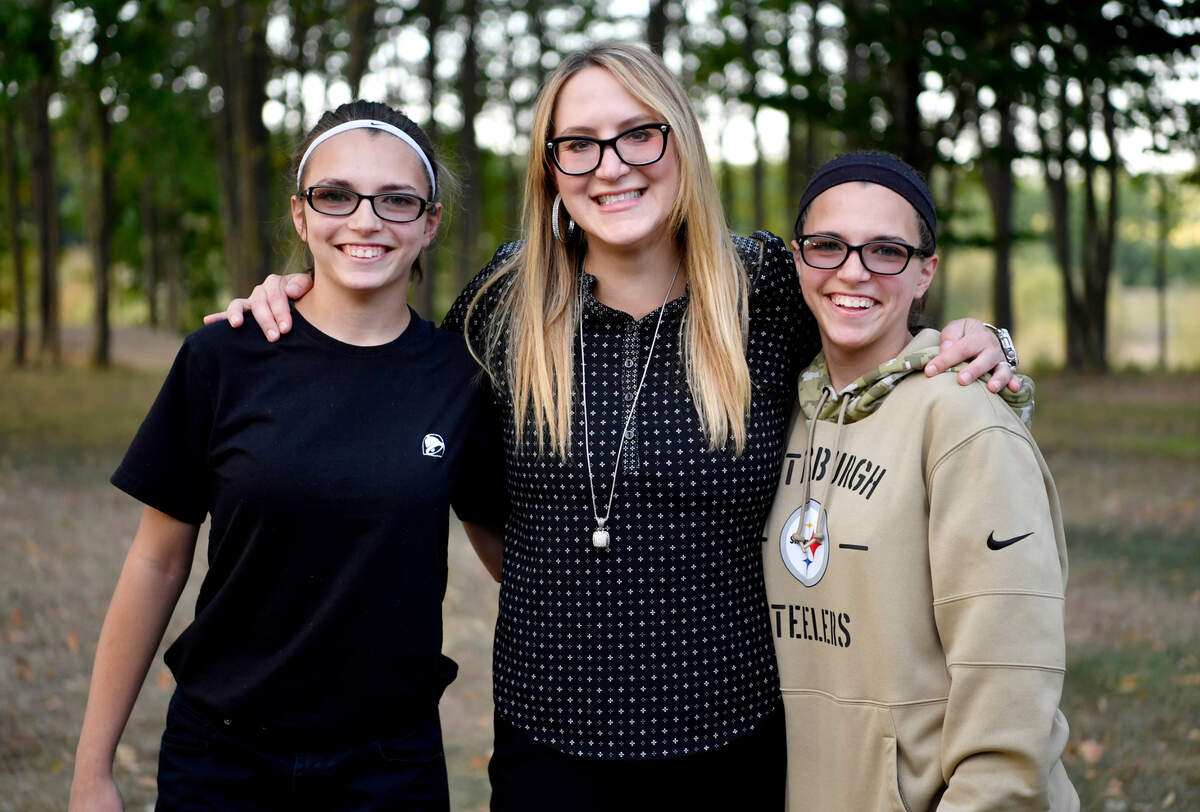
Epileptic twins Megan and Morgan Marko aren’t able to get their driver’s licenses, swim or be left alone. They each take about 20 pills daily.
And for each new friend they make or boyfriend they have, the Philipsburg-Osceola Area High School graduates have to explain their “plus sign.”
Living with epilepsy means the cheerful 19-year-old twins have to start each introductory conversation by asking others to call for help and start a timer if they have yet another seizure.
“It’s just a scary situation. No matter how many times you see it, it scares you every time,” said Megan and Morgan’s stepmother, Angel. “... They have a 16-year-old brother who has his driver’s license, and that’s something they haven’t been able to do. It’s those little rites of passage that they don’t get to experience as teenagers.”
Scars are a reminder
The twins’ battle with epilepsy started more than a decade ago when each experienced absence seizures, a loss of consciousness that typically lasts fewer than 30 seconds.
Those having absence seizures don’t fall to the ground or have muscle spasms, but they stop moving and speaking and stare blankly.
“It looks like a person is just daydreaming,” their father, Steve, said. “But if you ask them what I just said, they can’t remember.”
The disorder progressed in the following years to include grand mal seizures, a loss of consciousness with violent muscle contractions that can last several minutes.
Morgan experienced her first grand mal seizure in 2010, while Megan’s first came in 2018. The frequency of the seizures is sporadic — Megan had seven in June, none in July and one in August, as of Thursday — but Steve estimated they’ve experienced more than 100.
They have been hospitalized, transported by ambulance and flown by medical helicopter numerous times, Megan and Morgan said. There are constant reminders in the form of scars on their arms.
The most intense seizures Megan has endured came in June. She was walking at Mount Nittany Health’s Philipsburg location, had a seizure, fell into a concrete wall and hit her head off the concrete sidewalk.
She was tended to seconds later by registered nurse Randi Twoey, who worked with Steve and Angel for several years, but had never met their daughters.
The impromptu introduction was the last way Twoey hoped to meet the daughters of a longtime friend.
“I’ve been a registered nurse since 2005. I have seen alcoholics have seizures and epileptics have seizures in the hospital, but that was the scariest one I’ve ever seen,” Twoey said. “She was covered in blood. I was concerned that she was gonna aspirate ‘cause there was so much going on.”
Megan was hospitalized, treated and later discharged. But on her way back home, she experienced another seizure and was transferred to a hospital in Allegheny County.
Weeks later, after a series of medication adjustments, she fell in her yard after another seizure and was found by her father. It was the worst seizure either has ever experienced, Steve said.
He and Angel called Twoey — who refers to the twins as her “little sisters at this point” — shortly after and expressed an interest in adding a seizure response dog to their family.
Intense training
Training a seizure response dog is at least a yearlong process. It’s also an arduous undertaking, where only a fraction of a litter meets the necessary requirements to become a service dog.
New Hope Assistance Dogs, the Warren County-based nonprofit the Markos are working with, aims to place one dog with a family each month. Placing more than one dog per month is just a bonus, President Tammy Rogers said.
New Hope wastes no time to start training their dogs, which starts with rolling puppies around at about 3 days old. At 3 weeks, they begin to socialize the dogs.
Their initiation starts with people pulling on their ears and tails, pinching between their paws and otherwise “introducing them to everything in this world,” Rogers said.
The path begins to differ from there depending on what the dog will be asked to do. Some need to master escalators; some need to learn how to handle clear steps; and others need to know what to do if their owner is unconscious.
Seizure response dogs are trained to respond in myriad ways, including licking their owner, holding them down, turning them on their side, retrieving a phone or barking to alert others, Rogers said.
But that’s just the beginning. People often need to be trained more than their dog, Rogers said with a laugh. New Hope requires families that receive a dog to train with them for up to 14 days.
Many families struggle to understand that service dogs cannot legitimately serve more than one person at a time. Family members should not interact with the dog for the first few weeks to send a clear signal of who the dog should bond with, Rogers said.
“You want them to understand that if that person didn’t live, that dog would not be able to make it themselves,” Rogers said. “They’ve gotta rely on that person for everything from food to water to pottying.”
‘A little bit more freedom’
The cost to get an assistance dog can be prohibitive. The Markos’ prospective pooch could cost between $18,000 and $25,000, Rogers said.
The Markos and Twoey hope to raise $20,000 to get either a golden retriever or goldendoodle, with any remaining money expected to go toward unpaid medical bills.
They’ve raised about $10,600 as of Thursday, Twoey said, including more than $3,800 via a GoFundMe page.
The rest, they hope, comes from a benefit concert scheduled to begin noon Saturday at the Wagon Wheel Music Park, 491 Sleepy Hollow Road in Philipsburg.
Admission is $10, parking is $5. Several musicians are scheduled to play beyond dusk, along with a cornhole tournament, 50-50 raffle and more.
Neither Megan nor Morgan has a stage name picked out — they can’t rename the dog, but should have a fake name ready to share with others — but that isn’t representative of their excitement.
An added layer of safety and increased independence are two things they’re very much looking forward to, they said in unison.
“It’s gonna give them more ease in knowing that something or someone is all the time around them, that’ll protect them even if we’re not around at the moment,” Steve said. “It gives them a little bit more freedom to do their own thing.”
This story was originally published August 26, 2020 at 8:00 AM.