
ICE detainee who spoke out about conditions in Moshannon was punished, transferred
This story was produced collaboratively by WITF and the State College regional bureau of Spotlight PA, an independent, nonpartisan newsroom dedicated to investigative and public-service journalism for Pennsylvania. Sign up for Talk of the Town, a newsletter of local stories that dig deep, events, and more from north-central PA, at spotlightpa.org/newsletters/talkofthetown.
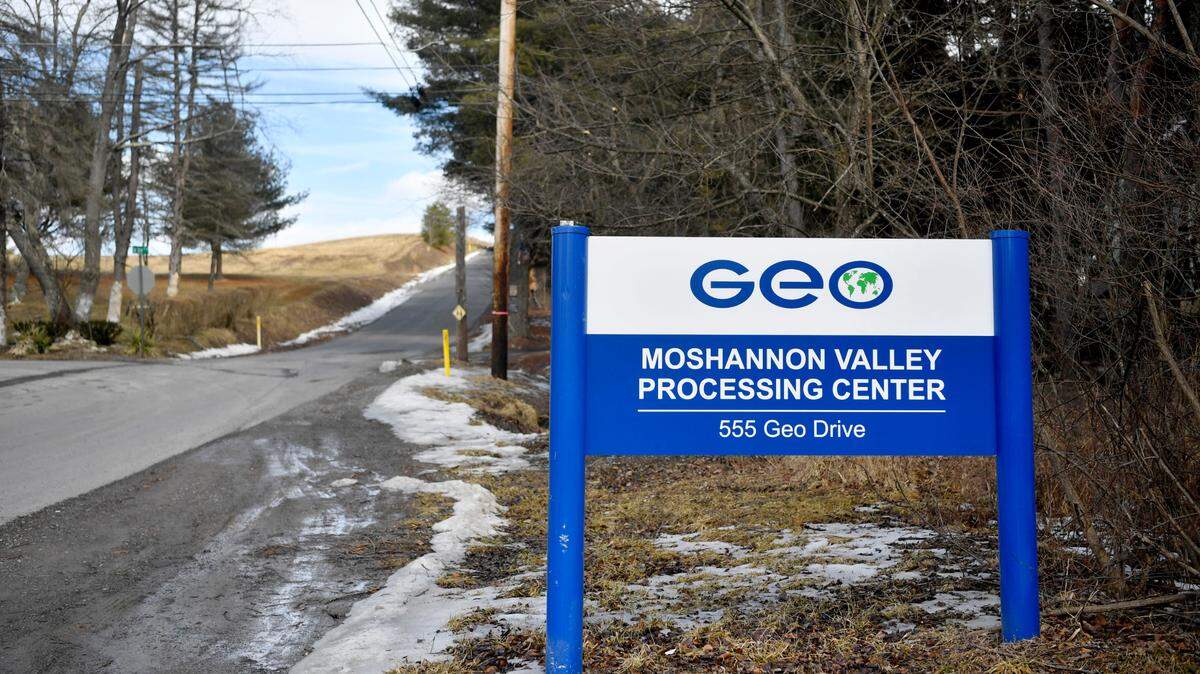
DECATUR TOWNSHIP — An ICE detainee was put in solitary confinement, then transferred out of state after the private contractor that runs a Pennsylvania detention center claimed he encouraged others to refuse meals to protest conditions, a report obtained by Spotlight PA and WITF reveals.
The document was completed just over a week after a protest at Moshannon Valley Processing Center in Clearfield County. First reported and called a hunger strike by PennLive, the protest happened spontaneously after a man vomited green bile during mealtime.
The Department of Homeland Security said at the time that claims of a hunger strike were “false.” A spokesperson told WJAC: “One detainee was taken to the medical facility and treated for flu-like symptoms. Due to this, some detainees chose to skip a meal that was provided to them and returned to eating normally the next day.”
Still, detainees were punished for what a facility inspector for GEO Group, the private prison company that runs Moshannon, described as a “proclaimed ‘hunger strike.’” The inspector pinned blame on Edin Daniel Chinchilla-Roque, writing he “was clearly inciting the group in C-Unit to refuse to accept or consume meals provided by the facility, in protest of alleged poor meals, alleged poor medical care and other complaints.”
Chinchilla-Roque told Spotlight PA and WITF he participated in the protest but did not instigate it.
“Everybody started at the same time when we saw the poor guy, that he was throwing up, he has a vomit, the green vomit,” Chinchilla-Roque, whose first language is Spanish, said. “He fell down on the ground, and nobody was helping him.”
Chinchilla-Roque’s disciplinary report says he was punished for “inciting a group demonstration.” That counts as a high offense in ICE’s detention handbook.
“They can do anything to me,” Chinchilla-Roque said. “I just feel like this have been like a punishment for everything I’ve been saying, for the information I put out of the prison. Because this is a horrible situation. I won’t give up.”
The GEO Group was able to quash any prolonged protest at the Moshannon Valley Processing Center. In the weeks since, other hunger strikes have erupted and been sustained at GEO-run immigrant detention facilities in Newark, New Jersey, on May 22, and in Adelanto, California, on May 20. At each of those facilities, the protesting detainees inside are coordinating with supporters outside the centers.
The GEO Group did not answer specific questions for this story, but a spokesperson wrote in an email that its “support services are monitored by ICE, including by on-site personnel,” and that the company is compliant “with ICE’s detention standards and contract requirements.”
ICE did not respond to multiple emails with detailed questions about conditions in Moshannon.
Detention officers put Chinchilla-Roque in solitary confinement and took away the electronic tablet detainees use to communicate with loved ones and lawyers. Chinchilla-Roque was isolated, the report says, “to deter further actions.”
Isolation was something Chinchilla-Roque feared.
Before the protest, he wrote letters about conditions at Moshannon to his attorney. The first, dated March 3, had 68 signatures from other detainees. The letter claimed the food is rotten and contains worms or insects; that detainees do not get adequate medical or dental attention; and that they have to beg for basic amenities like toilet paper and hand soap.
Spotlight PA and WITF first interviewed Chinchilla-Roque three days before the protest. Speaking through an interpreter provided by his lawyer, Chinchilla-Roque said he did not want to speak on the record at that time because he feared being sent to solitary confinement and cut off from his lawyer in retaliation. (Chinchilla-Roque later agreed to speak on the record with Spotlight PA and WITF in a call with his lawyer after he had been transferred from Moshannon.)
If he were targeted, he also wouldn’t be able to help people write letters about the conditions inside, Chinchilla-Roque said.
But he ended up in solitary anyway.
‘It’s for criminals, not for immigrants’
Chinchilla-Roque said he spent seven days in solitary confinement after he was blamed for organizing the hunger strike.
There is no fresh air or ability to go outside when in solitary, Chinchilla-Roque said.
Moshannon used to be a federal prison. The perimeter is still circled by barbed wire, and the interior is still designed for punishment. A 2024 report from the Temple University law school described Moshannon staff using solitary confinement to threaten and intimidate people, and reports from Harvard Law School and Physicians for Human Rights found Moshannon has been a national leader in using solitary confinement on immigrant detainees for at least the past three years.
ICE’s own data show Moshannon held 88 people on average in solitary from October 2025 to March, the second-highest number for immigrant detentions in the country. The facility, the largest in the Northeast, housed on average 1,600 people over the same time period, twice as many as Delaney Hall in New Jersey, where the ongoing hunger strike is happening.
“It’s very bad situation in the SHU,” Chinchilla-Roque said, using the shorthand phrase for the segregated housing unit. “It’s for criminals, not for immigrants.”
He lived in Adams County and ran a home improvement business before he was picked up by ICE. He has two offenses on his record. In 2019, he pleaded guilty to a summary offense, or the lowest level criminal charge in Pennsylvania, for harassment, and was fined $719.28.
According to a description in his legal immigration filings, Chinchilla-Roque was involved in a fight to prevent himself and his brother from being robbed. After his arrest, he was placed in immigrant detention and therefore not able to defend himself in court.
Chinchilla-Roque was released from detention, then in 2021 he pleaded guilty to a traffic ticket for driving while his operating privileges were suspended, for which he paid $441 in fines.
He is among the 78% of Moshannon detainees without serious criminal charges, according to data ICE released to U.S. Rep. Chris Deluzio (D., Pa.), who visited the facility last week with U.S. Rep. Summer Lee (D., Pa.).
Lack of medical care
Three deaths have been reported at Moshannon since it began operating as an ICE detention facility in 2021. Fouad Saeed Abdulkadir died on Dec. 14, 2025, after complaining of chest pain. He had been in ICE custody for 215 days.
Earlier that year, Chaofeng Ge died by hanging on Aug. 5. The death was ruled a suicide, but some reports say his hands and feet were bound.
Frankline Okpu died on Dec. 6, 2023, from drug toxicity and vascular conditions. A report from The Intercept found that GEO Group staff falsely logged checkups.
In the first six months of 2026, 18 people have died in ICE custody, the most ever through the same period. Last year, nine people died in ICE custody by June. Forty people have died since, marking the highest fatality rate in U.S. immigrant detention facilities over any 12-month span, according to data from the University of California School of Law. Under Presidents Barack Obama and Joe Biden, the highest number of deaths in a year was 11, which happened in 2011 and 2024.
The lack of access to medical care has been a huge concern to immigrant advocates like Zeynep Emanet of the Council on American-Islamic Relations.
Chinchilla-Roque has struggled with that issue at Moshannon. In his response on a copy of the incident report, he wrote in Spanish about how difficult it was to access medicine for his eyes, anxiety, and blood pressure.
Beginning April 21, he logged his blood pressure over a five-day period. Shortly after, he felt like his health was deteriorating, he wrote.
The blood pressure readings he recorded showed he was experiencing stage 2 hypertension, according to the American Heart Association.
When he repeatedly asked a guard for his anxiety meds, she replied, “we all suffer from anxiety,” Chinchilla-Roque wrote.
Chinchilla-Roque wasn’t alone.
“We know medical neglect is happening,” Emanet said. “They’re actively treating these people in a punitive way, which civil detention isn’t supposed to be punitive. It’s unconstitutional to harm someone while you’re holding them.”
She told the story of Izzy Aly, a Florida resident who is originally from Egypt and is being held in Moshannon. He has been denied proper medical treatment since he was detained in December 2025. In January, Aly received a medical exam from the Department of Homeland Security that revealed he had stage 3 kidney failure. He was not informed of this for two months, Emanet told Spotlight PA and WITF.
Aly has repeatedly asked to receive treatment, but Emanet said he has been denied access to the medical care he needs. On May 18, he reported seeing blood in his urine, which is considered a medical emergency. As of May 21, he had not been seen by a doctor that can treat his symptoms or been taken to a hospital, Emanet said.
Bobbi Erickson, founder of Indivisible Mayday, an advocacy group that works in north-central Pennsylvania, told Spotlight PA and WITF that people detained in Moshannon call and tell her how depressed and hopeless they feel. She said she isn’t an emotional person, but has cried more this past year than in her entire life. Erickson recently quit her job as a school “lunch lady” to focus on advocacy work full-time.
“People get sick in their minds from this psychological torture they make us go through,” Chinchilla-Roque wrote. “Some have been living in this torture for 10 months. They cry, scream, bang on the doors, and break the fire sprinklers out of frustration because they ask to speak with their families and they do not give them access to the phone or tablet.”
Complaints about access to mental health services and medications for anxiety or depression are laughed at by guards, Erickson said. If someone is lucky enough to receive medication for their mental health, it’s extremely inconsistent.
Congressional visit to Moshannon
Deluzio and Lee made an unannounced visit to inspect the facility on May 28, more than a month after the protest for which Chinchilla-Roque was punished.
Deluzio and Lee told reporters outside the facility that women in Moshannon also said medical care was poor, including one pregnant woman who said she was bleeding and didn’t know the status of her pregnancy.
Another woman began to describe how she was sexually assaulted in Moshannon, Lee said, but she and Deluzio were ushered away.
On one point, they disagreed with a common complaint about the facility’s food. The lunch of chicken, rice, and beans looked fine, Deluzio said. But he noted that it was only one meal on one day, and was offered when elected officials were present.
That same day, immigrant advocacy groups Free Migration Project, Juntos, and Indivisible Mayday also visited four men being detained. Erickson spoke to a man about the food by miming and yelling through a plexiglass barrier.
She asked him how the food was, and he replied, “Bad.”
The detention staff behind him said: “It’s chicken day. Tell her it’s good. Chicken day is good.”
He rolled his eyes and told Erickson they get meat once a month. To cope, he told her he spends close to $500 every few weeks to get food from the commissary and to communicate with family on his tablet.
Adrianna Torres-Garcia, co-director at Free Migration, visited a man who had been there for seven months and had never received a visit before. He tries to call home, but it’s very expensive, so he speaks to his family only once a month, Torres-Garcia told Spotlight PA and WITF.
The man told Torres-Garcia that being able to talk to them made his day, she said.
‘A very dangerous thing’
A week after Chinchilla-Roque was released from solitary, guards woke him up at 3 a.m. and informed him he was being transferred, he told Spotlight PA and WITF. He didn’t know where he was going to be sent, he said. Chinchilla-Roque said several other men who were being punished for participating in the protest were also put in solitary and then transferred.
ICE did not respond to questions about how many people were put in solitary or transferred in connection with the April protest.
Even more than solitary, detainees fear being transferred out of Moshannon, Erickson told the newsrooms. She said transfers are used to prevent detainees from becoming too close and organizing among themselves. Transfers can also move detainees farther away from their families or attorneys, for those who can afford them.
The punishments have created an environment of fear, Erickson said, noting detainees and their attorneys are extremely reluctant to speak with the press out of fear of retaliation.
ICE sent Chinchilla-Roque to Port Isabel Service Processing Center in south Texas, 30 miles from the border with Mexico.
Ten days later, ICE transferred him to Winn Correctional Center in Louisiana, where conditions are worse than at Moshannon, Chinchilla-Roque told Spotlight PA and WITF.
ICE has held Chinchilla-Roque in detention for nine months. His attorney, Harrisburg-based immigration lawyer Craig Shagin, said that’s a violation of a U.S. Supreme Court ruling against indefinite detention. It also serves no purpose because Chinchilla-Roque has always shown up to his ICE hearings and check-ins, Shagin said.
Instead, the federal government is paying private corporations to detain Chinchilla-Roque — companies with a financial incentive to spend as little as possible on detention in order to make profits from the contracts. GEO Group reports its earnings for the first three months of 2026 are up 17% over last year, bringing in $705.2 million.
“Taking custody of a human being is a huge responsibility,” Shagin said. “Why a private corporation should be entrusted with this, I really do not know. I think this is a very dangerous thing.”
A judge ruled in 2023 that Chinchilla-Roque is protected under the United Nations Convention Against Torture from being deported back to his home country of Honduras.
But Chinchilla-Roque still has an order of removal. ICE is trying to deport him to a country other than Honduras, a tactic in line with a Trump administration goal of speeding up deportations, including for people with some protection against removal.
The first country the administration tried was Mexico. In March, Shagin filed a habeas petition in federal court, meant to both block the removal and get Chinchilla-Roque out of detention.
“Despite clearly informing the DHS of his fear of removal to Mexico, and even though he suffers from a life-threatening medical condition that would place him at extraordinary risk if deported to a third country—including Mexico—where he has no legal status, no ability to work, and no support system, the government nevertheless continues to pursue his removal,” Shagin wrote in the petition.
But habeas claims are tied to location. They can be defeated by moving a detainee to another location, like from Pennsylvania to Texas, or Texas to Louisiana.
Shagin said he has two legal choices for his client. He can find a lawyer who works in Louisiana to file another habeas petition in the court there, or he can ask an appeals court that oversees Pennsylvania to take control of the case regardless of where Chinchilla-Roque is held. After all, it’s not individual detention centers that are holding him; it’s the federal government, Shagin said.
Despite his punishments, Chinchilla-Roque is undeterred from highlighting the struggles of detainees. People are scared and depressed, he said, and they try to help each other stay hopeful.
“We pray,” he said. “We ask God to help.”
Spotlight PA State College’s Marley Parish contributed.
SUPPORT THIS JOURNALISM and help us reinvigorate local news in north-central Pennsylvania at spotlightpa.org/donate. Spotlight PA is funded by foundations and readers like you who are committed to accountability and public-service journalism that gets results. Support WITF at witf.org.