Green space or affordable housing? State College Borough Council facing ‘moral dilemma’ with park
More affordable housing could soon be on the way in State College, but it’ll come at the cost of park space — and some neighbors aren’t happy about it.
Progress Development Group (PDG), a locally-based real estate developer, is seeking to build a four-story, 26-unit affordable housing apartment at the former site of Recumbent Bike Riders, at 1306 S. Atherton St. The problem is the only way PDG can construct the building is if it spills over into the small park behind it, taking up what the developer estimates is 16% (5,500 square feet) of Nittany Village Park.
Some community members and neighborhood associations believe that sets a dangerous precedent with the borough willing to surrender green space. Others labeled it a “win-win” because, in exchange, PDG would provide and maintain new (and needed) landscaping and playground equipment for the park.
“Twenty-six units of affordable housing. What a wonderful thing,” Councilwoman Katherine Yeaple said during last month’s presentation on the issue. “I only wish that you didn’t — it’s almost like a battle between affordable housing and open space, which I value equally. I value both, so I wish we didn’t have this opposition, so it’s a tough call.
“It’s almost like a moral dilemma. So that is my concern.”
No public comment on the issue took place at the last council meeting, but that’s slated to change with the topic on Monday’s meeting agenda. Council is not scheduled to take action at the 7 p.m. meeting — most still seemed receptive to the idea in May — but there’s sure to be debate.
“It sounds like this is the kind of project that is a win-win for the community,” Councilman Evan Myers said.
Said Heather Ricker-Gilbert, who lives near the park: “It’s not a win-win situation — because of the impact on the neighborhood, on property values, it’s on the fact there’s going to be lighting, there’s going to be parking, we’re going to lose trees, and we’re going to see this large, looming apartment building.”
Nittany Village Park: The main controversy
Residents emphasized to the CDT that they support affordable housing in their neighborhood, saying any opposition has little to do with concerns about home values.
They just don’t want to sacrifice their park, where children play, neighbors walk dogs and families play catch.
“When I heard this was an affordable housing project, to be honest, I was excited because I think that’s a really excellent use of existing commercial land,” said Dan Brown, who lives in the Tusseyview neighborhood. “Why I’m opposed to this, though, is the borough has limited green space ... and, as soon as we lose our parks, they’re gone forever.”
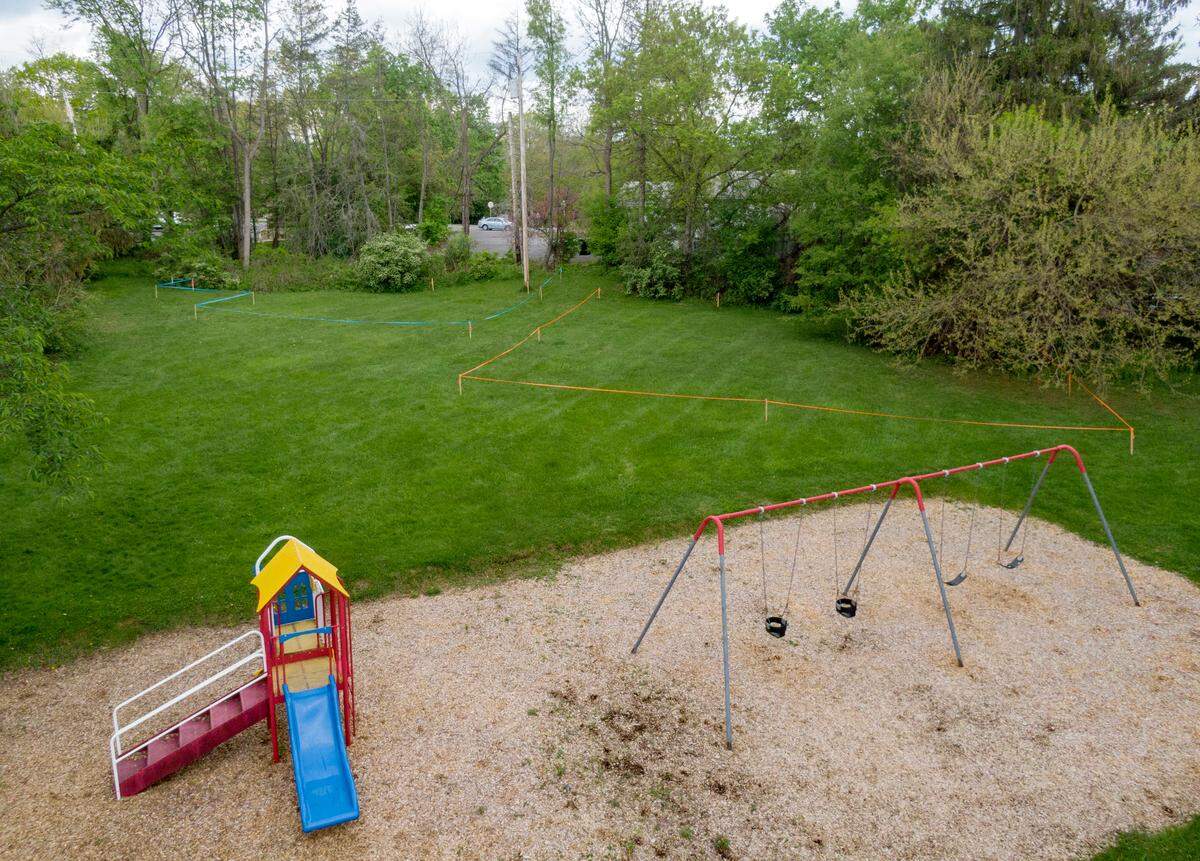
Also at issue is just how much of the park the project would take up. Although the developer estimated 16%, that also includes the park entrance from Old Boalsburg Road — which may technically be part of the park but isn’t actually used as part of the park, meaning that number could be artificially deflated. Further complicating matters is the fact that part of the park that residents use is actually part of the RBR property. Because of a 20-foot rear yard setback, neighbors routinely trespassed without even knowing it.
In other words, for different reasons, the park could be poised to get quite a bit smaller than residents are used to. At least one neighbor estimated the part of the park that’s used now would be reduced by 33%.
“All we’re asking for is to preserve the park,” added Ricker-Gilbert. “We’re certainly not against — we need — inclusionary housing in this town.”
On the other side of the issue, the State College-based developer has attempted to compromise at various points. When neighbors voiced concerns about taking up part of the park, PDG promised to beautify it with new playground equipment, picnic tables, landscaping upgrades and the installation of paths that comply with the Americans with Disabilities Act. PDG also scrapped five parking spots to take up less space. And it said it would maintain the park, in exchange for the borough leasing out the entire park. (Due to zoning issues, it’s markedly simpler to lease the full park and not just part of the park.)
Brian Hudson, former CEO of the Pennsylvania Housing Finance Agency, who retired last year, addressed the borough last month and pointed to similar public-private partnerships in Gettysburg, Harrisburg and Phoenixville. State College would not be the first municipality to “donate” land, he said.
“I know these are tough decisions, but every community I’ve worked with that’s donated land — whether to be a community building or a garden that went along with affordable housing — did not regret their decision to do that,” Hudson said. “It’s been a win-win situation.”
The main question now is whether both sides can feel satisfied with a deal, or whether one will leave the proverbial table unhappy.
Building & benefits
Because an affordable housing building like this must meet so many requirements, especially when it comes to qualifying for grants and tax credits, finding the right land is no easy task.
PDG should know. Since 2014, the subsidiary of HFL Corporation has been responsible for 140 affordable housing units in Centre County. It’s responsible for Atherton Place, a four-story building most residents recognize because of its Dunkin Donuts. And it’s expected to finish an 18-unit building in Ferguson Township by September.
But, this time, HFL’s executive vice president said leasing part of the park was necessary.
“It’s very difficult to find land in the borough that’s of size and scope to be able to build the type of Section 42 housing that we’re talking about,” said VP Ara Kervandjian, who noted that purchasing RBR’s neighboring property was also cost-prohibitive.
Developers are incentivized to build such affordable housing for several reasons. For one, the “affordable housing” title is only temporary for most units, for either 30 or 35 years, before it reverts to regular housing. (Two of the 26 units in this building will be under “affordable housing” for 99 years; the others for 30-35 years.) Secondly, the developer can apply for a number of grants and competitive tax credits to off-set costs.
As an example, Hudson said they’d like to apply through the Pennsylvania Housing Finance Agency for potentially a $1 million annual credit for each of the next 10 years.
In turn, the apartment building comprised of one-, two- and three-bedroom units would essentially charge rent at steep discounts for individuals making less than 60% of the area’s median income, or in this case less than $48,000 annually. (The number of household members is also taken into account, as are several other variables.) At Atherton Place, for example, monthly rent last year ranged between $185 to $1,015, with most rents falling between $800 and $1,000.
In Section 42 housing, unlike Section 8 housing, tenants also don’t get booted for earning a promotion or raise that puts them over the “need” threshold — as long as their salary doesn’t more than double. (Even if it does, that still might not be enough to be asked to leave.)
“I think this is one of the biggest win-win programs that’s out there for any family that wishes to excel in life and have a roof over their heads to live the American dream,” Kervandjian added.
The main downside with this program mainly comes from criticisms about its complexity. Because of its size — $9 billion annually nationwide — it’s sometimes prone to abuse. But, for those living in such apartments, there are normally few complaints. Waiting lists are typically long.
“This is a nice building,” Councilwoman Theresa Lafer said, referring to the proposed apartment. “I would live in a building that would look like this, if I were to leave my home and retire into somewhere else.”
What comes next
Neighbors first heard whispers of the proposed development, named Parkland Apartments, sometime last fall. They organized an online petition, wrote letters and contacted the borough — all before the council first publicly discussed the issue on May 10.
Public comment on the topic was not permitted the last time as it was under the umbrella of “special business.” But because it will now be one of three public hearings Monday, the public will be invited to comment this time.
No action is scheduled to be taken at Monday’s council meeting. But council will set aside time at a future meeting, where more discussion can be held and a vote can be taken. (It’s not yet known how quickly that future meeting might come.)
The Borough Council clearly wants to make both sides happy. Council members have previously supported both green spaces and affordable housing, but it’s rare that the two issues compete against one another.
Lafer succinctly summed up the council’s stance last month.
“I want a park, and I want affordable housing. I want them both,” she said, before adding, “I think we can manage to make both of these work.
“And that’s what I’d like to see.”