Noise, lights pit State College neighborhood against school district. What comes next?
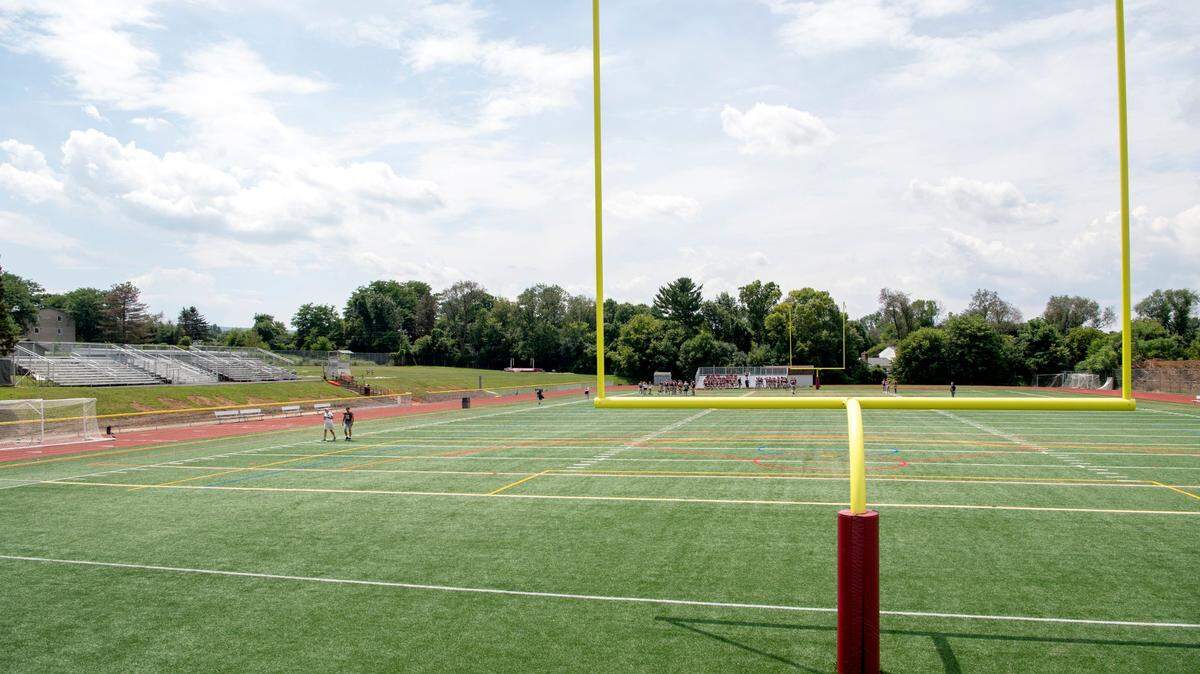
Amber Concepcion, president of the State College Area School Board, just wants a convenient space for the marching band to practice. Ted Reutzel, who lives near the practice field, just wants them to play where the noise doesn’t reverberate throughout his entire home — or at least to limit practice times.
But neither side can seem to find a solution to please the other, putting fall practice times and locations in doubt for the marching band (and others) who use the field at State College’s South Track Facility.
SCASD officials say there are no other good alternatives, as the North Field is too far for students to lug their instruments and the North Parking Lot isn’t built for a band. And some residents, in and around the borough’s Greentree neighborhood, say that’s not an acceptable response when one homeowner’s father went so far as to set up a bed in his office and wear noise-canceling headphones to limit the nighttime sounds, which continue as late as 8:30 p.m. in the fall.
Both sides have conducted presentations in front of borough council. And both sides will meet again Monday night to continue the public discussion. A number of potential solutions are on the table — but it’s not clear if any would make both sides happy.
Here’s a closer look at the situation:
Why is this a problem now?
Amy English, who spoke in support of moving and/or limiting the marching band, has lived in Greentree since 2007. And she knows what a lot of SCASD parents are thinking.
Why did you buy a home near a school if you weren’t willing to listen to the activities?
Well, for 12 years, she said, it was fine. Early morning track meets and afternoon soccer games weren’t a problem. The noise remained manageable. The band had practiced in the South Parking Lot for decades and, on some days, English would even escort her family to the lot so they could better hear the music.
But that all changed when both Memorial Field and the high school underwent a dramatic expansion/renovation before the pandemic, eliminating the space where the band once practiced.
State College Area felt the South Track Facility made the most sense as the band’s new location since it sits adjacent to the band room. Now, from late August until the end of October, the band practices there once the football team finishes up, meaning about 6(ish)-8 p.m. Mondays and 6:30-8:30 p.m. Wednesdays, in addition to daytime practices between July and August.
Reutzel, whose home sits closest to the facility, estimates the music plays at about 69 decibels on his property, based on a February sound study conducted by SCASD. (That’s like standing next to a vacuum cleaner, according to a noise chart designed by Purdue.) English, whose daughter plays in the band, feels the district is asking too much — especially considering the facility’s 70-foot lights, which were granted an exemption from the usual 25-foot height restriction.
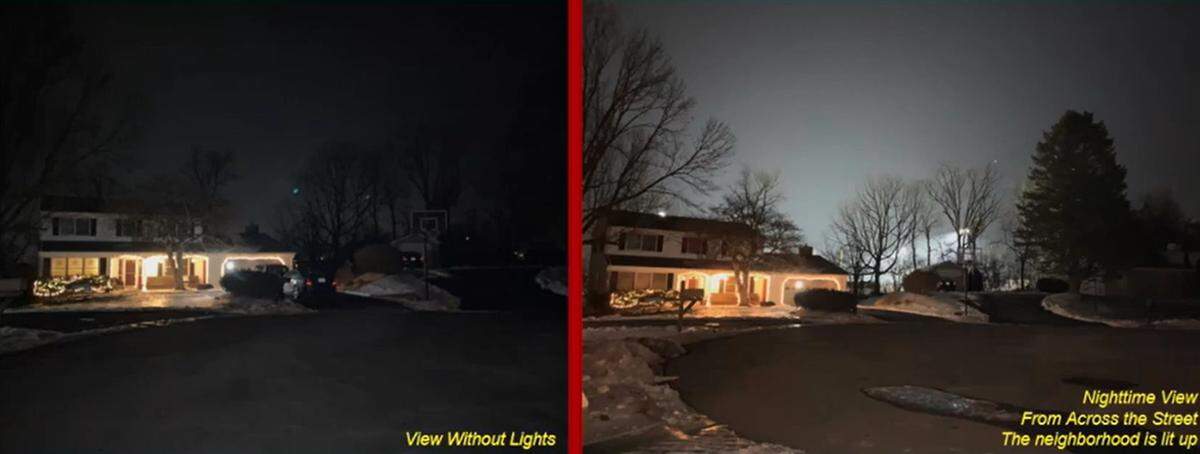
“What we didn’t sign up for was to live under the bright lights, as some families do. We also didn’t sign up to hear the marching band, 130 members strong, playing within a couple hundred feet of our home,” said English, who added her family might not have chosen to pay more than $100,000 to renovate their home if they knew this was coming. “We didn’t expect to hear every instruction provided to the band through our closed windows in our homes. We didn’t expect to feel the vibration of the bass reverberating through our homes.
“What we’re asking for are really the same things every borough resident already has and takes for granted — we just want some protection for the conditions in which we live.”
By Reutzel’s count, 51 single-family homes and 17 apartment buildings are impacted in some way because they’re within 1,000 feet of the South Track Facility. But English acknowledged those closest to the track, on Edgewood Circle, include about a half-dozen homes.
Mark Johnson, who lives in the Greentree neighborhood, understands there are no easy answers to this issue.
“It’s a misnomer here that this is an anti-band movement. It’s not. It’s pro-family,” he said. “This is a situation where the 10 weeks the practice does go that late, some of the folks’ homes in the community are basically rendered useless to serve as an actual home. You can’t watch TV or have a conversation.”
What does SCASD say?
Ultimately, district officials say they want what’s best for students — and that means staying put and increasing practice time.
Sure, practicing at North Field might ultimately be a potential solution. But officials pointed out that students would have to walk around the high school building — which boasts a similar-sized footprint to Beaver Stadium — and be forced to deal with an intersection, a steep grade and differently-abled musicians who might not be able to physically make the trek. (Moving the football team to North Field also provides a host of problems, since there are no goal posts and little storage there.) Yes, the North Parking Lot could technically be another answer. But, in the end, officials said the lighting there wasn’t designed for a marching band, and it’s not clear how easily the lot’s islands could be removed. Plus, the music could interfere with whistles and sounds at the nearby field.
Some community members believe the concerns of the few should not outweigh the priorities of the many. Others say part of living in the borough is dealing with parties and noise, and those impacted should essentially suck it up for 10 weeks out of the year.
“It just seems to us that few extracurricular activities are more essential to our youths than musical performance and athletics,” said Dan Letwin, who lives in the Greentree area. “And the last thing we ought to be doing, I think, is cutting back on the time they can put into these vital activities.”
.JPG "ADVleskowicz3 (1).JPG")
SCASD proposed the marching band be allowed to practice twice a week at the South Track Facility with an 8:45 p.m. end time, 15 and 45 minutes longer, respectively, than the current agreement. The South Track Concerns Committee proposed permitting the band to practice once a week at the South Track Facility with an 8 p.m. end time, meaning the band would have to find another location for a second practice.
Concepcion and Molly McAninch, coordinator for SCASD’s K-12 music program, insinuated that the committee’s proposal would be virtually impossible to follow. Concepcion estimated that the marching band lost about 25% of its practice time last year due to the earlier end times, so further reducing that would prove problematic. McAninch also said students take at least 25 minutes just to get prepared.
“I would like the time not be shortened for the rehearsals but to be extended so all students across the district can practice and perform well,” McAninch said.
It’s not as if SCASD has taken no steps to partially remedy the situation. Despite Reutzel’s estimates, the district’s commissioned sound study did not recommend any mitigation. And SCASD also installed landscaping in an effort to limit the lights from spilling over into the neighborhood, although Reutzel questioned the effectiveness.
What happens next?
State College Area can’t just do what it pleases involving its students and the South Track Facility because the 70-foot lights sit in a zoned residential area. As part of the 2019 decision to exempt the lights from the maximum 25-foot height — which allowed the football team to play its games there for a season — the district is essentially on a year-to-year operating agreement with the borough.
In other words, if the agreement ends, so does the exemption — and, then, so do the lights. And, without being able to turn the lights on, the marching band can’t practice at their usual times there.
According to Ed LeClear, the borough’s planning director, there are basically five actions that borough council can take when it hears this issue again Monday:
- Terminate the agreement (a lot less band): By providing the necessary 90-day notice to the SCASD Board that it is terminating the operating agreement, the district’s 70-foot lights can no longer be used. Period. That would effectively prevent the band from playing there, outside of daylight hours.
- Change the zoning (a lot more band): If the South Track Facility was not zoned residential, then an operating agreement would no longer be necessary. In other words, if borough council changes the zoning to non-residential, SCASD could leave the lights on until 11 p.m. and permit the band to practice whenever it sees fit. (This is a longer process and likely not something council would pass Monday. But SCASD is moving ahead with this in the long term, as it first needs to be heard by the Planning Commission, which should provide a recommendation to council around June 6 after hearing this April 6.)
- Take no action (nothing changes): This would essentially renew the operation agreement, meaning the current terms — two weekly practices at the South Track Facility, ending 8 p.m. and 8:30 p.m. — would remain. The operating agreement could be terminated next summer, and a compromise could be reached in the meantime.
- Propose changing the agreement (reach a compromise): This would also need to be accepted by the school board. The borough previously proposed a compromise, which would see the band being allowed to practice twice a week at the South Track Facility with both practices ending at 8 p.m. Another compromise could also be proposed Monday.
- Extend the deadline to act: The agreement ends July 6 so, because a 90-day notice is required to terminate, that means any act to end the agreement must come no later than April 6. Borough council could extend that deadline so it has more time to negotiate.