Renovating a State College historic district home is too costly, company says. Can it be demolished?
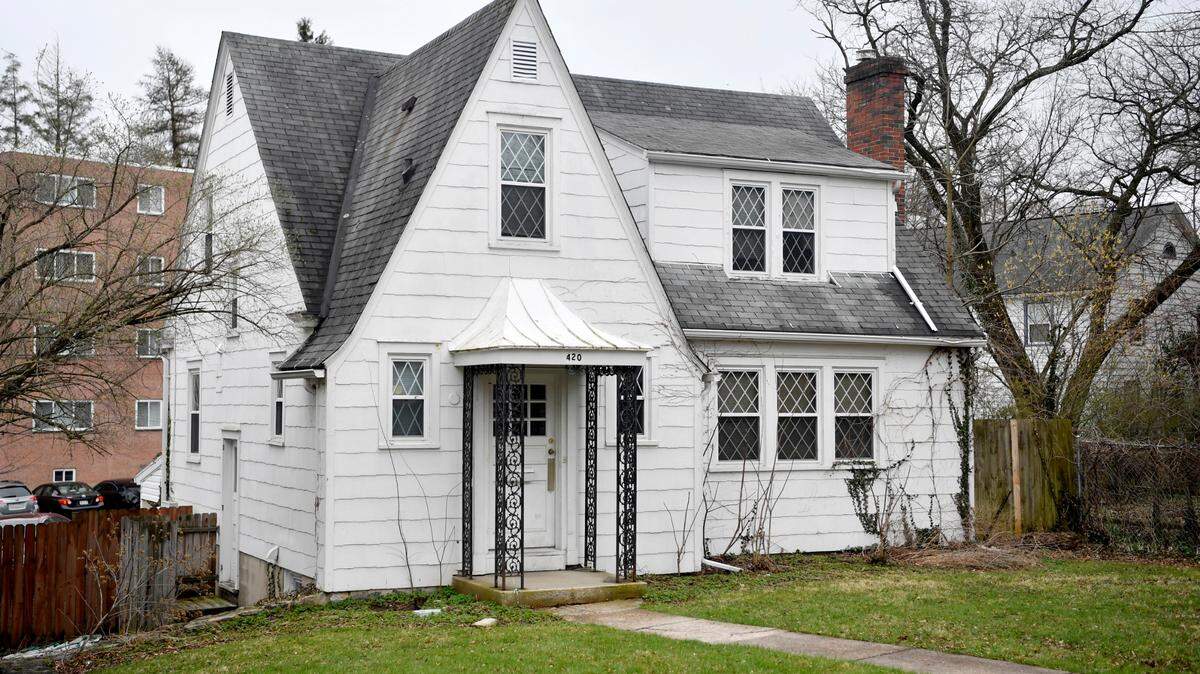
A real-estate company seeking to demolish a 1938 Sears “Lynnhaven” home in a State College historic district received a formal denial Monday night — but the battle over the house could still be far from over.
Burkentine Properties, together with sister company Penn State Ventures, purchased a home in the Holmes-Foster/Highlands Historical District for $300,000 in October 2020. Citing “unreasonable” economic hardship, Burkentine now wants to demolish the home at 420 E. Foster Ave. and rebuild — but, because such homes are protected within the historic districts, demolition is only permitted in “extraordinary circumstances.”
Borough Council voted 5-1 Monday night to reject calls for demolition. But Burkentine doesn’t appear ready to concede, as it previously wrote to the borough that any denial “will constitute unlawful taking, as it will prevent the Applicant from seeing an adequate return.” Burkentine can appeal to the courts or resubmit an application with more favorable evidence; it did not immediately respond to the CDT when asked about its next move.
Eric Boeldt, chair of the borough’s Historical Architectural Review Board (HARB), addressed council briefly Monday night.
“If the applicant considers this to be an insufficient return on investment, then the property owners made a bad business decision,” said Boeldt, who opposed the demolition. “And that’s not the fault of the borough or the citizens or the people that like historic districts.”
Burkentine, which rented out the home to students through the spring, believed it is suffering “unreasonable economic hardship” — in part because it weathered about a $5,000 net loss during a 14-month period and because three recent estimates put renovation costs between $715,000 and $750,000. But both the HARB and borough staff cast doubt on both assertions.
For one, they said, that net loss included a misleading one-time $12,000 cost for landscaping. In future years, without the landscaping, that means there would be a $7,000 profit. As far as cost of renovations, officials also believed many of the estimates included work that was unnecessary.
Removing the asbestos siding, for example, is not required if the siding remains in good condition. And in a March 1 letter, the HARB noted that regular Centre Region Code Administration inspections have found only minor or moderate issues, such as needing to replace smoke-alarm batteries, fixing cracked glazing on the front door and repairing deteriorated garage joists.
“Frankly, I think if we don’t go along with the HARB Board on this, we’re kind of abandoning the meaning of a HARB altogether,” Council President Jesse Barlow said, referring to HARB’s unanimous recommendation that council deny the demolition. “This is a clear case — frankly, to me — of a demolition we shouldn’t be allowing.”
Both the HARB and two historic districts were created in late 2017, in a move sparked after a homeowner sought to demolish one of the Sears houses in the College Heights neighborhood. At that meeting 5 years ago, former Councilman David Brown supported its creation — seemingly for cases similar to this. He said at the time he wanted to prevent realtors, developers and speculators from buying up the historic homes only to tear them down or turn them into rentals.
Current Council member Deanna Behring said Monday the timing of HARB’s creation is exactly why she intended to vote against demolition.
“The critical point to me is that the purchase of this house was on 10/15/20, 2 years after HARB was endorsed,” she said. “So the purchasers purchased this property with full awareness of the HARB and its restrictions and guidelines. So that’s the key point to me in my deliberation.”
The HARB wrote to council that, based upon its training with the Pennsylvania Historic Preservation Office, demolition is only an option when there is an immediate danger to public health and welfare (due to a structural deficiency, for example) or when the return on investment is economically unfeasible (like after a catastrophic fire or roof collapse, for example).
Councilman Peter Marshall was the lone dissenting vote. With three February estimates, he felt Burkentine presented enough evidence to show demolition made more sense than renovation.
“I think it’s gone too far, personally,” he said. “I think they have shown where this house is a mess and trying to fix it up is going to cost significantly more than tearing it down and building a new one.”
It was not immediately clear how Burkentine planned to proceed.
Holmes-Foster/Highlands contains 727 contributing buildings to the historic district, while College Heights boasts another 278 buildings. Both neighborhoods are on the National Register of Historic Places, as they reflect a number of popular architectural styles in the early 20th century.