
‘Conscience of the community.’ Local church marks centennial through service and progress
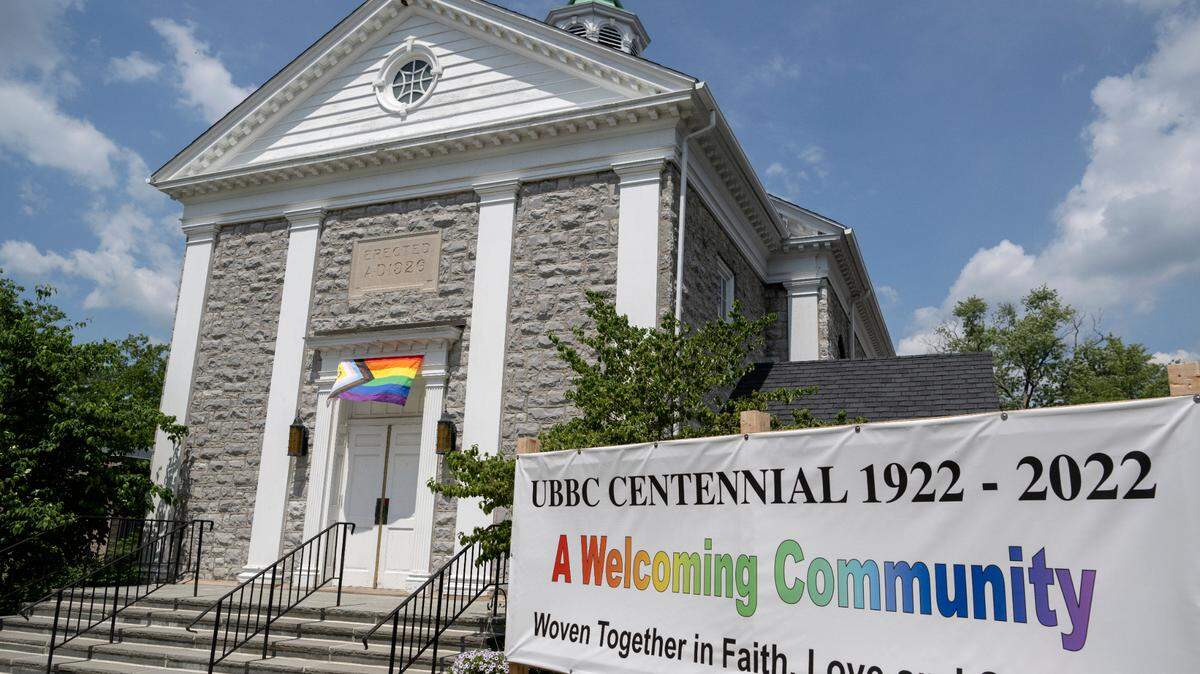
When Pastor Bonnie Kline Smeltzer arrived at State College’s University Baptist & Brethren Church in 2002, she was met with a congregation searching for answers after losing its institutional backing. Two decades later, parishioners from all walks of life are celebrating a landmark milestone and reflecting on the church’s commitments to service and progress.
The University Baptist & Brethren Church, located at 411 S. Burrowes St., is celebrating its 100th anniversary this year. Parish officials like Kline Smeltzer say continued commitments to core values have helped the church take root in the community since 1922.
“I think it’s really exciting to see how the origins of the church — wanting to be a home away from home for students, extending hospitality — has just woven through the years. I call it the DNA of this congregation,” said Kline Smeltzer, who will retire this summer. “It’s true over the last hundred years, and it remains true today.”
The UBBC’s centennial theme, “A Welcoming Community Woven Together in Faith, Love and Service,” aims to encompass what makes the church special, parishioners say. Centennial committee leader Ellen Nagy says the most significant aspect is the church’s knack for welcoming others and promoting acceptance.
“The people at this church greet you with open arms. You establish relationships with people,” said Nagy, who’s been a part of the UBBC community for more than two decades. “There are many wonderful churches, but you choose the one that makes you feel most comfortable. Everybody says, ‘Oh, this is like a family.’ Well, this really is a family. The warmth of the people … it felt very, very comfortable. That’s why I joined all those years ago.”
Acceptance prompts ‘spiritual deepening’
With one look at the UBBC’s welcome statement, it’s clear that the church has a more progressive outlook than some of its more conservative contemporaries. The creed explicitly welcomes worshipers of all ages, demographics and sexual orientations, as well as religious backgrounds.
Kline Smeltzer says the UBBC often appeals to community members thanks to its departures from more traditional structures.
“We have more former Catholics, Episcopalians, Methodists and Lutherans than we have either Baptists or Brethren,” she said. “I think they come because the core values of Baptists and Brethren are very attractive, but they don’t need names.”
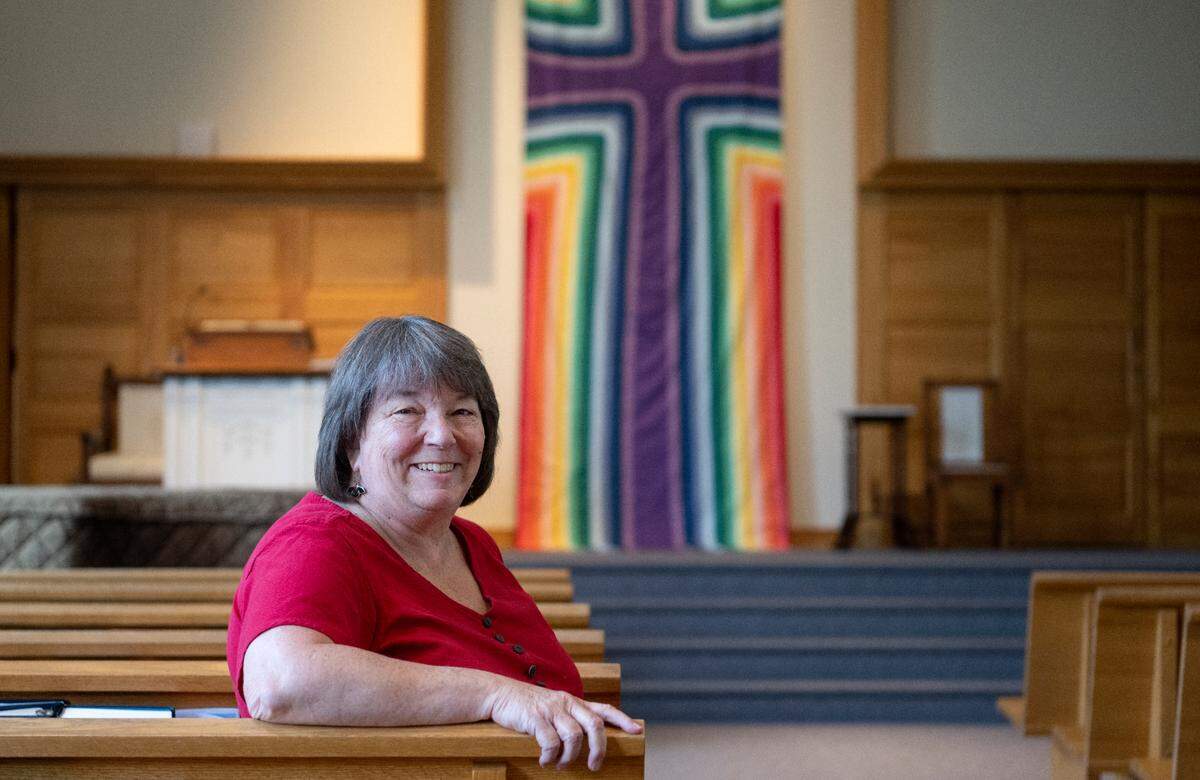
As any longtime UBBC member might tell you, acceptance has not always been well received by the church’s supervising organizations. In 1999, the Centre Association of American Baptist Churches “disfellowshipped” the church for accepting homosexuality, effectively disowning and shunning the UBBC. The move prompted church leaders to seek out a new institutional home, eventually winding up with the more accepting Philadelphia Association of American Baptists.
Through his service on a select committee, parishioner Neill Johnson helped guide the UBBC through that tumultuous period in the late 1990s. He said the church was surprised by the drastic steps its former supporting chapter took to reprimand it.
“As independent as we felt, we still were pretty hurt about being thrown out by the local Baptist association,” said Johnson, who first joined the UBBC as a Penn State graduate student. “They had to vote to change their constitution because it wasn’t even possible to take such drastic steps.”
Once those ties were cut, the UBBC began discussions with other supervising organizations. Johnson said those efforts helped the church expand its views of acceptance and reaffirm its stance on welcoming the LGBTQ+ community.
“We’ve learned a lot about ‘our welcome’ in much broader terms than welcoming gays and lesbians,” Johnson said. “That was especially important at the time because there weren’t many mainline churches in town that welcomed those crowds and recognized union ceremonies. We were going to do it anyway, but getting thrown out was pretty difficult.”
Now two decades later, the UBBC has amended its welcome statement to also accept the transgender community and new developments in gender expression and identity. Parishioners view that message as an ever-changing document that should reflect current times and social issues.
“The UBBC doesn’t rest on, ‘Oh, we were ahead of our time 30 or 40 years ago. We don’t need to worry about it anymore,’” said parishioner Erica Frankenberg, a Penn State professor. “Just in the time I’ve been here, we’ve expanded our welcome statement to include gender expression and identity. We’re pushed to think about other ways we can lean into welcoming and inclusivity. It’s especially important in a college town where populations are always changing.”
Although Kline Smeltzer became the UBBC’s pastor shortly after its transition between fellowships, she knew the process was difficult for the church’s parishioners and leaders. Looking back, she views the ordeal as a significant “spiritual deepening.”
“When I arrived in 2002, I found a congregation that was grieving the loss of their former pastor and being kicked out. It was like a mother kicking you out of your home for doing what she taught you to do, which is loving everyone,” Kline Smeltzer said. “The congregation learned that there are consequences for loving deeply, and there was a price to be paid. Fortunately, it was just an institutional price. Our congregation was stronger with a deeper resolve to stand by and welcome others.”
‘Walking the talk’ of faith
Another significant aspect of the UBBC that sets it apart from other churches, parishioners say, is its commitment to practicing faith in all aspects of life, particularly through community service and hospitality.
Kline Smeltzer said the UBBC has worked to expand its services to include all community members, including children, as more and more families join the parish.
“Today, we have a vibrant group of folks with children. Part of the reason we have families with young children is because of the values of this congregation,” she said. “We walk the talk of the Christian faith, and our welcome is wide. Families that are trying to raise children to have some kind of spiritual formation are looking for those values, and it’s clear that has continued over the 100 years. That is a real cause for celebration.”
Welcoming others calls back to the UBBC’s earliest days. In 1968, the Baptist congregation merged with a group from the Church of Brethren that was in need of a new home. Since then, the UBBC has remained aligned with both American Baptist Churches and the Church of the Brethren.
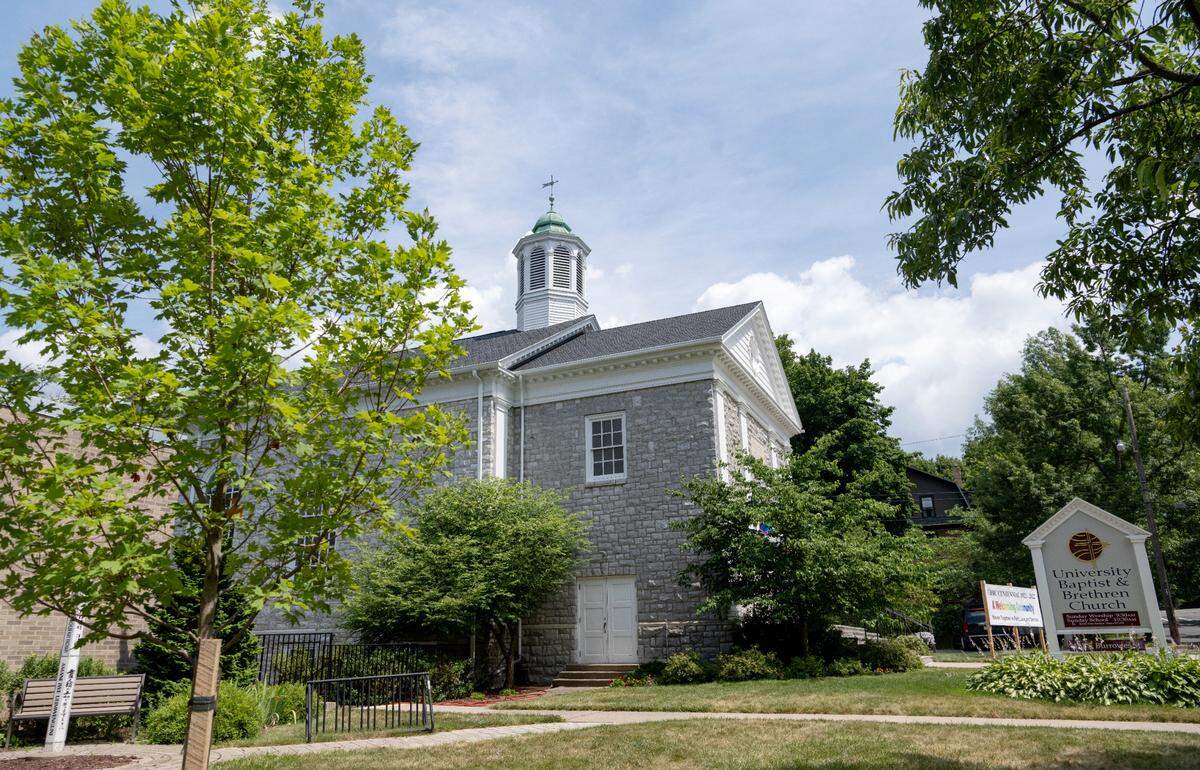
Just a few years later, the UBBC was also among the first local churches to bring in refugees. The parish welcomed Vietnamese refugees fleeing the Vietnam War, including sponsored students who would study in the area and at Penn State. Since then, the UBBC has collaborated with other organizations to resettle refugees from across the globe, including Myanmar, Cuba, Romania, Russia and Afghanistan.
The church’s wide acceptance of refugees prompted Carolyn Bellanti, a retired speech therapist, to join in 1975. She said global conflicts in the 1970s compelled her to volunteer and become more active within the community.
“I feel like we stand on some very big shoulders here,” Bellanti said. “The church has a long history of being the ‘conscience of the community.’ I think that’s a fair statement to say.”
Carolyn’s first date with her husband, John, came during a church fundraising activity. They’re just a few of many UBBC parishioners who commit to community service through a handful of initiatives, including drives for the State College Food Bank and support for charities like CentrePeace, which a parishioner founded.
Additionally, the UBBC lends one of its nearby properties to Centre Safe, which provides housing to local survivors of domestic abuse.
Reflecting on his decades with the church, John Bellanti says the parishioners’ active practice of their faith helps the UBBC make a difference in its community.
“Back 40-some years, we had a wonderful minister. In one of his sermons, he said something that would sound kind of blasphemous to some people,” he said. “He said, ‘Theology is about as important to God as ornithology is to birds.’ I think he was saying that it is the practice of our faith — living it, not just teaching it — that is a cornerstone of our church.”
The next 100 years
So far, the UBBC has hosted a handful of events this summer to recognize its centennial celebration, including a ceremonial tree dedication. The church is currently planning an end-of-summer picnic for early September and a “centennial celebration music event” in November.
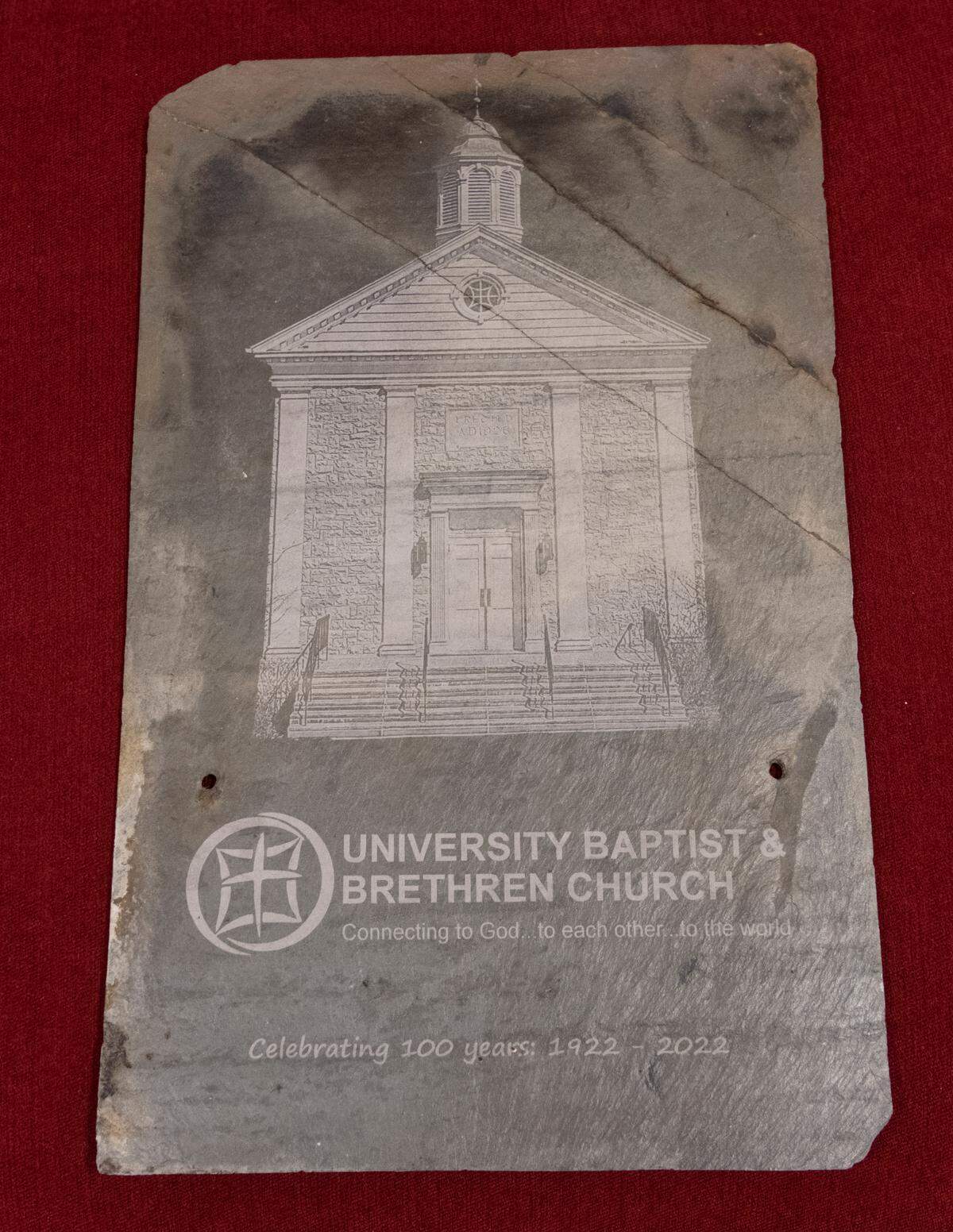
Additionally, through a unique fundraiser, the UBBC is selling its original 100-year-old roof tiles, now engraved with an image of the church and its logo. Proceeds from the sale will benefit the building’s maintenance fund.
While UBBC parishioners have spent hours planning the church’s centennial celebration, the congregation’s leaders know that the milestone is just the beginning. Organizers say that observing and understanding the UBBC’s history can help steer the church in the right direction across the next 100 years.
“It’s a party, but it’s also a meaningful experience,” said Ellen Nagy, who led the centennial committee. “How can we use what we know about the church in the past to inspire and focus on how we can help? I see that happening every day. It’s been a mix of fun, but also some deep thinking.”
As Kline Smeltzer prepares to retire at the end of July, the church is focused on lining up its next full-time pastor. Beyond then, the UBBC hopes to continue serving its community and further adapt to meet whatever challenges come its way.
“The centennial gains more meaning by not just focusing on the past,” Nagy said. “It is, gradually, becoming an inspiration by saying, ‘Where do we want to go?’”
%202.JPG)