What to expect from State College’s multi-year Calder Way Project, set to start Monday
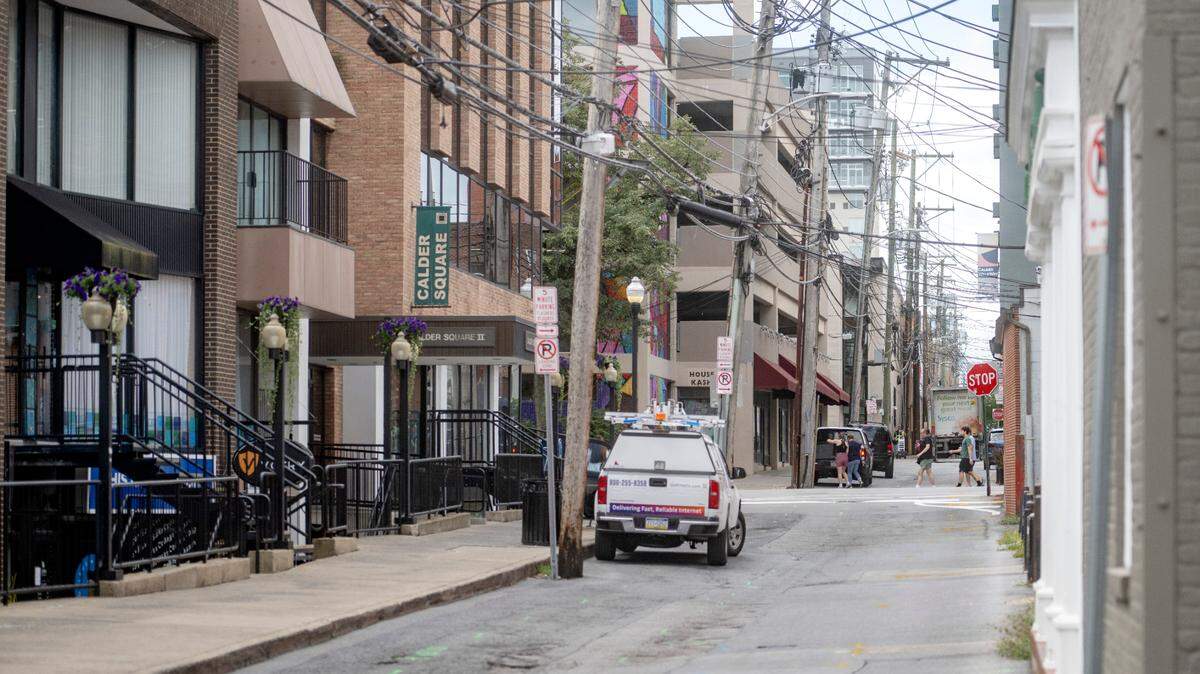
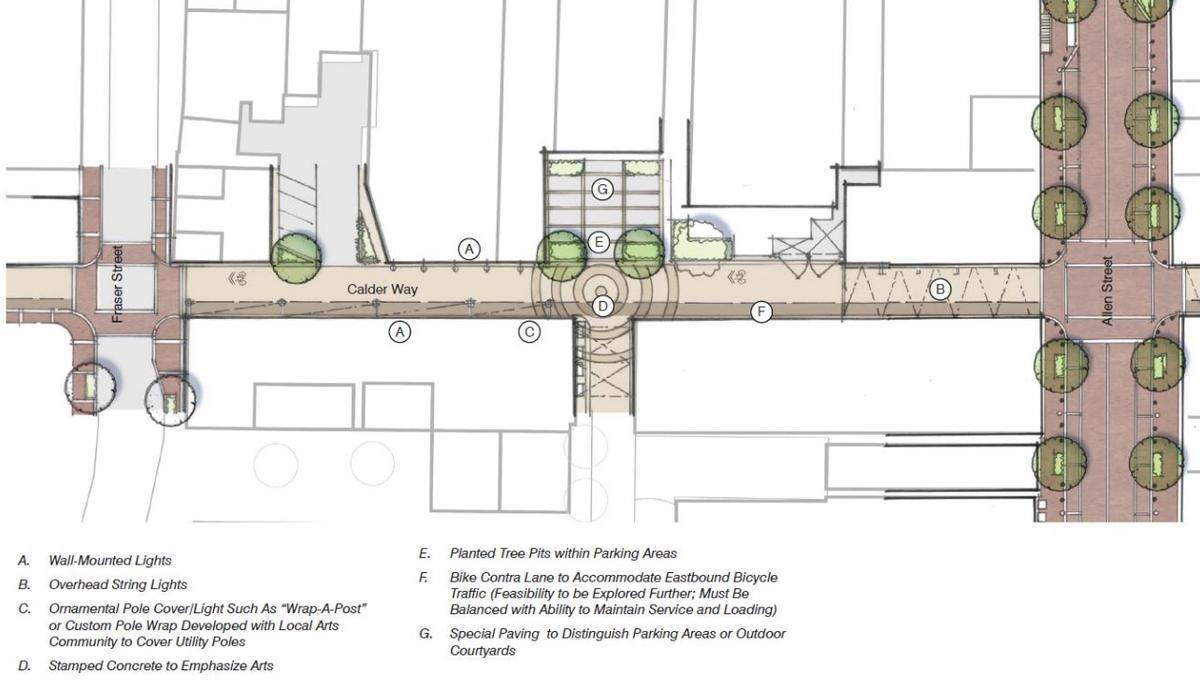
Imagine bicycling in a dedicated lane — or maybe walking on a wide shared path — in downtown State College’s Calder Way as dusk settles in. Crisscrossed string lights sparkle overhead while planted tree pits and mounted lights add to the ambiance.
Utility poles are wrapped in ornamental covers, some concrete is stamped with designs to celebrate the arts scene, and an outdoor courtyard can be found not far from the Allen Street intersection.
If everything goes according to plan, borough visitors and residents can expect that kind of scene in the heart of the downtown corridor when the more than $6.5 million Calder Way Project is finished, sometime after the final phase starts in 2027. But first, about a decade after that vision was initially publicly discussed, comes the hard part.
Starting Monday, the five-phase project will officially begin when construction crews arrive on scene between McAllister and South Fraser streets. They’ll first be tasked with upgrading and replacing utilities and infrastructure piecemeal throughout Calder Way, a long process that Council Member Deanna Behring described in June as “very disruptive” and as a “necessary evil.”
There will be noise. There will be traffic changes. There will be inconveniences. But, borough officials added, it’ll be worth it when the project is finished, with Calder Way refurbished and redone from High Street to Atherton Street. (In the end, vehicles will still have access for emergencies, essential services and parking — but the changes are designed to be friendlier to cyclists and pedestrians.)
“We’re working to make that inconvenience as bearable as possible,” said Elton Hayes, who’s serving as the borough’s Calder Way public relations official. “It’s going to be something that will not only benefit the businesses, but also visitors and residents to downtown State College.”
Project overview
Longtime borough spokesperson Doug Shontz, who still remembers the first meetings on this project, couldn’t quite say what came first — the desire to transform Calder Way into a safer haven for cyclists and pedestrians, or the need to replace aging utilities and infrastructure.
But, whatever the initial reason, officials believe it made sense for both objectives to be part of the same project.
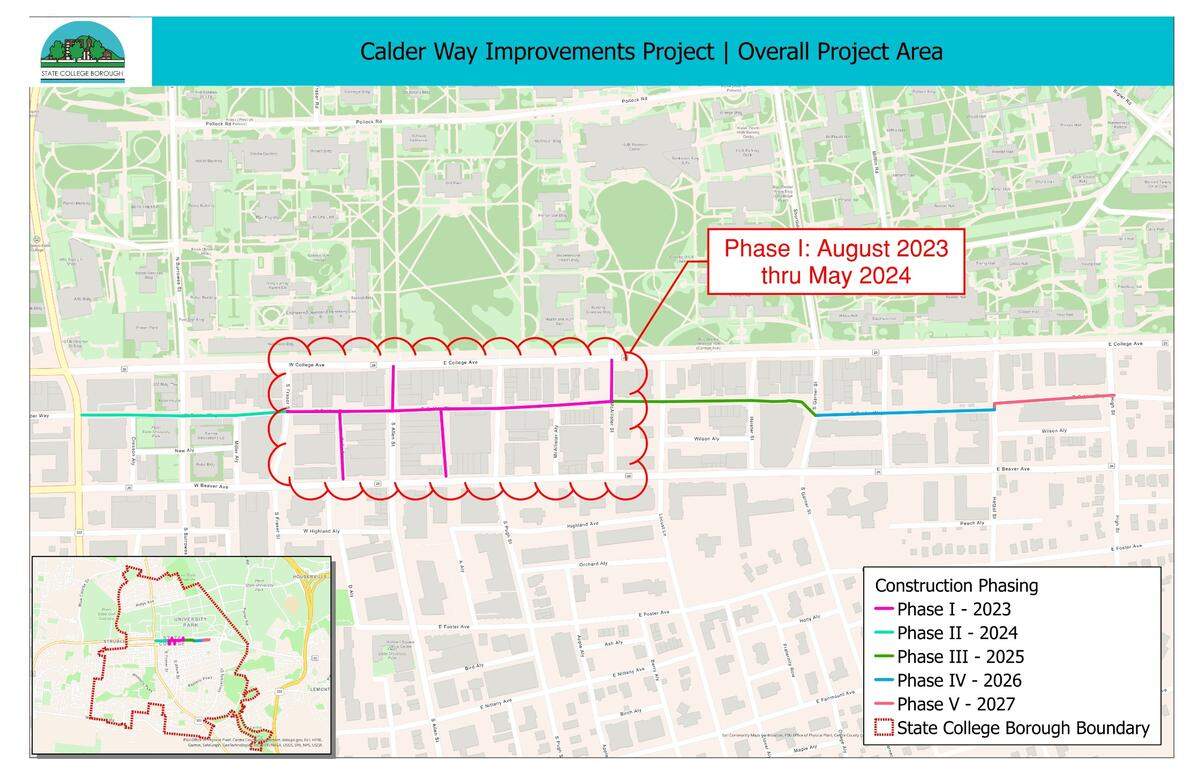
Every year through 2027, a new stretch of Calder Way — along with some nearby connected streets — will undergo construction and utility work. Near the project’s end, once utilities and infrastructure have been fully replaced on Calder Way, crews will install a bike lane for eastbound traffic, along with many of the streetscape improvements that defined the initial vision.
Phase 1, which starts Monday, will focus on Calder Way from McAllister Street to South Fraser Street. Phase 2 in 2024 will extend, on Calder Way, from South Fraser Street to Atherton Street. Phase 3 is McAllister Street to South Garner Street; Phase 4 will extend from South Garner to Hetzel Street; and Phase 5 in 2027 will go from Hetzel to High Street.
The total cost of the project is expected to eclipse $6.5 million, but the borough will not be responsible for the full cost. Utility companies will pay for their costs, and state/federal grants will cover other expenses. Because of those variables, an accurate estimate for the borough’s contribution was not immediately known.
What to know for Monday
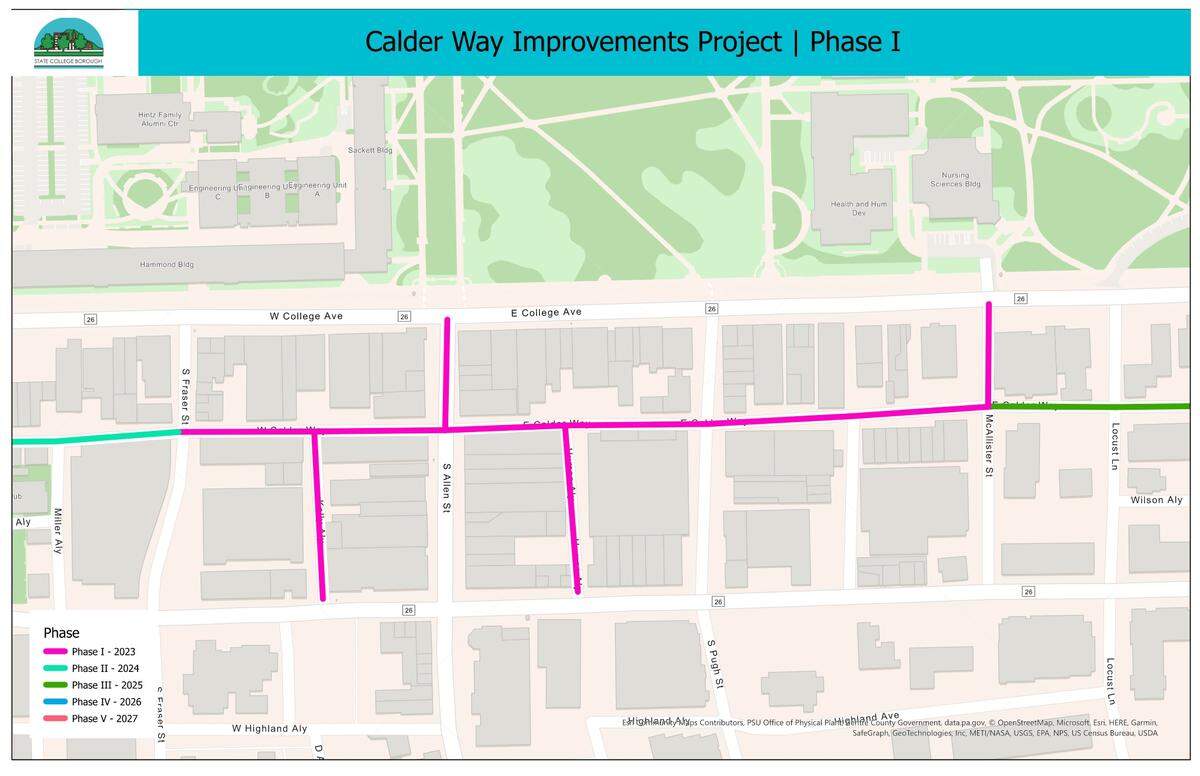
The first phase of the Calder Way Project, between McAllister and South Fraser streets, will kick off Monday — but, unfortunately, the construction and noise will only get worse a few weeks after that.
On Monday, crews will start the “exploratory excavation stage,” meaning they’ll confirm where existing utilities are beneath the road. Two-person traffic control should manage some localized disruptions.
But, starting Sept. 18, the real work begins — a week after the borough intends to post construction signage and message boards as a heads-up. Construction crews will begin installing a new water main and service connections on three streets emanating from Calder Way — Kelly Alley, Humes Alley (from Calder to East Beaver Avenue) and McAllister Street (from Calder to East College Avenue).
Other work planned for Phase 1 involves sanitary sewer, stormwater piping and gas mains, along with upgrading infrastructure like telecommunications and electrical utilities. By the full project’s end, the hope is for all utilities to be underground.
Construction is restricted to between 7 a.m. and 7 p.m. Monday through Saturday, and between 9 a.m. and 7 p.m. Sunday. There will be a number of no-work days to relieve some of the more heavily trafficked times, such as Friday-Sunday during all Penn State home football games and the borough’s First Fridays. (Other dates include, but are not limited to, Aug. 31 for the LION Bash, Sept. 4 for Labor Day and Oct. 31 for Halloween.)
Phase 1 will be put on hold during winter, likely sometime in November, before resuming once it warms up — at another time to be determined — and wrapping up around May 2024. Many times and details remain tentative due to all the project’s moving parts; construction was initially supposed to start in mid-July before supply-chain issues delayed the start.
Interruptions, business impact
Businesses in and around the construction areas will bear the brunt of the impact but, in an effort to minimize that, the borough hand-delivered letters about the project to more than 100 downtown businesses. Borough officials have also held discussions with the Downtown State College Improvement District (DSCID), a nonprofit that helps support the business community.
Communication and planning have been integral so far, officials said. Businesses whose employees typically park in private areas accessed from Calder Way will receive access cards to the Pugh and Fraser Street garages. And businesses expecting deliveries will see borough officials and construction crews coordinating to ensure certain sections might be left open at certain times, signified by orange cones.
“It’s going to be a give-and-take with everyone involved, but we’re invested on working collaboratively so the impact is minimal,” Shontz said. “And we’re going to give them enough heads-up so they can communicate what the impacts are to their patrons, as well.”
No businesses are expected to temporarily close during the project, but some will have to deal with the noise and inconvenience of construction. According to Lee Anne Jeffries, executive director of the DSCID, part of the plan is to embrace those challenges with humor — such as local bars and restaurants potentially offering “Hard Hat Happy Hours” or featured cocktails during construction season.
“Our message to the community is downtown is open for business and will continue to serve you throughout the process and into the future,” Jeffries said, adding the DSCID hopes to share updated project information with businesses “on a daily basis.”
Future updates on the project will be shared by the State College Borough at statecollegepa.us/engage. Events and business announcements from the DSCID can also be found at downtownstatecollege.com.