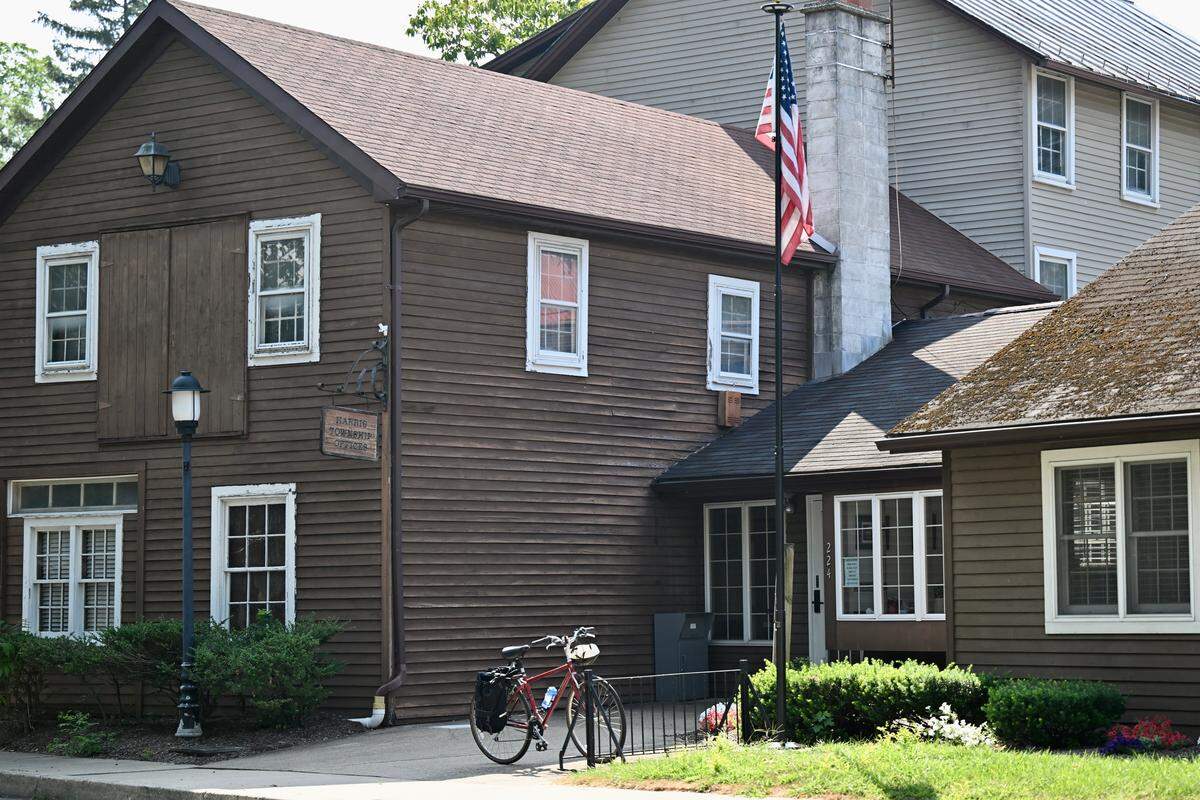
Harris Township implements new short-term rental ordinance. What to know
AI-generated summary reviewed by our newsroom.
- Harris Township adopted an STR ordinance requiring annual licenses, fees.
- Ordinance mandates owner-occupancy, parking per bedroom, 120-night cap.
- Applicants must submit drawings, proofs, $50 fee; township will process and notify.
The Harris Township supervisors unanimously approved an ordinance at their meeting Monday that puts into place a set of rules for the operation of short-term rentals (STRs) like Airbnbs and Vrbos.
Discussions on STR regulations started in April, when complaints were submitted to the township about empty homes in residential neighborhoods that had been turned into rentals, loud disruptions about those staying at the rentals and more.
Before Monday, the township had no STR regulations, unlike many of its Centre Region neighbors. Supervisor Bruce Lord said the development of the regulations took “months of hard work.” It has also frustrated the owners of many of the township’s roughly 50 STRs along the way.
One resident who had threatened legal action against a previous version of the ordinance shared a message of understanding at Monday’s meeting.
“This has been challenging for both sides, and I certainly appreciate that the board is doing their job to try to protect the citizens, and also understand that there’s an obligation to people who want to rent their homes, whether that be short-term or long-term,” said Eric Hurvitz, a real estate agent who owns an STR property in Harris Township.
“I understand that these conversations have been somewhat polarized, with each [party] having their own idea of what’s fair and equitable, but I also think we have a lot in common. I think we all think Harris Township is a great place, and we want Boalsburg to stay a special place. I think we all think that this ordinance is really important.”
What are the short-term rental rules in Harris Township?
Those looking to start an STR in the township must first obtain a non-transferrable STR license from the municipality, valid for one calendar year. Once the calendar year is up, STR owners must submit a license renewal application.
A scaled drawing of the property illustrating off-street parking spaces, floor plans, name and contact information for the person in charge, evidence to demonstrate that the property is owner-occupied, proof of registration for hotel tax, proof of a rental housing permit from the Centre Region Code Administration (CRCA) and a $50 fee must be included in every initial and renewal application.
All new STRs must be owner-occupied unless specified otherwise. Any STR property that was not owner-occupied and contained an actively used rental in the 60 days leading up to the ordinance’s approval would be exempt from the owner-occupancy requirement.
That non-owner-occupied exemption will cease in the future though if the property becomes owner-occupied, if it’s no longer utilized as an STR or if it no longer has a valid STR license.
A separate exemption to the owner-occupancy requirement will be provided for “temporary absence due to special circumstances,” like academic sabbaticals, military deployment, temporary work relocation, medical treatment or other circumstances. The exemption will not exceed 12 months, unless extended by the township for “a good cause.”
The ordinance also mandates that a maximum of two dwelling units per property could be utilized as an STR, that one off-street parking space be provided for each bedroom within an STR, that all occupants of the STR must park their vehicles within the designated spots and that the maximum occupancy of an STR be designated by the CRCA.
A 120-night yearly limit on the amount of total overnight stays an STR is allowed to host and a limit of 29 overnight stays in a row is also included, although some STR owners still believe that those numbers should be lengthened.
“[The limits] might preclude people from finding housing on a mid-term basis,” resident and STR owner Shawn Houtz said during Monday’s meeting. “It’s happened to me, where people have lost their homes and have needed interim housing — it’s very difficult to go find a place you can go and stay for a few months and not have to secure a long-term lease. ... I think Airbnb is the best way you can go and do that.”
Hurvitz agreed, noting that putting a 120-night limit on pre-existing, non-owner-occupied STRs would only lead to more empty houses in neighborhoods each year.
“I’m having a hard time understanding who it benefits to ensure that [the STRs] are vacant,” said Hurvitz, who encouraged the supervisors to work with STR owners to revise the ordinance in the future. “That compromise, I will call it, would go a long way toward bringing parties together.”
Currently, Harris Township’s 120-night limit is higher than some limits included in other Centre Region municipality’s STR regulations.
State College Borough also has a 120-night cap, but Bellefonte Borough has a 60-night cap, College Township offers a 45-night cap and neither Ferguson nor Patton townships have a cap. Halfmoon Township is the only Centre Region municipality with no STR regulations.
Moving forward, Township Manager Mark Boekel announced that because the ordinance is new, it would take some time for the township to process all new STR applications, and that township staff would maintain communications with those who apply so that the process can be made “as easy as possible.”
The township will reach out to STR owners to notify them of the new regulations, he said.
Those looking to apply for an STR in the township can do so by visiting the township’s STR-designated webpage, which contains the rental application, the full STR ordinance and more.