State College can’t use eminent domain for Addison Court, borough officials say. Here’s why
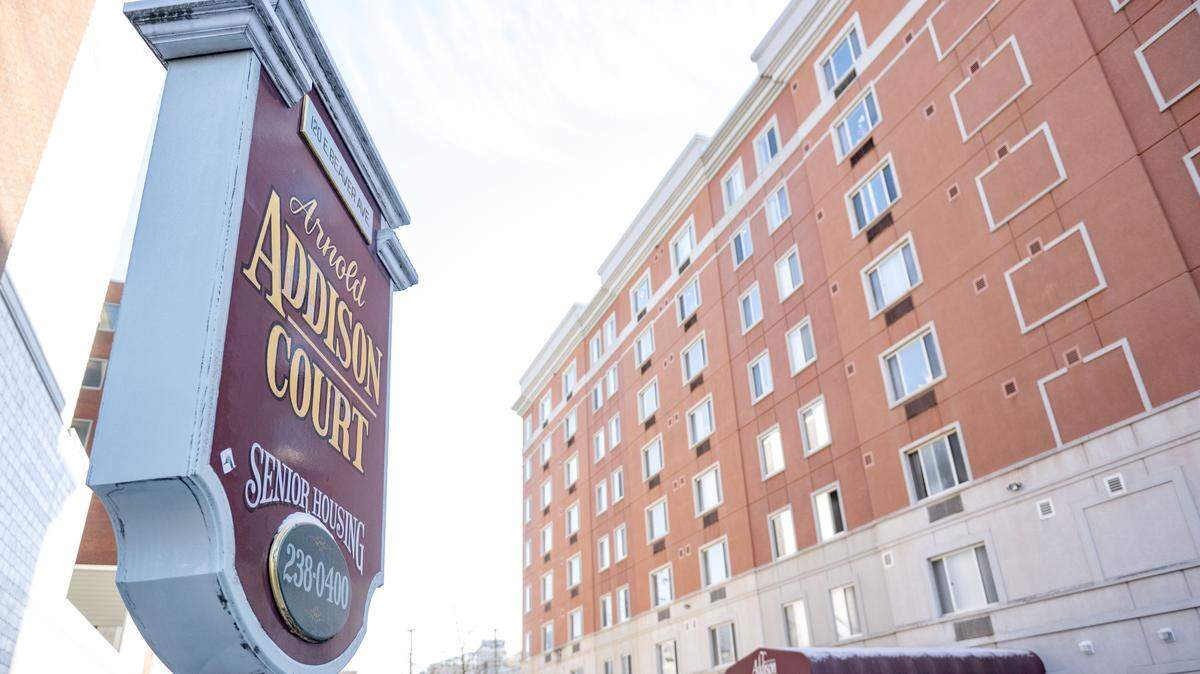
The idea of using eminent domain to “save” Addison Court, a low-incoming housing development in downtown State College under threat of being redeveloped by new owners, has been floated in recent months but is likely not an option, borough officials said.
Late last year, residents at Addison Court were notified that their leases would end in 2026 because the property was under consideration to be sold. Shortly after, the borough received preliminary land development plans for the redevelopment of the site at 120 E. Beaver Ave. The timeline has been extended a bit; in February, the owners sent an updated letter stating they should know by May if the building will be sold, and per Pennsylvania Housing Finance Agency regulations, those who were residents as of Dec. 31, 2024 may not be displaced, evicted or have their lease terminated prior to December 31, 2027 without cause.
But in the meantime, people have wondered if the borough could use eminent domain — the right of a government to take private property for public use (with compensation) — to keep Addison Court as affordable housing. The idea was pitched by former council member Josh Portney before he resigned earlier this year.
“We have to literally look at every option and, I’ve said this before, and I know it’s really uncomfortable for us, but we’ve done eminent domain before. We’ve done eminent domain for parking. Parking is a priority for us. We did it just down the street on a parcel, and I know that this is very controversial,” Portney said. “And this might be the most extreme thing that I’m proposing — and I proposed a lot of extreme things in my tenure — but we have to look at every option.”
He requested the borough add the discussion about the legal and relocation options they have related to Addison Court to a future agenda. But during a phone interview earlier this month, borough leadership said eminent domain isn’t a legal option here.
Terry Williams, the borough’s solicitor, said in terms of the eminent domain code, he doesn’t think it’s possible for State College to utilize eminent domain to acquire the building solely for the purpose of elderly housing.
“Pennsylvania has what’s called the Property Rights Protection Act, which is a 2006 act that made it clear that municipal entities, … they have to have express enabling legislation in order to utilize the power of eminent domain,” Williams said. “So for example, if the borough were condemning that site to build a parking garage, parking facilities are mentioned as an express proper use for the power of eminent domain, but elderly housing projects are not.”
That type of project is authorized by the housing authority law, Williams said, but the housing authority is a county authority, not the borough’s.
“Under amendments to the housing authorities act, boroughs are not authorized to have housing authorities. There are some because there were some created prior to that limitation in the act,” he said.
Borough looking at other options for Addison Court residents
Borough Manager Tom Fountaine said the council has made it clear that they consider it a priority for borough leadership and staff to address the issues with Addison Court, and they’ll continue to work on it. But in terms of exercising eminent domain to acquire the building, that’s not a legal option for the borough to undertake, he said.
At this point, he said they’ve already talked with many residents who may be impacted, and would continue to work with them on relocation assistance if the project goes forward.
“Other options are probably a little less clear right now, and we’re continuing to evaluate what opportunities we might have here to do something differently and see what can occur, and we’ll continue to work on that,” Fountaine said.
Williams said there is a distinction between using the power of eminent domain to acquire private property and a municipality using funds for the support of elderly and low-income housing projects. The borough is authorized to use money to support such projects, and State College does operate that type of housing facility, Bellaire Court Apartment Complex.
“So, we have done that, and certainly that’s something that we would continue to evaluate here to determine what we can do with the Addison Court project specifically,” Fountaine said.
How other municipalities have tackled similar situations
Because Addison Court is a privately owned property, the borough can’t tell the owners what they can and can’t do with it. Although the borough worked to support and provided a loan for the housing that expired after 30 years — which is typical time limit — the project is now out of the borough’s hands. Since the affordability requirements of the Low-Income Housing Tax Credit program expired in December 2024, future developments on the site are not required to be used for low-income or senior housing.
Nearby municipalities like Patton, Ferguson and College townships recently banded together to financially back efforts to save 49 affordable housing units in a Ferguson Township neighborhood. Patton Township Supervisors approved the Centre County Housing and Land Trust to reallocate $25,000 in American Rescue Plan Act funds toward efforts that would preserve Sylvan View Estates’ affordable housing status, which it shed on Dec. 31, 2024.
Ferguson dedicated $50,000 and College dedicated $150,000 in workforce housing funds toward the initiative.
Similar to Addison Court, Sylvan View Estates was built in the 1990s through the Low-Income Housing Tax Credit program, which mandated that the homes be income- and rent-restricted based on the median area income for 30 years. Since that also expired in 2024, the partnership that owns the development is looking to sell, CCHLT Executive Director Missy Schoonover said in January.
The townships’ contribution will allow a private developer to purchase and renovate the property using funds from the Pennsylvania Housing Finance Agency PHFA, Patton Township Manager Amy Farkas previously said. They would then turn the property back over to the CCHLT, which would preserve the development’s affordable housing status for another 99 years.
Fountaine said the Centre County Land Trust and the State College Land Trust are two separate entities, and, at this point, the borough doesn’t have enough information to be able to say if something like that would be an option in the case of Addison Court. The SCLT is contained to the borough, as opposed to one working with various regional entities.
“That’s certainly a potential approach that we would evaluate,” Fountaine said.