
Justice still sought for slaying victims decades after death
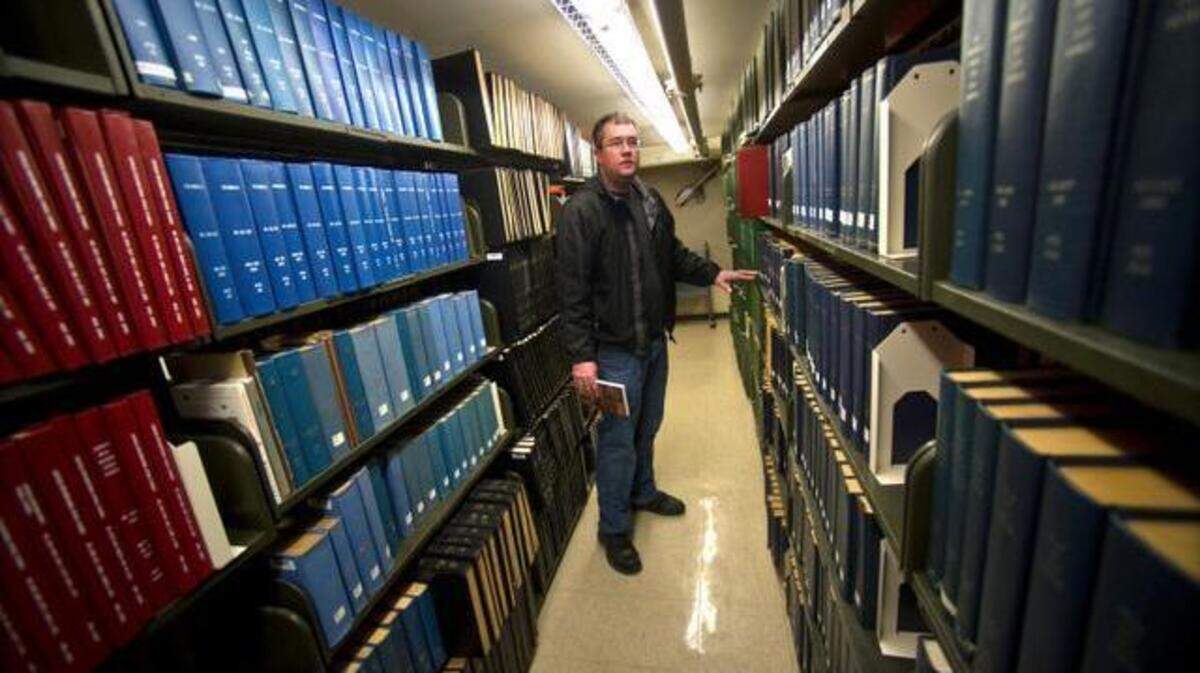
Ask students outside Penn State’s Pattee Library if they know who Betsy Aardsma is, and you get a few nods, a few people who think the name sounds familiar — but more crinkled brows and head shakes.
Ask about the murder in the stacks, and that’s different.
Most seem to have heard some version of the story of the Holland, Mich., graduate student who died in the library in 1969. But almost 45 years later, it has become practically an urban legend. Almost everyone who knows about it thinks it happened in a slightly different place.
Author Derek Sherwood can show them exactly.
“This is the aisle, down at the end there,” he says, standing in what was Level 2 on the November night, Thanksgiving break, when Aardsma was stabbed between two rows of shelves of books about Europe.
There is no plaque memorializing the spot where the 22-year-old woman who loved literature and dreamed of the Peace Corps was killed. Sherwood says the floors of the library were even renumbered, with Level 2 becoming Stacks BA on the official Penn State map.
B for Basement, A for the kind of half-floor between B and 1 that packs in more books, not the initials of the victim, he says.
Sherwood started the website www.whokilledbetsy.org, then later wrote the book “Who Killed Betsy?” to try to work through the mysteries surrounding the case. He isn’t the only one fascinated by it. A Penn State filmmaker, Tommy Davis, has made a film, “ Betsy.”
The murder came at a time before Penn State had a police department, when campus security called in state police, who have handled the case ever since. Today, it is the responsibility of Trooper David Clemens, who handles all of the unsolved cases for Troop G.
Sherwood’s book puts forth Richard Haefner, a geologist who was a grad student at Penn State at the time, as the possible suspect. Haefner died in 2002, but the case has still not been closed. Centre County District Attorney Stacy Parks Miller referred to the case in a recent press conference on another issue, saying that a likely suspect was deceased.
Clemens says positively identifying the culprit, even a deceased one, is still important in a cold case.
“Families deserve to know,” he said.
The Baileys in Philipsburg still only know that they lost their 21-year-old daughter Dana, also a Penn State student, when she was stabbed in her off-campus apartment on Allen Street during spring break in March 1987.
The case has been in the hands of State College police for 27 years as District Judge Tom Jordan, then a detective in the borough, and now Sgt. Ralph Ralston have followed the timeline that ended with Bailey’s death.
Freedom of Information Act requests for autopsy reports and other data over the years have been turned down due to the open nature of the investigation. After the 1990 murders of five college students in Gainesville, Fla., local officials were in contact with police there about possible similarities. That case was solved when Danny Rolling was indicted in 1991. He later confessed and was executed in 2006.
Ralston had been familiar with the case from its first days, when he was on patrol, but spent lots of time reviewing the notes, the reports and the evidence when he inherited the case from Jordan. He wanted to know everyone and everything he could, to make sense of what was there and ask new questions in new ways.
A lot of work since then has involved taking advantage of new technology, something that can make a big difference in cold cases. When initial DNA work was done with evidence, the science was relatively new. Work was done by a private lab, and little lab work was done for years after that.
Over the past 10 years, however, Ralston said, that changing science has prompted more review.
He has resubmitted samples to be tested for short-term repeating DNA, then Y-chromosome STR, mitochondrial and even the touch DNA that can pick up genetic material from the least contact.
The investigation has gone beyond the lab, however. It actually has gone as far as Colorado, where Ralston has followed bread crumbs, meeting with people to interview, to exclude or to gain samples for more lab tests. One such interview was even scheduled for Friday.
The freedom to have a senior investigator like Ralston devote that kind of time to the case is one reason he says State College has kept the investigation in-house while some smaller municipal departments might turn the files over to state police.
There seems to be more to it, however.
Ralston is protective of Bailey and her family. He wants to minimize the pain the open wound gives them. He holds out hope of seeing the case through to the end.
“There is only one person that knows what happened,” he said. “Hopefully someday I’ll have the opportunity to interview that person and find out.”
Does he think that will happen?
“I would like to think so. I would hate for it to go unsolved,” Ralston said. “I would like to believe that before my career is over, there will be a significant break.”
But Ralston is just two years from retirement.
For some cases, they go on so long that few remember the names — the way Aardsma has become for some “the girl in the stacks.” Go longer and the murder itself gets lost to time.
Even those who deal with cold cases every day were hard-pressed to place the name of Rachel Taylor.
It has been 74 years since the Penn State freshman, just 17 years old, was killed in Lemont over Easter break. Her skull was broken, her body found in the driveway of Lemont Elementary School by a janitor.
No arrests have been made. The case is still considered open.
The three unsolved murders share so many details: young women, students at Penn State planning for futures that would never come. They all died during midsemester breaks. Aardsma even lived in the same dormitory Taylor had lived in.
“We always hope for resolution. There is always a need for people, families in particular, to know what had happened and to be able to find peace or a sense of closure,” Penn State spokeswoman Jill Shockey said.
Until then, the investigations continue.
This story was originally published August 10, 2014 at 10:31 PM with the headline "Justice still sought for slaying victims decades after death."