
SCASD’s Delta unveils new logo, branding as it transitions to separate school
AI-generated summary reviewed by our newsroom.
- SCASD's Delta Program unveiled new logos as it transitions into a separate school.
- Delta plans to pursue federal magnet school designation to improve awareness.
- New Delta branding emphasizes core values of community, democracy and choice.
As the State College Area School District’s Delta Program transitions to a separate school, committee members and community volunteers are working to increase its branding and visibility.
Branding for the Delta Program — which will split into a middle and high school starting in the 2025-26 academic year — took a major step forward this summer when it received a new wordmark and pair of logos following a months-long development process. Officials guiding Delta’s transition also hope to increase the soon-to-be schools’ visibility by pursuing magnet school designation through the U.S. Department of Education, which could help it better attract students and support more diverse educational offerings.
Here’s a look at the latest updates as State College’s Delta Program, a democratically run alternative schooling program since 1974, prepares to finally transition into its own schools.
‘Mind-expanding’ branding
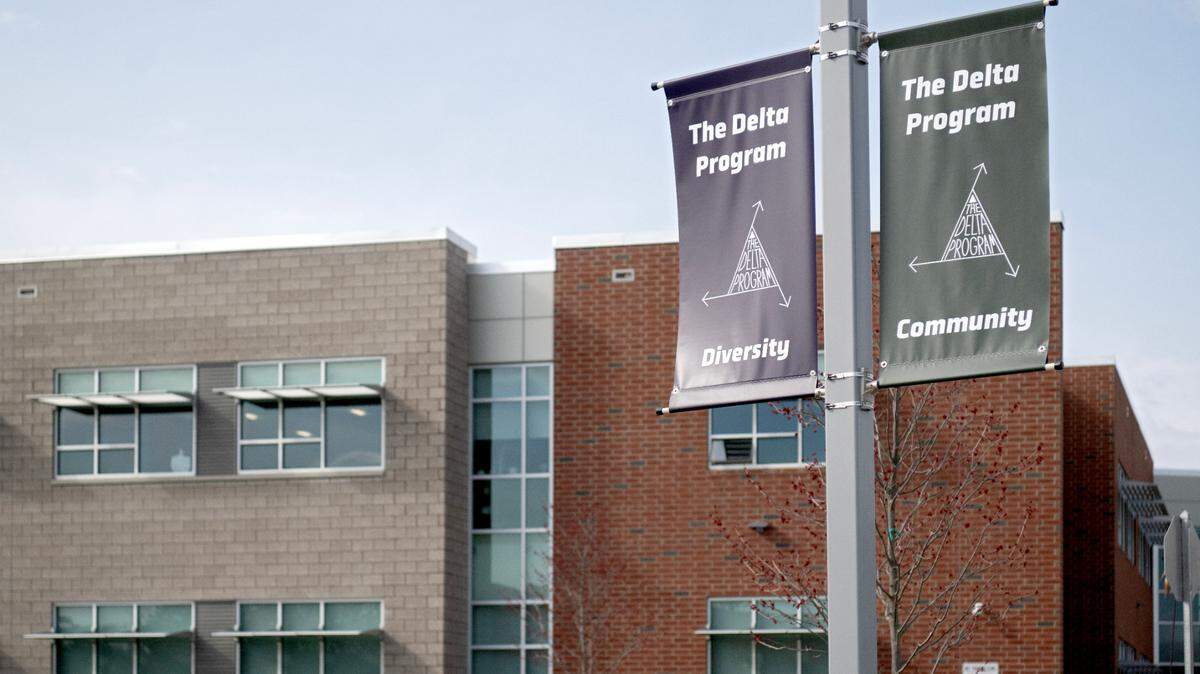
Delta’s new logo prominently features an optical illusion and three of the alternative schooling program’s core elements: community, democracy and choice.
The famous shape, known as a Penrose triangle, cannot exist in three dimensions but can be expressed mathematically in five dimensions, said designer Peter Aeschbacher, an associate professor of architecture and landscape architecture at Penn State. He said the shape, which may be recognizable to those familiar with M.C. Escher’s artwork or the film “Inception,” ultimately represents the Delta Program.
“It felt like this, with the three — community, democracy and choice — elements of Delta, was a perfect metaphor for our community,” Aeschbacher said at Monday’s school board meeting. “That it’s only through this magical combination with all those things coming together that it reads as this element.”
During board discussion on Monday, school board member Carline Crevecoeur somewhat jokingly wondered if the logo’s appearance as an optical illusion could give community members the impression that Delta itself is an illusion. Board member Jesse Barlow, who was sworn in earlier in the meeting, said he would prefer to call the logo “mind-expanding.”
“I think the emphasis might be not on the illusion part, but on the fact that it’s magical when all of these elements come together,” said Aeschbacher, who is a Delta parent.
Delta will use both a formal and an informal logo when it debuts as a separate school. The former would commonly appear on school signage, letters and paperwork, while the latter would typically see use on apparel, car magnets and more.
Earlier this year, a dedicated branding subcommittee worked with students, faculty, staff and families to ask focus questions, workshop proposals and learn what core elements should appear in the new branding for the program. The subcommittee eventually received several designs that were put up for rounds of voting to select a winning concept.
“The whole entire process, we tried to keep in mind that this was something representing our community, so our community’s voice and needs and vision had to be well represented throughout,” said Kristen “Dot” Burnett, a Delta teacher and branding subcommittee member.
Aeschbacher said the final design is a “perfect metaphor” for Delta.
“It was a design that came together really quickly, the concept of it,” Aeschbacher said. “The fine-tuning really comes in with the typography, making sure there’s balance. It was a really well-written design brief that laid out very clearly the conditions they were looking for — something that matched Delta both for its middle school and high school.”
Becoming a magnet school
As Delta transitions into its own middle and high schools, program officials are working to pursue federal designation as a magnet school.
The U.S. Department of Education defines a magnet school as “a public elementary school, public secondary school, public elementary education center or public secondary education center that offers a special curriculum capable of attracting substantial numbers of students of different racial backgrounds.” Delta officials say they’re working to better understand magnet designation, the processes behind achieving designation and how Delta’s “characteristics and philosophy align with those of a federally recognized magnet school.” With no state-level magnet school designation available in Pennsylvania, Delta officials are examining designation on the federal level.
Delta’s newly formed magnet school subcommittee has proposed a magnet theme centered on “modeling, participating in and teaching democracy,” Delta teacher Leah Mueller said during a board presentation Monday. The theme reflects Delta’s existing model as a “democratic school of choice” for the past 51 years, she said.
“We thought this transition from a program to a school would be a really good opportunity to become a magnet school because we’re already operating as a magnet school in many ways and because we are a school of choice within the public school district,” Mueller said.
“We also thought this transition would allow us to provide that essential school of choice that would be open to all grade-eligible students, to retain our current enrollment procedure of a random lottery system, common for many magnet schools, to solidify Delta’s current practices to present the differences in our structure and curriculum and to provide transparency and consistency to the community concerning who we are and what we do,” Mueller continued.
Unlike some other magnet schools, Delta would remain available to only students within the State College Area School District if it receives magnet designation. The program still has an active waiting list.
Erica Frankenberg, a professor of education and demography at Penn State, said achieving magnet designation could help improve Delta’s visibility within the district and attract more students.
“What I think is important about magnet schools, regardless of whether they’re within [a school district] or also admitting out-of-district students, is that it has an active recruitment plan,” Frankenberg said before the board. “It makes sure everyone who is grade-eligible for the school knows about it. And even though there are more applicants than there are seats for right now, it means that people equitably know about it and can easily apply to it.”
Board member Peter Buck, a former Delta student, spoke in support of pursuing magnet designation for Delta. He noted the ongoing transition and potential designation as a magnet school could help improve Delta’s branding as a unique program and strengthen awareness throughout the district.
“I really think part of what I hear in this proposal … was that by codifying it, we recognize [Delta’s] specialness and the board and the district come together to say that following on the resolution we had, and following what’s happened over the last year and a half or two years, to really make it something truly permanent and durable that says this is a unique, special place, and we’re going to recognize it basically in the most concrete fashion that we can,” Buck said.
Planning and implementing magnet designation can take years, the U.S. Department of Education says, and Delta officials have not suggested an estimated timeline for the program’s pursuit just yet. The subcommittee will use the federal Magnet School Development Framework while exploring the process and will provide updates to the school board and administrators in the future.
Delta received approval in May 2024 to separate into its own middle and high school, largely to help receive more accurate state testing data that are not mixed with State College’s other middle or high schools. Delta’s programs, which feature a shared leadership model, smaller class sizes and flexible scheduling, are available once district students reach the sixth grade.
This story was originally published July 23, 2025 at 6:30 AM.
%202.JPG)