
Solar arrays at Centre County schools could be ‘a major solution,’ new report says
AI-generated summary reviewed by our newsroom.
- New research says investments in solar power for schools could reduce local energy costs.
- State College’s school district has solar arrays at five buildings, with two more coming.
- Maximized solar efforts in schools would produce huge savings and power, the study says.
A new report suggests increased investments in solar power on school grounds could help reduce energy costs in Centre County and across Pennsylvania.
The study, published this week by the PennEnvironment Research & Policy Center, estimates Centre County schools would produce significant savings if they each installed solar arrays on their rooftops. Total energy savings across the county in just the first year of maximized installation usage in such a scenario would crack $1.8 million and generate 16.8 million kilowatt-hours — enough to power 1,557 local homes.
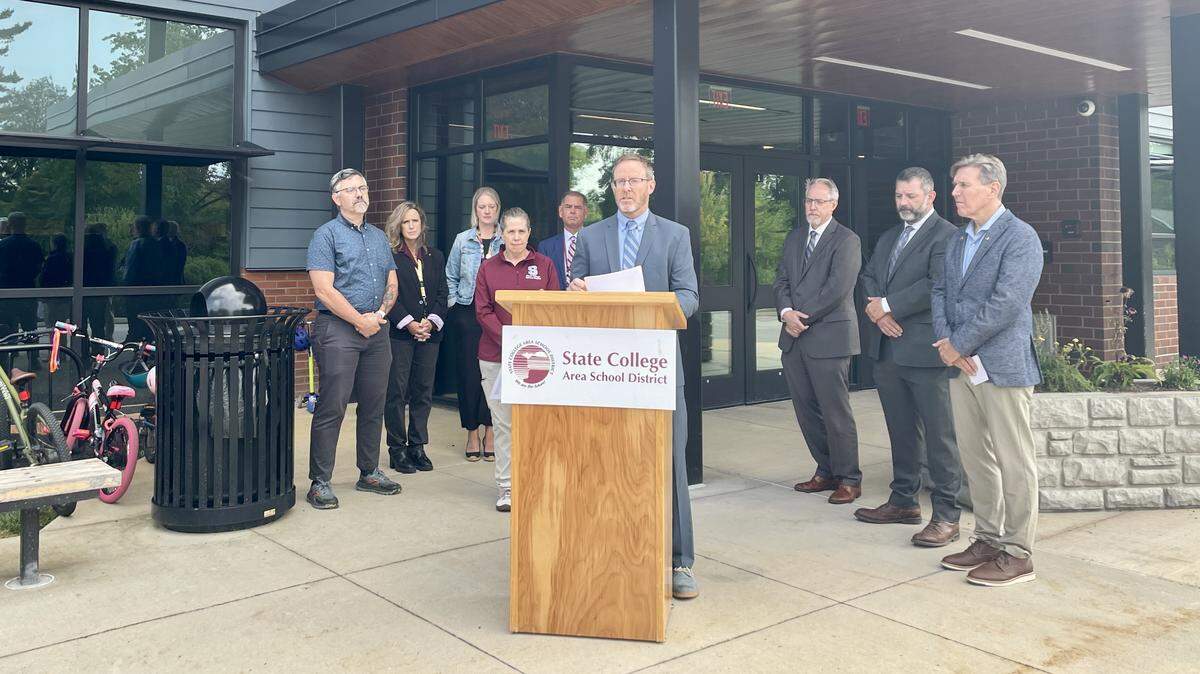
PennEnvironment leadership joined local officials outside State College’s Corl Street Elementary School on Friday morning to tout the opportunities solar arrays could provide for Centre County schools. David Masur, the executive director of the Philadelphia-based nonprofit research group, said solar-fueled schools would help reduce electricity costs and while prioritizing clean energy.
“Our findings come at a critical time when local and state officials grapple with an increase in electricity prices and strains on our electricity grid due to the expansion of [artificial intelligence], data centers and other major energy users,” Masur said. “Our school buildings can be a major solution to this challenge.”
PennEnvironment’s visit to Centre County comes as the group tours Pennsylvania this week to promote its research. Friday’s event had a fitting backdrop, as five State College Area School District schools and facilities are already equipped with solar arrays.
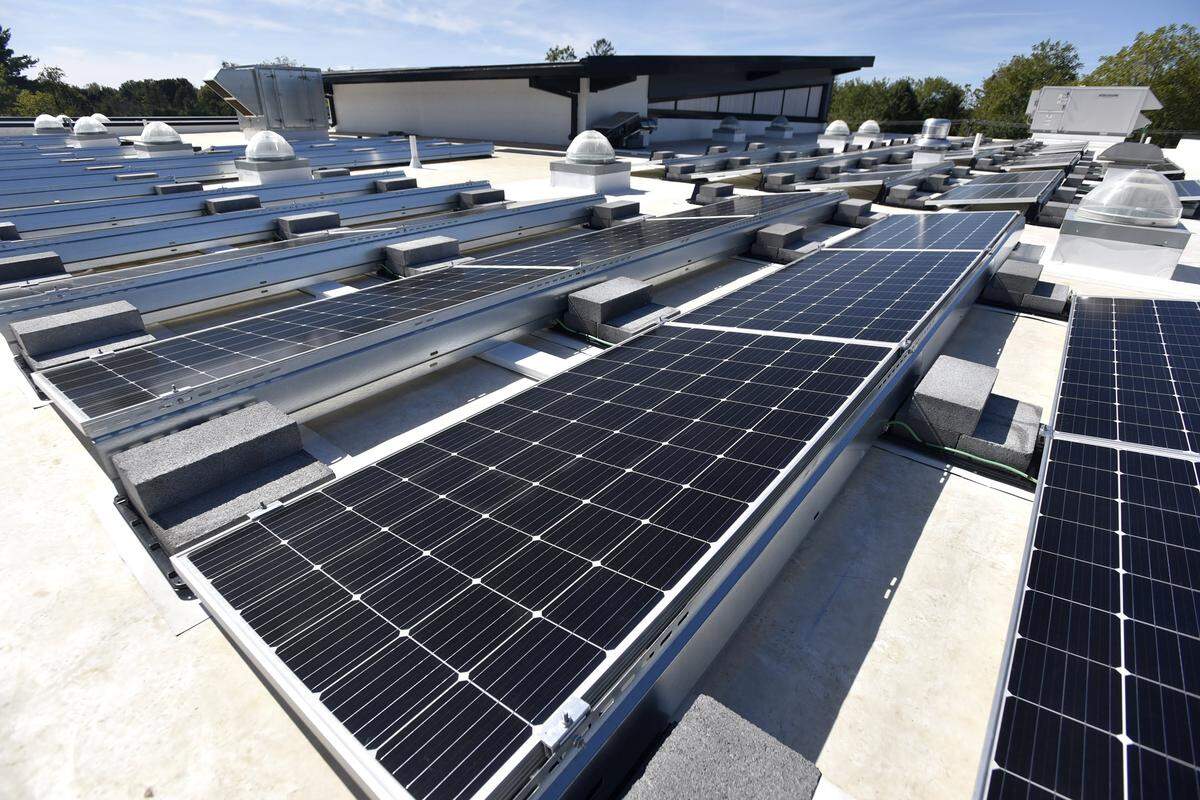
State College’s district took major steps to invest in clean energy when it equipped three elementary schools — Corl Street, Radio Park and Spring Creek — with solar arrays during construction and renovation projects completed in 2019. The three projects received a combined $245,500 in grant funding from Pennsylvania’s Solar Energy Program to help complete the arrays, which were estimated to provide between roughly 10% and 15% of each building’s total electricity.
The district’s Physical Plant and Facilities Building and the North Building of its high school campus are also equipped with rooftop solar arrays.
State College’s district was also the first entity to sign on for a solar power purchase agreement between 10 governmental entities in Centre County. With contracts finalized, the 15-year agreement is expected to construct a solar array in Clarion County by fall 2026.
New grants boost solar investments
A new grant program, aptly titled Solar for Schools, aims to directly help Pennsylvania schools construct solar arrays and reduce energy costs.
State College’s district received a $300,000 grant through the Solar for Schools program to help fund a 630 kW array at the new Park Forest Middle School planned for construction off of Valley Vista Drive in Patton Township. A separate $99,288 grant will help fund a solar array installed as part of the ongoing expansion efforts at Mount Nittany Elementary School.
“These grants were integral to our use of solar arrays in these new projects,” said Amy Bader, the district’s school board president. “The benefits of adding solar to our rooftops have been clear, both financially and in achieving our sustainability goals. We hope other districts will explore this opportunity and that they encourage their legislators to robustly fund this program.”
State Rep. Paul Takac, D-College Township, spoke in favor of continued investments in solar energy for Pennsylvania schools.
“Solar for Schools is a wise investment, and it’s a responsible use of taxpayer dollars. This saves local taxpayers money while also benefiting the environment,” Takac said Friday. “All too often, this is portrayed as a false choice between one or the other. But despite the political rhetoric and, frankly, misinformation that’s coming from the Trump administration and, sadly, some of my colleagues in Harrisburg, solar is one of the most cost-effective means of generating renewable energy.”
PennEnvironment’s study recommends local, state and federal officials make it easier for schools to “go solar” by funding grant programs and restoring federal incentives for renewable energy programs, which were slashed by the One Big Beautiful Bill Act enacted by Congress.
Some other Centre County school districts have installed solar arrays on their rooftops, too. Back in 2011, the Bald Eagle Area School District implemented solar panels at its junior-senior high school and Wingate Elementary School, while the Bellefonte Area School District constructed solar arrays at its Pleasant Gap and Marion-Walker elementary schools and high school.
About PennEnvironment’s research
PennEnvironment’s research team analyzed the potential electricity production, financial savings and emissions reductions by calculating the rooftop areas of suitable Pennsylvania school buildings, estimating their potential solar outputs and determining how many “typical” homes they could power. Some portions of the study used county-specific formulas to determine how exactly sunlight would strike solar arrays or how produced power could translate to savings for local taxpayers.
Researchers identified school rooftops as ideal sites for solar energy because they are often flat and unshaded, usually sit near open spaces and serve as important centers within their communities. PennEnvironment’s study found that Pre-K through 12th-grade educational buildings in Pennsylvania present a combined total of nearly 2,000 football fields’ worth of rooftop space suitable for solar arrays.
If the commonwealth’s roughly 5,000 schools each installed solar arrays and used them to their full potential, they could produce power equal to roughly 187,000 homes each year. Maximized solar installations would also reduce carbon dioxide pollution and save about $342 million over the lifetime of the arrays, the report claims.
PennEnvironment’s full report, “Solar Schools for Pennsylvania: Repowering Education with Clean Energy,” is available to read online.
%202.JPG)