
'Year of action:' Here's what Penn State was like in 1968
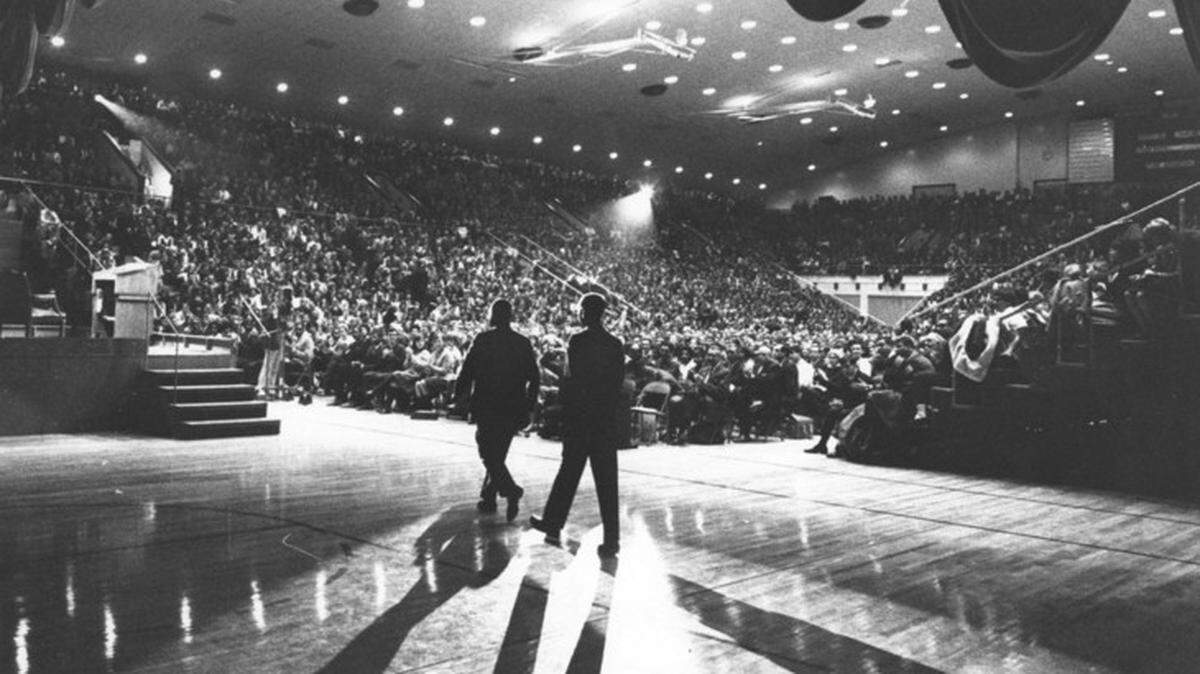
It was a home game during the undefeated 1968 football season, but game day gridlock wasn’t the reason a bus was stuck at then-Penn State president Eric Walker’s house.
Walker was hosting a visit from the U.S. Army Chief of Staff William Westmoreland, and the bus was supposed to take Westmoreland from Walker’s house to Beaver Stadium, to watch the Penn State-Army game.
The visit by Westmoreland in early November had not gone over well. Across the country, Westmoreland was recognized as the face of the U.S. war efforts in Vietnam, spurring criticism from students and other protestors who were critical of him and the administration of President Lyndon Johnson.
Earlier that year in State College, a pair of former Penn State students had been convicted of desecrating an American flag. In the summer, the same students had also unfurled an anti-war sign that said “Make Love, Not War!” a popular protest slogan at the time.
Approximately 75 members of the Students for a Democratic Society surrounded the bus in protest of Westmoreland’s visit, according to an article by the Penn State Libraries. They distributed handouts that advised demonstrators, “General Westmoreland is here today. Welcome a mass murderer,” according to the Daily Collegian. Eventually, the police were called.
It was not the first protest that Penn State students enacted that year.
Some things never change
In a recent telephone interview, Paul Levine, the Daily Collegian’s editor at the time, said the atmosphere of the campus could be summed up in three words: “involvement, unrest and chaos.”
Nationwide, problems from 50 years ago still exist, from race relations to war and world tensions.
In the years since, much about Penn State has not changed: Students still go to football games, still go to class, still go to fraternity parties.
Michael Milligan, a history professor at Penn State, has researched and taught a “History of Penn State” course. Milligan said that issues in 1968 and today, like housing shortages, textbook prices and tuition, have been around much longer than a half-century.
“A lot of the same themes come back time and time again,” Milligan said.
However, there are differences. Students in 1968 had class six days a week, and women couldn’t play in the marching band. People dressed in suits for football games. There was no on-campus bookstore — a point of contention which students would protest — and certain dorms, like McElwain Hall, were for females only and had a kitchen and dining space in the basement.
Tension brewing
While the mandatory draft conscription meant that male students could be called to fight in the war, worries and anger about Vietnam was a dominant threat hanging over campus. Fear and political unrest fueled unease on campus, “no question about it,” Levine said.
Denise Demong, class of 1970, recalled taking part in activism efforts on behalf of Eugene McCarthy, who was running for president on an anti-war platform. In a telephone interview, Demong remembered that students — who wore blue jeans during the day — would “dress up” in participation with the “Get Clean for Gene” movement, then go campaigning door-to-door at night in State College and in the larger communities.
Penn State’s tumultuous year was part of the national unrest on college campuses across the country.
From New York to California, students were protesting everything from civil rights and Vietnam occupation to dorms and tuition. Protests at Columbia University shut down campus over what was called a “racist” administration plan in April, and in February, students at San Fernando Valley State College staged protests that led to the creation of an African-American studies program. New York University students protested on-campus recruiters from the Dow Chemical company.
Penn State was no exception to the tension.
“There was a lot of upheaval, both on and off campus,” Stephen Solomon, class of 1971, said. “And I think that really defined the times in which students spent their years there.”
Nearly 10,000 of Penn State’s 26,235 University Park students signed a petition, presented in March, in support of establishing an on-campus bookstore. The Undergraduate Student Government organized a three day boycott of the off-campus bookstore to demand lower textbook prices and better prices upon rental return, according to the Collegian. On May 13, African-American students confronted Penn State officials to talk about demands ranging from more “black undergraduate, graduate and professors” to an African American culture studies program, a Martin Luther King scholarship fund and more “black literature ... in English courses.”
Student life and shock
Kevin Nelson, who started at Penn State as a freshman in 1968 and lived in State College until a recent move to Florida, said not all students cared about protesting.
“There were some people who would get in picket lines and hold signs, and then some who didn’t care less,” Nelson said.
Normally, State College was a sleepy town. During that time, activities were primarily focused around campus.
If students wanted entertainment, they went downtown to the bars or stayed up late talking to their friends — or, in the case of women who wanted to stay with their boyfriends, sign out to “the New College Diner,” the one restaurant in town that was open all night. Only senior female students were allowed to stay out past the midnight curfew, and men weren’t allowed to go into the female-only dorm rooms, part of the campus culture that defined the university’s "in-loco-parentis" authority style. According to an article by the Penn State Libraries, the curfew was extended to 1 a.m. and then abolished.
Herlocher’s restaurant, advertising the lure of its air-conditioning and new menu in the Collegian, offered a cheesesteak sandwich for 85 cents and French Fries for 30 cents. Students could eat at Boot’s Dairyette, or go to G.C. Murphy’s five-and-dime store. Downtown, they could buy vinyl albums, T-shirts or novels, according to Nelson. By May 18, edging closer to the end of the spring ‘68 semester, students were using the Collegian’s classified advertisements to rid themselves of everything from a portable tape recorder, electric guitar and 1955 Jaguar.
Before the 67-68 school year ended, tragedy struck the nation. Civil rights activist Dr. Martin Luther King Jr., who had spoken at Penn State three years earlier, and presidential candidate Robert Kennedy were assassinated. Their deaths added to the emotional turmoil in Happy Valley as well.
“It was stunning, and horrible, and shocking, and shook our world,” Levine said. “It seemed like the whole fabric of our society was getting torn apart, and we didn’t know what to do.”
Making change
Over the summer, a $100 tuition increase was approved for the upcoming school year, increasing $25 per term. In total, the new tuition increase added up to $525 for in-state students completing a three-term school year and $1,200 for out-of-state students, according to the Collegian.
By September, enrollment was set to break a record high, according to the Collegian.
Almost immediately after returning to campus for the 1968-69 school year, students found themselves relegated to lounges and temporary housing, just as supplemental housing would be called upon again almost 50 years later.
Housing was “a huge issue,” on campus during the 1960s, said Milligan.
Students took to sleeping in tents at Old Main, in a makeshift camp nicknamed “Walkertown.” Participants also joined in to express discontent with the housing situation, according to the Collegian.
In October, before the occupation of the president’s driveway, the Students for a Democratic Society also protested the presence of recruiters from the Central Intelligence Agency.
In November, a vigil was held to show support for a petition requesting “increased black student enrollment.” In the 1960s, according to an article from the Penn State Libraries, there was estimated to be fewer than 200 African-American students enrolled each term.
Issues with government ties and racial tensions would continue to spill beyond 1968, however, the following semester, a new student publication, “The Water Tunnel,” protested the connection of the Garfield Thomas Water Tunnel (now the Penn State Applied Research Lab) with military efforts. Meanwhile, African-American students built a brick wall symbolizing the distance between the Penn State administration and the Douglass Association, a group on campus which aimed at better rights and stronger voices for the African-American community. During the night of the 1969 draft lottery, Demong remembers seeing young women in a range of emotions from “upset, crying (or) happy” based on if men they knew had numbers low enough to be called to leave Penn State and possibly go to war.
Demong doesn’t believe that the “incredible social upheaval” on campus would have happened without the Vietnam protests, or without the changing popular culture of the times.
After Westmoreland came to campus, Morris Shepard, an assistant professor of human development, called for Walker’s resignation in an article that made the front page of the Daily Collegian. Walker did not resign, later retiring in 1970.
For Solomon, the time stands out as a year of action. “Black Culture Classes” were added to the curriculum in October, with new courses including “Afro-American Literature in the 20th Century,” “Afro-American History” and “Development of Afro-American Religion,” among others. Some students without housing were allowed to live off campus. An on-campus bookstore was approved.
“It was certainly possible to go to your classes and do your readings and study for your exams and everything,” he said. “But so many things were happening around (the students), both in the world and on campus, that it was hard to miss them.”
A University Libraries exhibit, "1968: Student Activism at Penn State and Beyond," is open through July 31 in Pattee Library's Franklin Atrium.
This story was originally published May 16, 2018 at 11:21 AM with the headline "'Year of action:' Here's what Penn State was like in 1968."