
‘We’re in a bit of a shock.’ Penn State parking deck moves forward while residents’ concerns remain
Update: Trustees unanimously approved a resolution on Friday to expend funds for the West Campus Parking Deck.
Penn State’s Board of Trustees is set to approve almost $132 million in capital projects, including the new James Building and the controversial West Campus Parking Deck, on Friday.
The proposed $60.57 million, six-level parking deck, which was approved Thursday by the finance committee for the full board to vote on Friday, will be constructed on the existing Red A parking lot and provide 1,653 parking spaces for Penn State faculty, staff and students, said Bill Sitzabee, vice president of facilities management and planning at Penn State. The project, designed by St. Louis-based design and building company Clayco, Inc., consolidates parking on West Campus and shifts parking from other parts of campus to the deck, he said.
The plan includes two CATA bus stops and a bus turnaround, a bicycle repair shop on the ground floor, roof design for solar panels, extension of White Course Drive and expanded storm water basin to accommodate the planned West Campus College of Engineering buildings. Funds for the project, said Sitzabee, come from “financing assessment, self-supported borrowing and auxiliary and business service reserves.”
“Primarily this parking garage enables the current projects” featured in the West Campus Master Plan, he said, including planned buildings West 1 and West 2. West 2 shares a wall with the proposed parking deck, which is “critical in us getting that second project moving forward.”
Some members of the State College Coalition of Neighborhood Associations said they were initially caught by surprise that the board plans to vote on a project with major concerns in the community and whose Traffic Impact Study has not been approved by the state Department of Transportation.
A Penn State spokesperson confirmed that the board plans to vote to expend funds for the parking deck on the condition that the TIS is approved by PennDOT.
Coalition members and residents of State College neighborhoods located near the proposed parking deck previously objected to its projected impact on traffic in the area, including increased congestion, long wait times, pedestrian safety and possible elimination of current bicycle paths. Residents shot down a second proposed entry/exit point at Buckhout Road and West College Avenue, and have lingering concerns about a second proposal with only one entry/exit point at White Course Drive and North Atherton Street.
“We’re in a bit of a shock to learn that (the parking deck plan is) going to the trustees before Penn State ever got back to us as they indicated they would,” said coalition coordinator Donna Queeney.
Carrie Jackson, a member of the Holmes-Foster Neighborhood Association and the coalition, said she still feels like there are major questions about whether a single entry/exit point at White Course Drive and Atherton Street is feasible. She also said there needs to be a mechanism to evaluate the traffic impact of the parking deck on the community several years down the line.
“We need to be discussing with Penn State how are we going to implement changes in a manner that is going to minimize the impact on multiple neighborhoods and what plans to do they have in place to help mitigate negative consequences of the increased traffic,” she said.
Though members of the coalition said they understand the need for increased parking on campus, they expressed a desire for Penn State to practice more transparency with the coalition and greater community.
“We respect the fact that Penn State is absolutely critical to this community, but we would hope that Penn State also considers the community critical to their welfare,” said Queeney.
College Heights Association President Steve Mower, also a member of the coalition, said that although the coalition has discussed its concerns with Penn State representatives, he thinks “that if Penn State is genuinely committed to an ongoing productive ‘town-gown’ relationship, no vote should be taken without the benefit of the Board of Trustees hearing directly from representation from the neighborhoods.”
Coalition members and representatives from Penn State plan to meet next month for further discussion on mitigating the traffic impact of the parking deck.
The finance committee also approved the plan to rebuild the James Building at 121-123 S. Burrowes St. for a full board vote Friday. The $56.8 million project involves demolition and construction of an 85,000 square foot, six-story building on top of the existing 30,000 square foot facility.
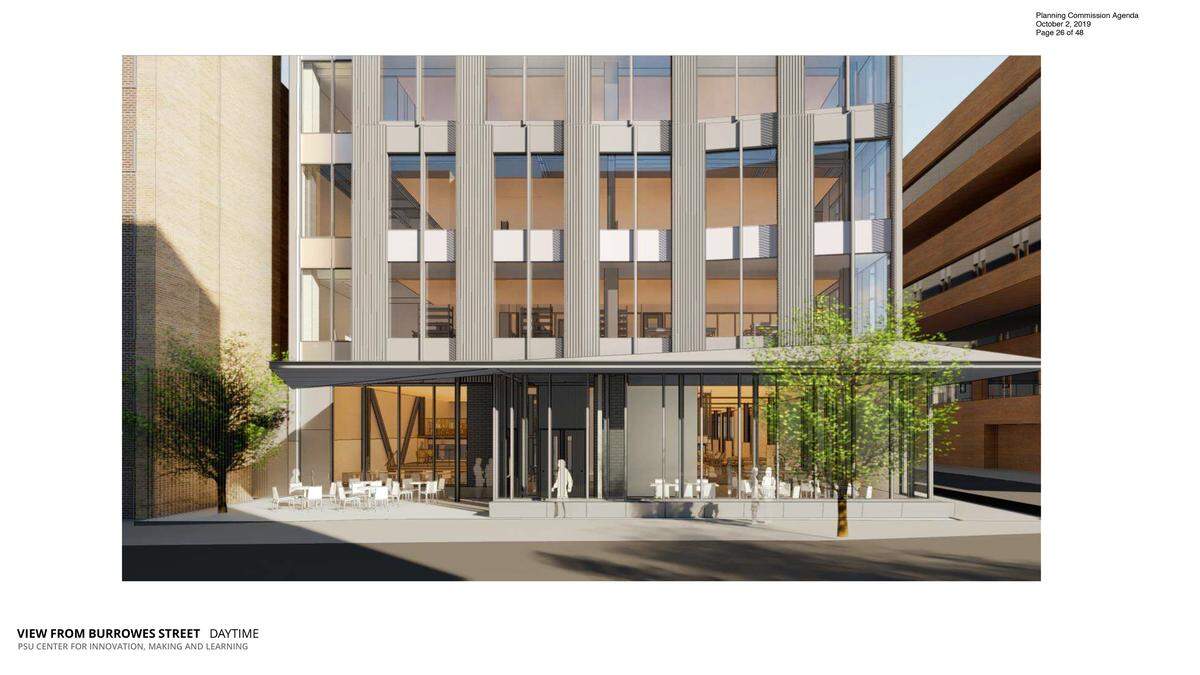
The James Building was most recently occupied by the Donald P. Bellisario College of Communications, Media Effects Research Lab and The Daily Collegian student newspaper, which have all mostly relocated to different buildings until the Willard Building construction is complete in late 2020.
Invent Penn State and Happy Valley Launchbox will relocate from their 224 S. Allen St. location to the first and second floors of the James Building, while the deans and academic support staff of the College of Earth and Mineral Science and Information Sciences and Technology will move to the fourth and fifth floors. The third and sixth floors of the building will be “shell space” with fit-out costs not included in this project, and the below-ground level will include 31 parking spaces.
The first floor will also include a new entrepreneurial hub and makerspace area, known as “Launchbox 2.0,” which will include workshops, classrooms, collaboration and lecture areas, co-working spaces, offices and an event and multipurpose space. The building exterior will be made of glass and metal, which will allow the makerspace to be visible from the sidewalk to increase connection to the community, said Sitzabee.
This story was originally published November 14, 2019 at 5:01 PM.
.jpg)