What ‘core principles’ does Anthony Fauci live by? Here’s what he said at a PSU awards ceremony
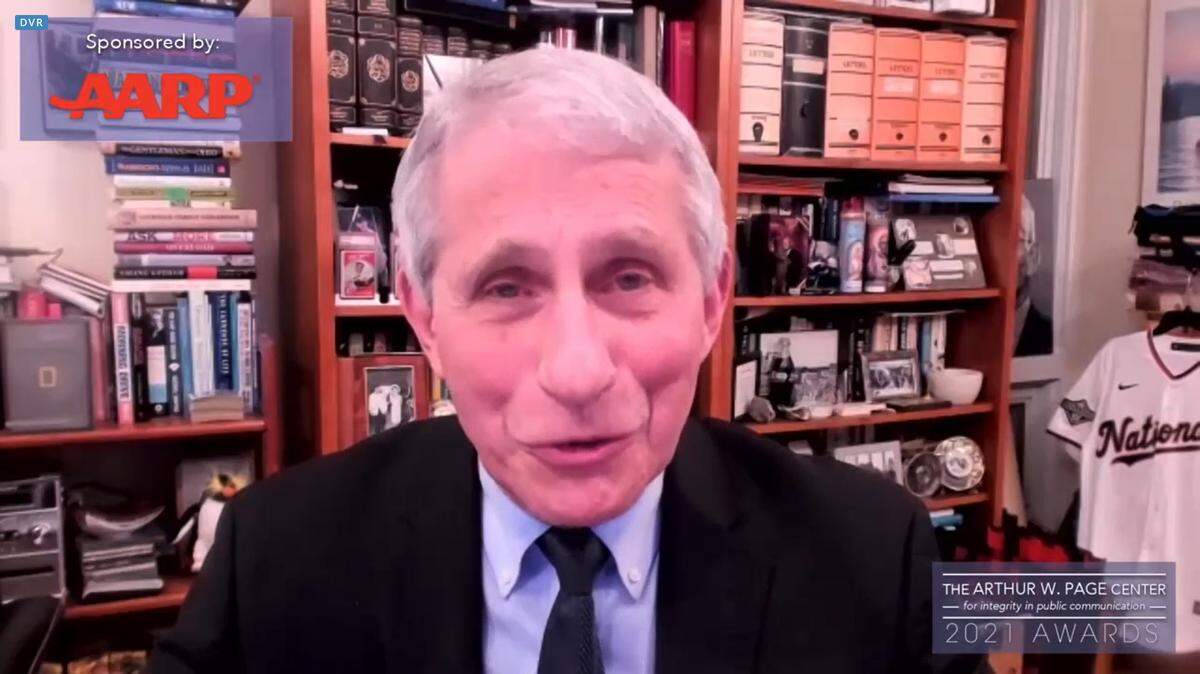
Dr. Anthony Fauci, widely regarded as one of the most trusted voices during the pandemic, told an online crowd Wednesday night about some of the principles he lives by: Never exaggerate. Never minimize — “and never, ever, be intimidated or pressured into agreeing with something that you do not believe is true.”
Fauci, America’s top infectious disease expert, was one of four honorees Wednesday to accept Penn State’s Larry Foster Award for Integrity in Public Communication, given out annually by the university’s Arthur W. Page Center. (The other honorees included Judy Woodruff, anchor and managing editor of PBS Newshour; Eugene Robinson, Washington Post columnist and editor; and Bill Heyman, CEO of Heyman Associates.)
During a brief acceptance speech — one that was watched by students at more than a dozen universities, based on an interactive chat room — Fauci emphasized the importance of honesty and integrity in public communication, especially when it comes to science.
“The public needs to hear the truth as it is, rather than as they might want it to be,” he said, sitting in front of a cluttered bookshelf and Washington Nationals jersey.
Likewise, Fauci didn’t mince words when asked by an audience member about the nation’s preparedness for the next pandemic. He opened by explaining that Johns Hopkins University had previously voted the U.S. as the best-prepared for a pandemic outbreak. “And yet, if you look at what has happened over the last year, we have suffered the most, worse than any other country in the world,” he said.
A good infrastructure, a strong science base and a global health security network can only take a country so far, he added. It also must respond in a unified way.
“And, as we have learned through painful experience now, a divisive nation does not respond very well to something that is uniformly experienced by everyone — namely that these types of infections don’t have any borders,” he said. “So individual components, individual states doing things differently, did not serve us very well.”
Fauci’s remarks mostly focused on the topic at hand, public communication. But the Chief Medical Advisor to the President still had the virtual audience buzzing with thanks and congratulations.
The 80-year-old New Yorker went into greater detail among his core principles, which offered some insight into his public approach during the COVID-19 pandemic. Among them:
- Know your audience: “I know scientific colleagues and public colleagues who speak to public audiences like they are speaking to their post-doctoral fellows or to an audience at the National Academy of Sciences. When you speak to the general public, appreciate that you are certainly speaking to a mixed audience. Do not talk down to them, nor over their head. Strike a balance of getting a clear, crisp message across so that almost everybody will get something out of it, some more than others.”
- Remember the purpose of communication is not to show how smart you are: “It is to have people understand what you’re talking about. How often have we heard audiences comment, after hearing a lecture or a press conference, say, ‘This person must be brilliant — but I did not understand anything that he or she said’?”
- Keep your message precise and brief: “Once you get that down, then you can exercise and maintain your integrity.”
He added that those listening should always answer the questions that are asked, not be afraid to say “I just do not know,” and never guess. He also said to make sure, in the absence of enough data, that you qualify any opinionated statement and do not state opinion as fact.
That mindset has helped guide Fauci to a decorated career that’s spanned more than 50 years — one that’s garnered a 2008 Presidential Medal of Freedom, among more than a dozen other prestigious honors. Former President George W. Bush even appeared during a pre-taped awards video Wednesday, praising Fauci and offering his congratulations.
Wednesday’s awards ceremony was the fifth annual event for the Page Center, and the cost to attend online was free — although donations were suggested for professors and professionals.
Located in Penn State’s Donald P. Bellisario College of Communications, the Page Center aims to “advance integrity in corporate and public communications.” It was founded by Larry Foster, a Penn State alumnus and public relations expert.
It is Fauci’s third noteworthy award already this calendar year. So far, he’s already earned the Public Welfare Medal of the National Academy of Sciences in addition to the Dan David Prize, an annual Israeli award that offers three $1 million grants for innovative research.