Meet the Penn State deans: Lee Kump talks diving, his best-ever gift — and superpowers
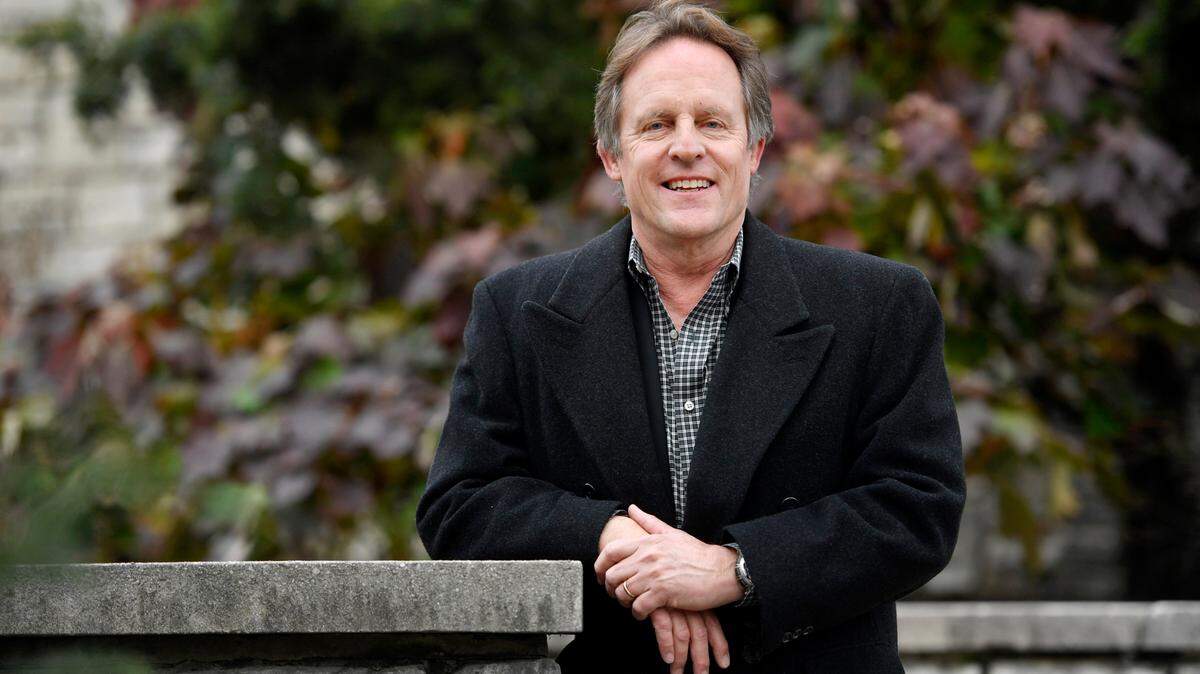
As part of a collaborative effort with Penn State, which is releasing a monthly video on school deans and their perspectives and passions, the Centre Daily Times is continuing a lighthearted Q&A series that highlights a different dean every month in the hopes the local community gets to know them outside of the classroom.
Up next: Lee Kump, Dean of Penn State’s College of Earth and Mineral Sciences.
Kump first joined Penn State in 1986, after finishing his doctorate at the University of South Florida. He worked his way up from assistant professor, becoming head of the Department of Geosciences in 2011 before becoming dean in 2017. He’s worked as an editor for several prestigious publications, such as “Science” and “Nature Scientific Reports,” won countless awards (i.e. Robert M. Garrels Award for sustained and distinguished achievements in geobiology), and is responsible for writing more than 100 articles — and plenty of books — on his chosen topics.
Personally, he’s also a fan of scuba diving.
Centre Daily Times: It’s winter in State College, so let’s use this first question to potentially bring up warmer climates. You’ve been scuba diving since you were a kid and you’ve been able to dive at some different places — so if you could pick any place in the world to go on a diving excursion, where would you go?
Lee Kump: Well, I’m a geologist and I’ve never seen the Grand Canyon — and I’m a marine scientist and a diver, and I’ve never seen the Great Barrier Reef (in Australia). And so, if there was one place I could go, it would be the Great Barrier Reef to see that amazing ecosystem while it’s still relatively healthy.
It’s the world’s largest reef ecosystem, and it’s incredibly diverse. But it’s also under stress. I didn’t have to think too much about it when you asked but, on the other hand, I always worry about the impact diving itself has on the places that we visit. ... You do it as responsibly as you can. But my urge is to get to the most healthy reefs that we can find and see those and share those with students and family. But, on the other hand, the conservationist in me says, “We need to protect those environments.” And so maybe hands-off is the best approach.
CDT: For argument’s sake, we’ll say you’ll go on your diving excursion — and then it’s hands-off. But that brings me to my next question. You’ve written and spoken a lot about climate change, and a recent study reported on by Newsweek found that 10% of Americans still don’t believe in climate change and another 15% aren’t sure. What’s one fact or stat regarding climate change that, if it doesn’t convince the naysayers, would at least act as the scariest fact for those who do accept climate change?
Kump: Drawing on my geologic training, most of my research activities have been around investigating ancient global warming events. And it’s from that perspective of seeing how the building of carbon dioxide in the atmosphere — in these cases, through natural processes like volcanic eruptions, for example — has led to global warming in the past. And we can document that, and the most severe of those events caused mass extinction. ...
What I think the scariest fact associated with that is that we’ve put a lot of effort in determining how fast carbon was being emitted during that time (of earth’s biggest mass extinction event, 50 million years before the dinosaurs during the Permian Period) so you can compare it to the current fossil-fuel burning carbon emission rates. And to the best of our ability for this event and other global-warming events, the maximum rate of carbon emissions was about one-tenth of what we’re emitting today. And so you put that into perspective, and the largest mass extinction was driven by volcanic CO2 carbon dioxide emission that was 10% of modern fossil fuel burning.
Now, it was a much longer duration. But, nevertheless, rates matter. Rates of change are what life has a hard time adjusting to. ... So that, to me, really justifies the focus of net zero carbon emissions in the next couple decades and why it’s really important.
CDT: Well, count me as even more thoroughly concerned than before. But let’s take a leap out of the classroom because the goal here is to cover a variety of topics — and not just the serious ones. So let’s go non-serious to balance this out: You’ve been at Penn State for more than three decades, so you know the area well. If someone was visiting Penn State for the first time, what three locations would you take them for the “true PSU experience”?
Kump: Well, I think you have to take them to Beaver Stadium. That’s got to be part of the experience. It’s such an important part of the student experience; it’s something that draws you in. Vast hordes of people come in to celebrate the team. It’s a social event — it’s the tailgating, the camaraderie that’s developed around the sport, the pride the community has for the football team. It’s just a vast structure. So it’s like going to see the Colosseum in Rome, right? I think it’s at least part of a drive-by of a visit to State College and Penn State.
There are other campus locations but, when I do have people here, I immediately take them back behind Tussey Mountain and up to one of the vistas up there on the seven mountains, just for that contrast. Because I think one of the real appeals here of living in the Centre Region is how quickly we can get out to nature and hike and ski and explore. So that’d be part of my tour as well.
And then I think getting into the downtown setting and getting into the classic bars, like Zeno’s and places like that, it’s just part of the college experience.
CDT: Since we’re right around the holiday season, now’s an appropriate time to ask: What is the best gift you’ve ever received — or given? And let me preface this by saying the answer has to be an actual present; if you tell me it’s your wife giving you children, I’m going to have you answer again. (laughs)
Kump: Oh geez. Because, yeah, I was immediately thinking — well, what we do during the holidays is travel. Does that count? (Editor’s note: We’ll allow it.)
My wife and I are both from Minnesota, and we’ve raised our kids here. So every holiday we’d drive to Minnesota. We’d have a 1,000-mile drive crossing I-80, but we still travel and so this holiday — my son lives in Reno (Nevada) now — because we dive together and we’ve always done these outdoor things together, we always try to find a way to get together during the holidays. And so our holiday gift to each other for the last several years has been alternating between skiing out at Lake Tahoe by him in Reno or going somewhere else. And, this year, we’re going to the Bahamas — omicron allowing — and we have a house rented there and a boat, and we get to go diving and exploring there.
So that’s what we’ve been giving each other for the last several years. And it’s been part of this experience of always traveling with the kids. ... It’s just about getting the family together in a relaxing setting.
CDT: We’ve arrived at our final question — and I always like to save the weirdest for last. I’m going to list four superpowers, and I want you to pick the one you’d most want to have and explain why. Here are the superpowers: Power of flight, ability to breathe underwater, invisibility and super-speed like the Flash.
Kump: You’d think the obvious one would be able to breathe underwater, but Jacques Cousteau figured that out for us when he invented the aqua lung. So we already can breathe underwater. So I don’t need that superpower since it’s already available.
I’ve always wanted to be able to fly and not in an ultralight or a glider — but to have self-propelled flight. When I was a little kid, I would just imagine I had that power. I can remember laying down, looking up at the clouds with my mother, and we were talking about being able to fly because she wanted to fly like the birds do. So I’ve always wanted to do that, to have that same freedom to explore and move about in an environment you don’t otherwise have access to as an unwinged human.
So I would think probably power of flight.