Meet the Penn State deans: Kimberly Lawless talks required reading, teachers — and winning the lottery
As part of a collaborative effort with Penn State, which is releasing a monthly video on school deans and their perspectives and passions, the Centre Daily Times is continuing a lighthearted Q&A series that highlights a different dean every month in the hopes the local community gets to know them outside of the classroom.
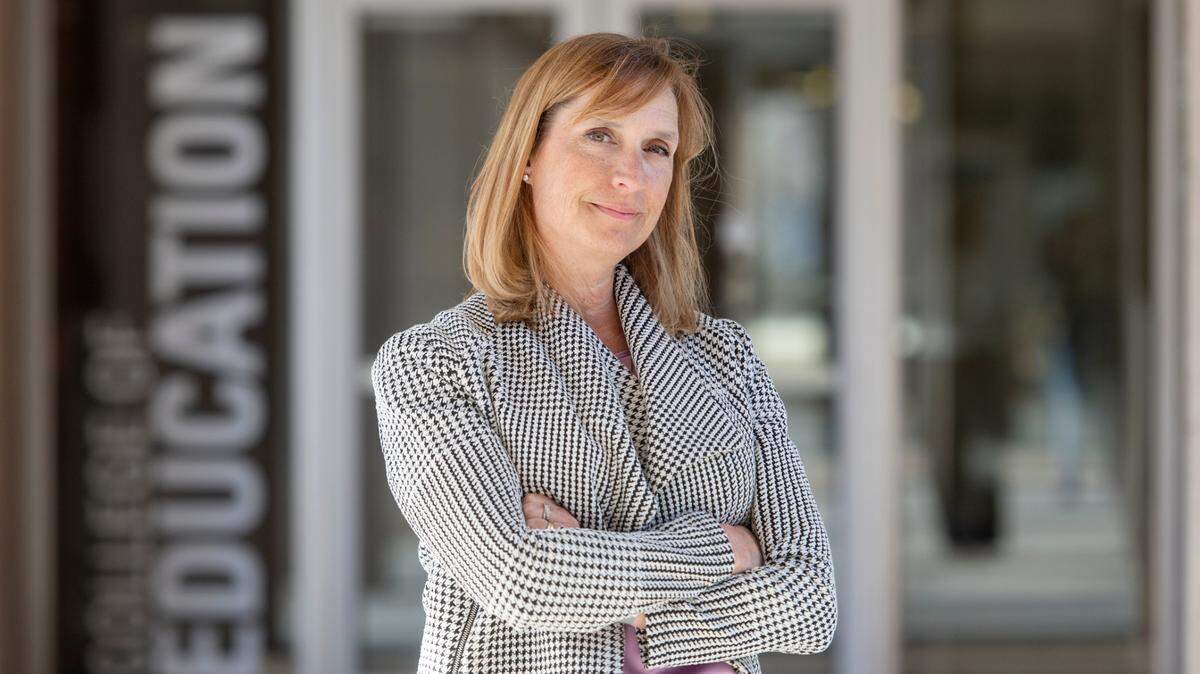
Up next: Kimberly Lawless, Dean of the Penn State College of Education.
Lawless arrived in Happy Valley in September 2019, after a 20-year career at the University of Illinois at Chicago (UIC). Her research — which focused on integrating educational technology with students’ STEM and writing skills, particularly seventh- and eighth-graders — garnered more than $30 million in grants and contracts at her previous stop. She was named the 2018 Distinguished Researcher in the Social Sciences from the UIC.
Personally, she also enjoys crafting and creating — whether it’s sanding, painting, upcycling, etc.
Centre Daily Times: Let’s start off talking about your hobby because that’s pretty unique. You’re technically not into “woodworking” — or making things from complete scratch — but you craft and upcycle a lot of old or unwanted things, not unlike on the HGTV show “Flea Market Flip.” What piece are you proudest of, and how did you get into this anyway?
Kimberly Lawless: I first got into it from my mom, who was a child of the Great Depression. So she had this kind of love for things, just accumulating things and never throwing anything out and always repurposing things. So I can remember, from the time when I was really little, my mom would redo bureaus and magically make them into some new type of cabinet. She once made a bureau into a doll hotel for me.
So I’ll find a piece — I find lots of roadside throwaways — or I’ll buy some pieces inexpensively at yard sales or tag sales or antique stores. I look at them, and they somehow speak to me and tell me what they’re supposed to be. Sometimes, they’re supposed to be exactly what they look like (laughs) and a bureau is s bureau. But, sometimes, the bureau will become a bar or another type of storage unit. I’ve repurposed an entertainment center into a children’s kitchen that had an oven in it and a fridge in it.
My favorite piece I’ve probably done was one of the simplest, but it was a sentimental piece. So I took a bureau that my grandmother had when I was little, and I repurposed it for my son’s apartment. So it was sanding and painting and kind of going over all the gouges that I remember putting in that bureau when I was little and smoothing them out while keeping the same character as part of the piece. ... It’s still a bureau. It just has so many memories built into it.
CDT: If you could choose one book as a mandatory read for high school students — any book — what one are you choosing, and why?
Lawless: Well, because I’m a faculty member, I can’t limit my answer to one. I’ve got to make things more complex than that. And the truth behind it is that one book is a serious book and one book is a book that I just think people need to carry with them.
I’m a big lover of children’s books, picture books, so I think every high schooler needs to revisit the book, “Harold and the Purple Crayon.” If you’re not familiar with that book, it talks about this young child Harold who has a purple crayon, and he uses that crayon to draw the world that he imagined so he can experience it. And I think that’s a critical lesson for people to understand, that you may not live in a world that has a moon that shines moonlight or a cityscape that has a window overlooking a harbor but, if you have tools, you can create that world and craft it for yourself in a way that you can experience it. And that is an important skill for people to understand that, when we move through education, the point is to give people the tools to create a world that doesn’t yet exist. That’s how we know we’re successful. ...
But the serious book that I think every high schooler needs to read is, “I Am Malala,” which is really an incredible story. It tells the story of a young Middle Eastern girl whose father is an educator and owns/runs a school and is a big believer in education. But she’s a female in the Middle East under a Taliban-controlled country. And, in Taliban-controlled countries, women do not have access to education but, because of her father and because of her own love of learning, she becomes an ardent advocate for education for everyone. And she ends up being shot for that advocacy. And it’s a beautiful story about how important education is for every single individual.
CDT: I want to ask you one more question related to your profession before we get into some more lighthearted questions. But I want to open it up on the subject of teachers and education. Both topics have been in the news a lot lately. But, from your perspective, what is the single most-important issue facing teachers right now — and how can that issue be fixed?
Lawless: I think there’s a couple questions in what you just asked me. If you parse it out differently, it’s, what are the big issues facing education? And then what are the big issues that are facing the actors in the education space, whether it’s teachers or students? And I think the answers to those questions are overlapping with one another. ...
So, if we’re talking about education, I think the biggest issue facing education is school funding right now because that hits every component that you have. It talks about how much money we spend per pupil, how much money we have for extracurricular programs, how much money we have to spend on programs for student health and well-being, teacher pay, as well as other ancillary things. ... There’s persistent historical problems with how we do school funding in this country. It is funded off property taxes, and it’s done at a district and state level.
And, if you think about the fact that about 22% of students in the nation live at or below the poverty line, those students have the worst outcomes from our schools. And, in 17 states, the majority of students are at or below the poverty line — so those states function less well than the states that have a more affluent student population base. So school funding is the biggest nut that we really have to figure out.
But, if we’re talking about teachers ... we’re at a place right now in our country where teacher morale is at an all-time low. And there’s a whole concomitant set of things that impinge upon teachers and are causing this morale problem. Part of it is the school funding, right? So we know that teachers are underpaid, and that means they also feel undervalued. ... Their jobs are getting harder and harder. So, in the College of Education, we’re looking at the cost of education to become a teacher. And the unmet need of our students who need financial resources to help them graduate is about $40,000 so we’re aggressively going after scholarships and repurposing funds to try and buy down that debt.
Another one of the things we’re doing is ... working with districts that have a disproportionate need for teachers and they’re hiring teachers on emergency certificates, which means they have a bachelor’s degree already but they don’t have teacher training. So we’re working with those districts to do a residency-based program for those teachers.
CDT: You arrived in Happy Valley in September 2019, before the pandemic started. So I think you should still able to answer this question: What Centre County restaurant or cafe have you frequented the most — not even necessarily your favorite place, but just the place you find yourself visiting most often?
Lawless: So, answering that question honestly under the context of being what I call a pandemic, meaning the majority of my experience is during a pandemic ... my most frequent cafe in State College is my own kitchen. My husband is a fabulous chef, home chef, but a fabulous chef. And I’m a baker. ... He’s Italian, so he can make anything out of pasta — any kind of sauce, protein. He makes magic happen. I bake cookies. I’m famous for my cookie platters at Christmastime; I make 25-30 different kinds of cookies.
So, between the two of us, we have just about everything we need out of our own kitchen, and that is by far my favorite place to eat. And that’s where I’ve had my best food in Centre County.
That said, I’m also fan of pizza. So ... I have tried all kinds of pizza places here, and I will say there’s a good share of pizza places in a college town like State College. So I’ve had Italian pizza, Greek pizza, made-to-order pizza, frozen pizza, grocery pizza, restaurant pizza — and I’m still in search of the perfect pizza in State College. I’m a big fan of New York style pizza and I know it’s out there, but I haven’t found it yet. So I’ll keep trying.
CDT: We’ve asked past deans about time travel and superhero powers so, for you, I want to ask about the lottery. If you hit the Powerball tomorrow, what’s the first “selfish” thing you’re going to spend the money on? And, no, that means you can’t just tell me you’d first give back to the university or your family.
Lawless: That is what I want to answer, and I’m going to use my prerogative as dean to do so. (laughs) If I were to win the Powerball, the first thing I would do is I would reflect on how I can make sure that my family will be sorted well in the future. I mentioned earlier that there’s about a $40,000 gap for students that are incurring debt in teacher preparation so, if I were to win multiple hundreds of millions of dollars, I would endow scholarships to close that gap — to make sure that the best and the brightest individuals that wanted to be teachers had access to a teacher preparation program the quality of this one.
And the reason why is those teachers are going to be the teachers of my grandchildren some day. And I want my grandchildren to have the best teachers. So it is self-serving. ...
But what’s the first thing I would buy just for myself? I know — I would buy myself an engraving machine. So, when I do my crafts, I would have the ability to do signatures, whether it’s wood pieces or metal pieces that I’m working on. I’d have the ability to add a little extra pizzazz to them.
This story was originally published March 17, 2022 at 2:58 PM.