
Old Main’s frescoes are touched up each year at Penn State. Here’s a look at how it’s done
Every summer, Penn State’s campus buzzes with activity as construction crews repair and renovate buildings, roads and sidewalks while most students are away. This week, though, the university turned its focus toward a beloved but often-forgotten feature: Old Main’s frescoes.
On Tuesday, a crew of conservators set up in Old Main to touch up the historic art installation as part of an annual maintenance plan. Following a routine assessment, experts found a need to repaint some areas where the frescoes meet the “chair rail” that lines Old Main’s central staircase and second-floor walls.
Repairing decades-old murals is no easy task — even for experts like Jeff Johnson, who holds 33 years of experience under his belt. The Johnson & Griffiths principal says such technical work requires strong attention to detail.
“These maintenance touch-ups help to make sure (the frescoes) are not getting worse or cracks aren’t opening up somewhere,” Johnson said on Tuesday with a watercolor palette in hand. “Every year, we check to make sure they’re stable and nothing major has happened.”
Together, conservation firms Johnson & Griffiths and Albert Michaels work to maintain Old Main’s frescoes. The two led Penn State’s major repair of the murals in 2013, which tended to water damage and wear and tear that took a toll on the historic installation. By filling cracks with wax, conservators helped maintain the artwork while also providing a versatile medium that would make future repairs easier. Ultimately, the “ambitious restoration project” helped restore the frescoes’ original quality and color, preserving them for future viewing.
The 1,300-square-foot frescoes circle the upper level of Old Main’s lobby. Their images and scenes call back to Penn State’s overarching educational mission, represented by depictions of student life on the eastern wall and sections devoted to agricultural prowess and Pennsylvania’s mining industry. Serving as the frescoes’ centerpiece is a towering mural of Abraham Lincoln, who signed the Morrill Land-Grant Act of 1862 that helped found the school that would eventually become Penn State.
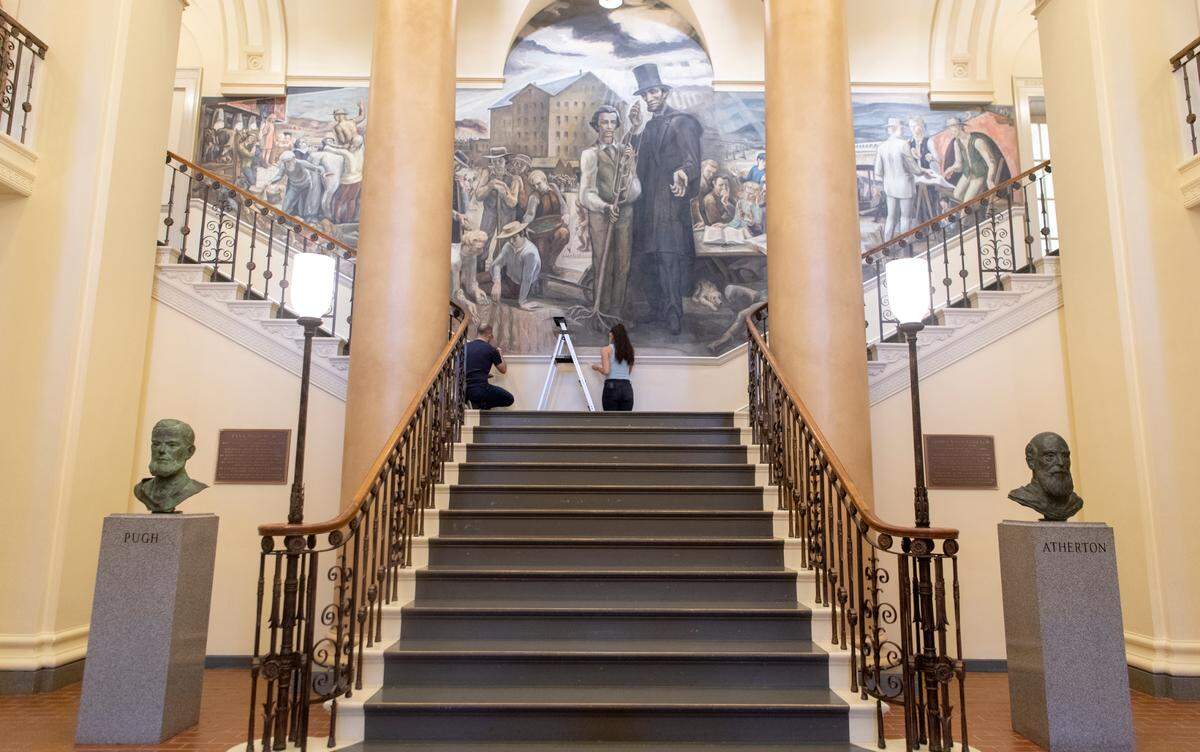
Conservators like Johnson work on projects all across the mid-Atlantic and northeast, including the Pennsylvania State Capitol, President Lincoln’s Cottage in Washington, D.C. and Penn State’s own Burrowes and Chambers buildings. He says preserving historic artwork is always a rewarding process.
“We feel lucky that we’re able to work on something as important as this,” Johnson said. “This is such a part of Penn State and the university, and I hope that most people know about it. It’s such a beautiful piece of artwork.”
Shawn Vennell, a conservator from Albert Michaels, says he and his partners always hope restoring artwork will spark interest from the public. But Johnson says that preservationists can do only so much.
“We restored the whole interior of this space,” Johnson said. “I think it’s up to the university to get the word out to come check them out.”
Next week, the original sections of Old Main’s frescoes will celebrate their 82nd birthday. The idea for such an art installation dates back to the 1930s when three professors of art and architectural history sought to create a mural “embodying a pictorial synthesis of Penn State’s founding and growth,” according to the university’s archives. Thanks to a gift from the Class of 1932, Penn State brought in artist Henry Varnum Poor to make the project a reality.
Poor was widely regarded as a master of the fresco medium, through which paint is directly applied to wet plaster. He began sketching designs for Old Main’s mural in September 1939 and started painting in April 1940. Just two months later on June 18, 1940, the frescoes’ original section was completed.
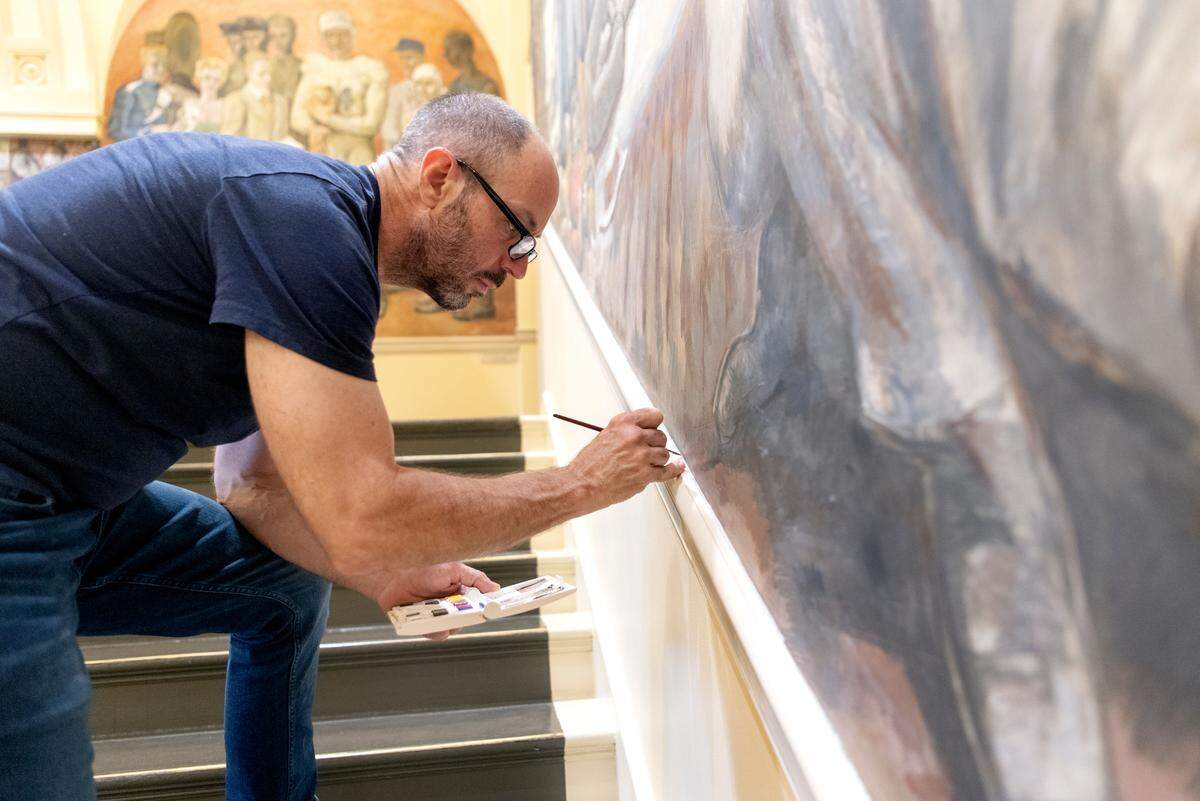
Penn State’s sophomore, junior and senior classes voted in December 1941 to fund a continuation of the mural on Old Main’s eastern and western walls. Although plans were delayed due to World War II, Poor returned in 1948 to expand his artwork. The newer portions, which symbolized Penn State’s academics and service to the commonwealth, were completed in June 1949.
Although the Old Main frescoes may go unnoticed by some students, their significance isn’t lost on university officials. Moving forward, Penn State says it’s prepared to continue conserving its storied history.
“The University is dedicated to caring for and preserving Old Main’s land-grant frescoes,” Bill Sitzabee, Penn State’s vice president for facilities management and planning and chief facilities officer, said in a written statement. “The frescoes serve as an extraordinary visual reminder of our University’s history and unique land-grant mission. To preserve the paintings is to connect to our past.”
Visitors who would like to view Penn State’s land-grant frescoes can visit Old Main during business hours from 8 a.m. to 5 p.m. Monday through Friday.
This story was originally published June 16, 2022 at 6:00 AM.
%202.JPG)