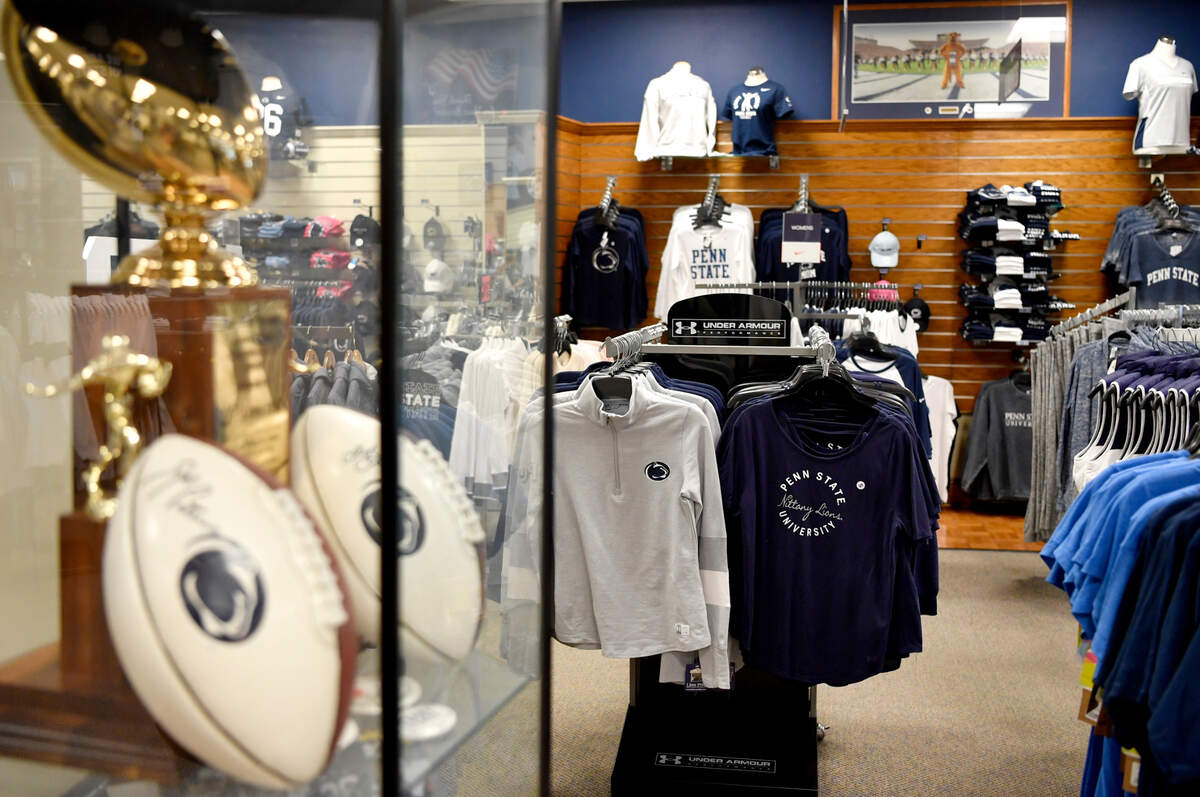
Penn State denied quick trademark win, judge questions sports merchandise industry
A federal judge denied Penn State a swift trademark victory earlier this month in a narrow ruling that questioned the longstanding foundation of the multibillion-dollar sports merchandise industry.
Chief U.S. District Judge Matthew Brann gave the green light for online retailer Vintage Brand to proceed with claims that Penn State’s use of its logos on merchandise is ornamental and fails to function as a trademark.
At issue is whether consumers perceive marks on merchandise as a way to express support for their favorite university or whether the school has produced, approved and guaranteed the item’s quality.
Brann’s ruling filed July 14 suggested the modern collegiate trademark licensing regime may be “built on sand.”
He wrote there may be a widespread, erroneous belief among consumers that you can’t reference a team on merchandise without a license. And some scholars, Brann wrote, have said cutting off competition leads to higher prices and lower quality.
“It would seem perverse to award market exclusivity based on a fake-it-until-you-make-it approach,” Brann wrote in his 23-page ruling. “If consumers’ confusion stems from their incorrect belief that goods bearing Penn State’s emblem must be licensed, shouldn’t that belief be corrected, not perpetuated?”
Penn State declined comment through a spokesperson.
Leslie Vander Griend, an attorney for Vintage Brand, wrote in an email Monday that the university is trying to “preclude Vintage Brand from selling custom items decorated with historic public domain artwork copied and enhanced from vintage memorabilia.”
“Now that consumers are celebrating such historic designs, Vintage Brand suspects the University hopes to secure a monopoly over this burgeoning market by asserting rights long ago expired or never acquired in the first place,” she wrote. “It is Vintage Brand’s position that this lawsuit is an anti-competitive attempt to claim non-existent property rights and to dominate the market with overpriced consumer products and fewer options. But a basic objective of the law regulating the American free market economy is the promotion and encouragement of competition, and Vintage Brand stands for this principle.”
Tulane sports law professor Gabe Feldman described the ruling in a tweet as a “potentially industry-shifting legal decision.” Trademark attorney Josh Gerben said Brann’s commentary was “a bit of a head-scratcher.”
“The way the judge lays this out in talking about how trademark rights work in the judge’s mind is not connected to the reality of how the marketplace currently works,” Gerben said. “I think that would become very clear if this case did go through a trial and all the facts came out about how trademarks work and how licensing works in today’s world.”
Harvard law professor Rebecca Tushnet wrote in an email that Brann considered the basic premise of trademarking, something that many courts have not squarely addressed in recent decades.
“Courts have often skipped past that and treated trademarks as a means to extract value from consumers, but that is both a big expansion of the historical scope of trademark and dubious as a matter of First Amendment law,” Tushnet wrote.
Penn State, which filed a lawsuit against Vintage Brand in June 2021, wasn’t the first to sue the apparel company that often uses retro logos and images to sell merchandise. More than a handful other universities have lodged similar allegations.
Brann did not immediately accept that Penn State’s marks functioned as trademarks. He wrote there needs to be a fact-intensive inquiry about consumer perception.
The ruling, UCLA law professor Mark McKenna said, was “refreshingly in-depth.” Brann’s decision will not become binding precedent on other courts, McKenna said, but the judge’s reasoning could be persuasive in other cases.
On the horizon, Gerben said, is “a lot of settlement discussions” before a potential trial.
“Penn State, I think, still has a very, very strong case here. In order for Penn State to really lose, there would have to be an upending of how current trademark law works, and I don’t see that as being very likely. Therefore, Vintage Brand would have a very strong impetus to try to settle this case before taking it to trial and risking a loss at trial,” Gerben said. “I think at the end of the day you’re going to see this case is settled and this opinion that the judge put out there ... likely gets put in a drawer somewhere and maybe another federal court looks at it and takes it up later in a different case, but it would be very unlikely to me that — given the economics involved in this case — that this thing would actually get to trial and we have some kind of massive shift in trademark law because of this.”