In first town hall, Penn State president fields questions on layoffs, campuses, budget & more
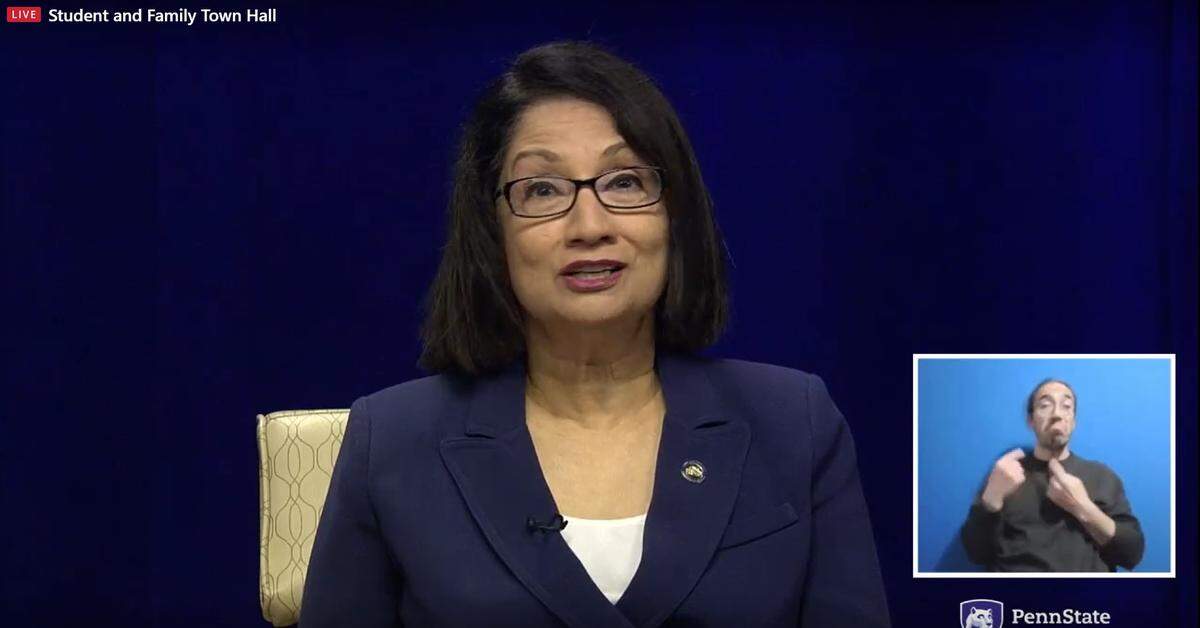
After 19 weeks on the job, Penn State President Neeli Bendapudi oversaw her first of two university town halls on Wednesday morning — one directed toward faculty and staff, another for students and parents.
She was joined by several other executives at each virtual town hall, tackling questions on budgetary issues, college rankings and future university plans. Here are some of the highlights:
Changes to the budget, budget process on the way
Penn State operated at nearly a $200 million deficit the last fiscal year and, while a significant portion of that can be attributed to the pandemic, Bendapudi also noted that there remains a “structural deficit.” In other words, the university’s financial issues aren’t simply going away as COVID becomes less of a concern.
“It’s going to be a tough 12 to 18 months but we gave our word that by 2025, we will get to a balanced budget,” Bendapudi said, referring to a promise made to the university’s board of trustees.
In some of the university’s most visible actions, it implemented at least a yearlong “strategic hiring freeze” last month and will save about $46.2 million from an across-the-board 3% cut. It’s also looking at ways to increase revenue — such as offering a corporate sponsorship program, which promotes student networking and offers connections with faculty. And it’s also seeking to reduce costs, with Bendapudi explaining one example of how she planned not to fill an executive’s role by having his duties taken over by her chief of staff.
The budget allocation process — which departments get what money — will also be overhauled starting in November. Sara Thorndike, treasurer and senior vice president for finance and business, said officials aren’t even sure how the current allocations were derived.
“It’s legacy. It’s called an incremental budget, which basically means you get the same amount you get the year before,” Thorndike said. “And, sometimes, there’s a little bit of change and it really has not kept up with enrollment changes, for example, or other priorities the university has that we want to financially provide resources for. So we’re really starting over.”
Thorndike said a group of about 12 people are meeting every week to discuss those future budget allocations. And Penn State is also being guided by 13 decision points outlined by the EAB, formerly known as the Education Advisory Board.
A budget for the 2022-2023 fiscal year, which usually would’ve been presented to the board in July, will instead go before the board of trustees next week.
No plans to shutter commonwealth campuses
Officials received about 10 questions on the future of Penn State’s 20 commonwealth campuses, and Bendapudi addressed the concerns directly. At each town hall.
“There are no plans to close any of the commonwealth campuses,” she said at the earlier town hall involving faculty. “And, as I said, I really think that’s the strength — it really drew me to this opportunity at Penn State. The fact that 96% of the citizens of this commonwealth are within 30 miles of one of our locations, what a powerful statement that is. ... So what we need to do is make sure they continue to stay vibrant.”
When asked again at the second town hall whether any campuses would close, Bendapudi simply said no before echoing a similar sentiment on their importance.
Bendapudi is hoping to increase enrollment at the commonwealth campuses, which have experienced a 20% decrease in enrollment over the last five years. To combat that decline, she recently hired Matt Melvin to serve as vice president for the newly established enrollment management office, which most Big Ten schools already have.
Questions also arose at the town hall on whether there would be program closures at certain campuses, as Penn State Altoona was forced to cut six academic programs in the spring — before Bendapudi officially came on board. Although Bendapudi said, “There are no plans to just go in and shut down programs,” officials intimated that such cuts were possible once the issue is looked at more deeply.
“Some people think just because we have duplication of programs being offered in a couple of places, does that mean you shut down one? No, not necessarily,” Bendapudi told students and parents. “Because we are so dispersed, we might need engineering at more than one location. At the same time, I owe it to you. Because when we talk about cost containment — let us say there’s no student demand for a particular program or courses, then we cannot keep them open because that cost will have to borne by the rest of you.
“This will be an incredibly collaborative process. .... So please know that our singular focus is on your success, student success.”
‘Reductions’ are possible — but no mass layoffs planned
Early in the morning’s first town hall, one of faculty members’ biggest fears was addressed when the issue of potential mass layoffs or furloughs was brought up.
Jennifer Wilkes, interim vice president for Human Resources, did not directly tackle the subject of furloughs, but she did address the question of mass layoffs.
“We have no plans for mass layoffs,” she said. “There may be some personnel changes in units largely based to attrition or not backfilling vacant positions. And while some reductions in some units are possible, we are not planning for any mass layoffs. ... Budget executives in each of their units will be tasked with making decisions that are in the best interest of their unit to support our students and for the betterment of the university.”
During Bendapudi’s opening statement, she added, “We cannot just cut our way to excellence.”
Reaction to US News’ ‘Best Colleges’ rankings
Penn State dropped a few spots in U.S. News and World Report’s latest “Best Colleges” rankings, which were released Monday. When it came to public schools/national universities, Penn State came in at a respectable No. 31 — but that was an eight-spot drop from last year. When it came to overall national universities, Penn State was No. 77, a 14-spot tumble from 2021, which put it further behind No. 62 Pitt.
The issue was brought up separately at each town hall and was also tackled during a Q&A on Tuesday with the faculty senate.
Bendapudi believed the drop likely came, at least in part, as a result of U.S. News ranking Penn State as a system — not just University Park, which it did last year — as that might have skewed its graduation rates. Big Ten counterparts, such as Michigan and Ohio State, were still ranked this year based on their main campuses.
“We are addressing it with them; we are trying to make sure they’re aware,” Bendapudi said. “But I will tell you that our students are considered some of the most employable. We do so very well on the rankings that matter; look at our research records. This is truly a flaw with how they calculated our graduation rates and some other issues.”
Bendapudi acknowledged some might call them “sore losers” for pointing out any issues. And, while she said in a news release that PSU cannot be defined by any one ranking, she also admitted that the rankings do matter to large sections of the population.
She said her team will be briefed on the nuances of the rankings Friday. Bendapudi also said she wants to have a conversation with U.S. News.
The Centre Daily Times reached out to U.S. News for an explanation, and the outlet acknowledged in a written statement that there was a change to a metric involving the Integrated Postsecondary Education Data System (IPEDS).
“In its 2022-2023 survey, U.S. News stated that ‘The graduation and retention figures below must align with what your institution reported to IPEDS, unless your institution reported inaccurate information that is being corrected,’” U.S. News wrote in an email to the CDT. “The survey also stated that this data would be used in our rankings calculation. This was a change to how this metric has been requested in previous years, and was implemented to allow U.S. News to use IPEDS data to verify certain data in submissions by surveyed universities.
“To provide context to readers with respect to this result, we included a note on Penn State’s 2022-2023 profile on USNews.com indicating that graduation rate data used in calculating the ranking represented the entire Penn State system and was taken from the U.S. Department of Education.”
Student support, mental health remains a priority
Although Penn State implemented a “strategic hiring freeze” last month, the university said it would continue to hire for positions involved with safety, student success and compliance. So, when asked specifically about students’ Counseling & Psychological Services (CAPS), an official told students and parents that the university wouldn’t “retreat” from its commitment there.
Damon Sims, vice president for student affairs, implied there could be future changes, however.
“These are the kinds of services that really are essential services; they go to the core of student success,” he said. “Student well-being and health are extremely important to us. Always, they remain important to us; I do not see any expectation for a retreat, from our commitment to these services. ... But again, we want to continue to be creative, thoughtful, mindful of the need to keep costs down.
“And we want to work closely with our student partners and making sure we’re delivering those services as effectively as we can. But they go to the core of what we do on behalf of students, and I don’t expect those to be diminished in any fashion.”
Eventually, Bendapudi would like to streamline other support for students so they don’t have to navigate a hundred different offices for different problems. In other words, if a student has food insecurity problems, mental health concerns and maybe their car broke down — they won’t have to visit different offices for help.
“We’re working on it,” she said. “I know we have a tough budget situation, but we want to get to the place where you only have to reach out to one place, and then you have someone who’s your guide in helping to navigate a complex system.”
Also on the topic of student support, Thorndike said the university couldn’t yet make any promises to students on whether those who won’t see the tuition increase this year — because their families earn less than $75,000 annually — would see the increase next year. She said officials will know for sure once they get through this fiscal year.
This story was originally published September 14, 2022 at 4:43 PM.