Ex-Penn State President Graham Spanier discusses Sandusky, Paterno statue & do-overs in Q&A
For the last decade, former Penn State President Graham Spanier has remained mostly silent while listening to those around him fill in the details of the Jerry Sandusky child sex abuse scandal.
Now, Spanier — who was forced to resign in 2011 in the wake of the scandal — is finally sharing his perspective.
Spanier released a new book Sept. 6, titled “In the Lions’ Den: The Penn State Scandal and a Rush to Judgment.” The 512-page memoir focuses on the criminal justice system and the university fallout involving Sandusky.
The former university president recently sat down with the Centre Daily Times for a Q&A on the book, along with topics related to Sandusky’s acts and the university’s responses. The interview has been edited for clarity, grammar and length.
Centre Daily Times: This book has been roughly a decade in the making. How satisfying is it to see your memoir in bookstores now — and what kind of response have you gotten so far?
Graham Spanier: Well, certainly, it’s a relief to have it done and see it not only in print but that it’s finally being distributed out there and people are getting it. I am astounded when I get emails, as I have the last few days from people who got the book and stayed up all night to read it ... and people saying, “I just ordered four more copies because I’m giving them out as Christmas presents.” That’s great.
... The audible version of the book — and I narrated the audible version myself; I put my old radio announcer cap back on — and, for some reason, Amazon wouldn’t release that until the official release date of Sept. 6. But now I have people who are listening to the book with even one person saying, “This, your experience, is such a nerve-racking story that I wouldn’t be able to read the book. But listening to it in your voice, which I know, is something that I’m doing.” So people are listening to the book and folks are like, “Thank God, I got it because now I’m driving to Florida and we can listen to it all the way there.”
CDT: Obviously, this book doesn’t get written without Jerry Sandusky. So let me just ask you directly, since you sort of stopped shy of directly offering a take in your book: Do you think Sandusky is innocent or guilty?
Spanier: I say in the book right off the bat this is not about Sandusky or about his guilt or innocence, which I feel I had to say for a couple reasons. One is I didn’t know the guy. I only had one conversation with him in my life. There was a picture taken of us at a picnic 25 years ago that has been widely reproduced and I’m thinking, my band — I play in a Dixieland jazz band — and I remember we were playing at a picnic and he was there, and somebody got a picture. And people keep reproducing that picture as if we were well-acquainted, but I only recall one discussion with him about 25 years ago. So I don’t know Sandusky.
I didn’t attend his trial. I didn’t follow the situation with him very closely because I was dealing with my own situation. I do say a couple things in the book that are relevant to your question. One is that I went to trial in 2017; they sent him to trial within months, and the judge refused to postpone it. And they only got their discovery material like two days before or something, right before thousands of pages of this Brady Discovery material. So I think there are a lot of people who would agree that he probably didn’t get a fair trial, but I just don’t have enough information to judge him.
What I kind of knew through the grapevine was that he was like an adolescent in a grown-up body. He was a goofball. And I knew he had founded this charity, but I was never involved in The Second Mile. I was too busy. I was never even asked to be on the board. ... I just didn’t know much of anything about The Second Mile or Sandusky. So I mentioned in the book, there are a lot of people — I mentioned them by name — who have researched every aspect of this, and they believe he’s innocent. And he’s still in court today; I think there’s a new filing out there, I’ve heard. So it’s not my place to make a judgment about him.
I am convinced, from what I was told originally in a short conversation and with everything I’ve learned since, that nothing happened in that shower that night (in 2001). And in fact, as I point out and people keep forgetting, Sandusky was found innocent — not guilty — of that Penn State shower incident, which is one thing that came back on Joe Paterno, Tim Curley, Gary Schultz and me.
CDT: I would like to press you on one point — when you said you don’t have enough information to judge. I understand what you’re saying about that specific incident, but Sandusky was still found guilty on 45 charges involving 10 boys. In your book, you point to examples, such as the Central Park Five, where the villains were “overzealous prosecutors.” But, with the Central Park Five, there were no eye witnesses and, in the Sandusky case, there are double-digit witnesses/victims. So what would be enough information, and why is it so hard to acknowledge that Sandusky is guilty?
Spanier: Well, I’m aware of the (Mark) Prendergast book (“The Most Hated Man in America: Jerry Sandusky and the Rush to Judgment”). So he calls that into question. John Snedden, the federal investigator, calls it all into question because he’s delved into it. If you listen, as I have, to John Ziegler’s series of podcasts, where he has interviewed everybody around this. Fred Crews, an eminent scholar, retired now at the University of California-Berkeley, who has spent the last several years looking at all of this. They have all raised serious doubts about Sandusky’s guilt.
These are people who I respect, and I respect their work, but I have not spent the kind of time these folks have looking at every last detail. I’ve read the products of their work. So I just don’t feel I’m in a position to pass judgment one way or another. You know, a lot of people who have defended me are people who knew me intimately, knew me well. .... I didn’t know Sandusky, so I can’t. There’s very little I could say about him.
CDT: If I’m remembering correctly, you alluded to a Malcolm Gladwell piece in your book, one that essentially focused on how difficult it is to recognize if you know a sexual abuser because obviously they try to hide that part of their lives. That being said, knowing what you know now, if you could do anything differently, what would you do now?
Spanier: Well, I think there are some lessons to be learned from all this. Given what Joe Paterno was told more than 20 years ago and what he then told (former athletic director) Tim Curley and what Tim Curley told (former vice president) Gary Schultz — and then what Tim told me, in front of Gary Schultz, kind of four steps removed. With the information that we had at the time, it’s hard to say we would have done anything different because we thought we were being very responsible.
Tim took the lead, to go off and talk to Jerry Sandusky and say somebody was uncomfortable seeing that you were in the shower with a kid. So cease and desist. Gave him a directive, which he accepted. And, since he hadn’t been employed by the university for a few years, went to the head of The Second Mile and said we got this report, he works for you ... could you please follow up on it? We thought that was pretty responsible.
Now in 2022, knowing how it all unfolded and knowing — two decades later — of the heightened sensitivity in our society to anything, whether it’s a shower or horsing around with a kid or just putting your knee affectionately but not necessarily sexually on someone, yeah, you would raise it to a higher level of intervention, which is a term I used when I replied to Tim Curley. “Let’s see if he gets the message. If not, we might have to go further.” But, you know, we heard you got the message. So now I think if you heard anything, even vaguely or remotely suggestive, you would call the police or Child Services or whatever, which any of us would have happily done if we thought we’d heard anything that was more than just horsing around. Which is exactly what we heard.
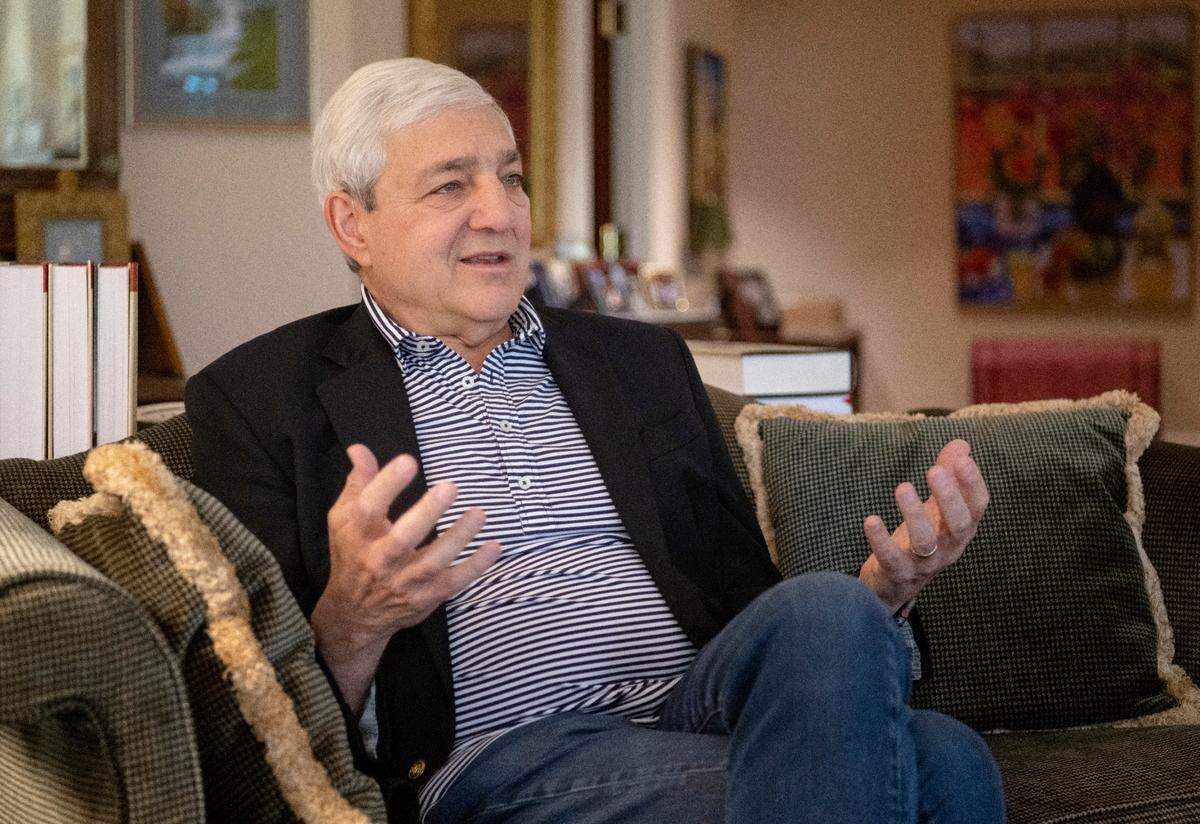
CDT: As you know, a lot of attention — both from the media and otherwise — has focused on Joe Paterno and university officials such as yourself. From your perspective, what person or group do you think should have been a larger focus? Or who played a larger role than most people realize?
Spanier: The people who have really devoted the last decade to trying to get the truth out have focused on some of the things I’ll mention. And I’m hearing from a lot of people reading the book saying, “I knew some of this, but I’ve learned so much. I had no idea about (former Gov. Tom) Corbett and about (former state prosecutor Frank) Fina and (former PSU general counsel Cynthia) Baldwin and others because they didn’t get a lot of the attention.”
But, you know, I have very factual information in there about Gov. Corbett’s role — about the “coincidence,” and I’m using that word a little sarcastically, of my being called to the first step in the Grand Jury process on the very day that he announces the largest cut in the history of American higher education, a 52.4% cut in Penn State’s appropriation. And then immediately after that meeting being subpoenaed to the Grand Jury. I talk about Corbett, and I mentioned how many witnesses there were to him saying, a month before the election of a new governor, that if he was elected governor, he would remove me as president of Penn State. The he gets elected governor, and his first act is this budget proposal. Then he puts Linda Kelly in to finish his term as attorney general and she and the head of the criminal division, Frank Fina, who was attached to Corbett, they come after me.
It takes them a year to get there because they had no evidence. There was no evidence against me. They were desperately trying to find something, and all they could do is — three days before the election of a new attorney general and Frank Fina knew he would be out of a job — they bring in Cynthia Baldwin before a Grand Jury. And let’s just say that it’s very clear she was not entirely truthful. But they used her testimony to charge me. So I was charged a year later and then they recharged Curley and Schultz at the same time, so all three of us would have the same identical charges and they could then argue we should be charged together — so if any one charge against anyone of us stuck, it would affect all three of us. I don’t even talk about that in detail, all the legal maneuvering they were up to. ...
So then you have the Grand Jury judge, who was removed by the Pennsylvania Supreme Court for his wrongdoing in this case. Cynthia Baldwin was censured for this by the Supreme Court. Frank Fina’s license was suspended by the Supreme Court. All of those things for what they did to me. But I’m the one who ended up in jail.
CDT: One related event that still stirs debate all these years later is the removal of the Joe Paterno statue. What was running through your mind when that happened? And would you have done things differently if you were still president at that point in the summer of 2012?
Spanier: I say in the book, first of all, I think that was a mistake. That was bowing to what what they perceived was some level of public pressure, but I think more people — far more people — are unhappy that the statue was taken down than not. I would not have done that.
I think we have to be careful in our society about changing history. Behind that statue, as you recall, was a wall that said, “Coach. Humanitarian. Educator.” Joe was all of those things. I say in the book, I don’t think we ever had a conversation about football, and I saw Joe maybe almost every week over 16 years. Hundreds of times. And it was never about football. It was about fundraising, philanthropy. Now, we would talk about NCAA legislation or something like that, but Joe continued to coach until he was 85 because he could continue to help and support the university. It wasn’t because he had to coach one more football game. It was his life. It was how I felt as president. ...
He was probably the lowest-paid head coach among the top-20 coaches in the country. No, I would not have taken the statue down. Not only did they take it down, and I talked about it in the book .... but almost everybody who was designated to go deal with that didn’t want to do it. But it was their job.
... Here’s what bothered me even more: Not only did they take it down and hide it. They did not tell the Paterno family ahead of time; the grandchildren are seeing it on ESPN. And then they completely re-landscaped the area, so it would be impossible for almost anyone to know that it was there. I can’t remember if this part survived the editing of the book, but it reminded me of something in my own family’s background from the Holocaust, where there’s a site that I visited where Hitler ordered the reconfiguring of a community, of the landscape, to hide it ever existed. It just struck me. It struck my heart because it reminded me of something in my own family’s background. So, no, I wouldn’t have done that.
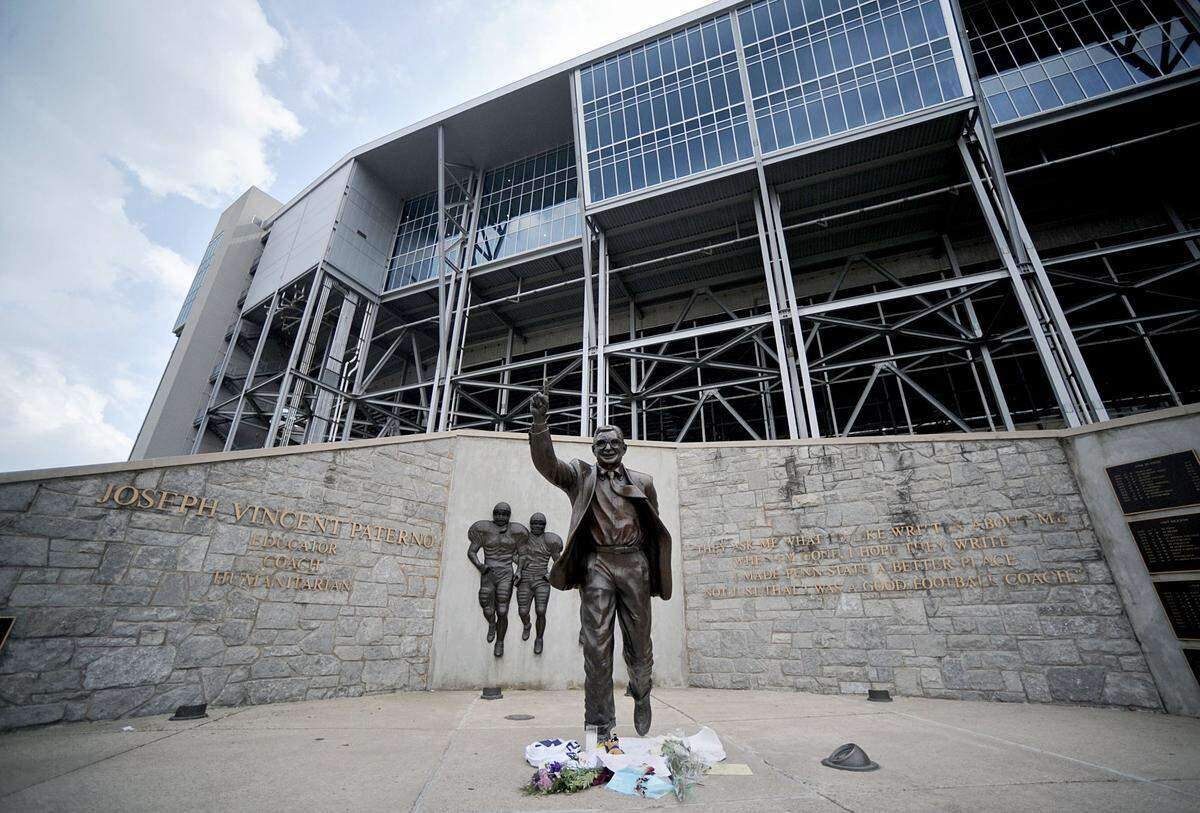
CDT: What would you like to see happen to the statue now? I’ve seen some alumni recommend it be put in front of the library, others say it should be in the All-Sports Museum or maybe you think it should be put back the way it was before. What would you like to see, ideally?
Spanier: I haven’t thought about it specifically. I would do one of those things you just described.
Yes, of course, it would have more visibility by the stadium or by the library — even more perhaps, or in the library. In the sports museum, a little less so, but you could see that connection. So, yes, the statue needs to come back and be put somewhere.
I would say I’m reluctant to weigh in on that publicly because I really admire this new president, and I think she is going to make great decisions. And I don’t want her feeling that I’m looking over shoulder and saying what should happen. But something should be done with that. It needs to come out of hiding. Absolutely.
CDT: Something else you expressed frustration over, and it’s mentioned in your book, is that the board of trustees muzzled you when news of Sandusky first broke, between Sunday and Tuesday. I’m just curious what you would have said because, at that early point in the story, you were still basically implicated in a cover-up and there were questions about your candor. What would you have liked to say, and what kind of impact do you think that would’ve had?
Spanier: Well, I would like to think that it would have made a difference because I had a reputation of getting out in front of every crisis. I wasn’t the kind of person who hid.
When we had the shooting on campus (in 1996), I was conducting two briefings a day for the media. I had a policy, because of my background in journalism, my commitment to journalism, of answering all media inquiries. Hundreds — thousands, maybe. Every day there were media inquiries, and I had a policy of answering every media inquiry, same day. I never hid from the media or the truth or a crisis. ...
And the moment this story broke, I was ready to be on it. It was the fact that nobody was saying anything and started to let it get out of hand. And you started having the Harrisburg Patriot-News, which always disliked Penn State, and the (former CDT editor-in-chief) Chip Minemyers and others who started their own narrative (in later months). On that Tuesday morning, there was a full front-page editorial in the Harrisburg Patriot-News, basically declaring Paterno and me guilty and saying we have to be fired. So I was on it immediately with our board of trustees and was being told, no, the board is going to handle this.
... So what would I have done? Of course, what I would have said, first of all, you get the fact that here’s what’s happening, here’s what we know. I did issue a statement, supporting Tim Curley and Gary Schultz, which by the way was approved by the chair of the board. They later argued that I shouldn’t be president anymore because I had defended Curley and Schultz. ... We had already decided Sunday that we were going to have an independent investigation. I’m not sure I would have hired Louis Freeh, but we now know the fix was in for that. And we would have basically said, “Here’s what’s happening, folks. Here’s what we know. Calm down. And let’s get on top of this.”
And we would have had briefings every day if we needed to, on top of that. Saturday and Sunday, I’m saying to (former board of trustees chair) Steve Garban that we need to have a board meeting every day to decide how to do this. On Sunday, I was told, no, no, we don’t have to rush it up. We can wait until Tuesday to have another board meeting. Well, by then, we were closing off space for satellite trucks and people were outside the Paterno residence full-time. Bands of students were roaming around town from Beaver Canyon to Old Main to the Paterno residence. ... So, yeah, I would have been out there in front of it, dealing with it. Instead, nobody heard anything from the board of trustees from Saturday to 10 p.m. Wednesday night when 200 reporters are getting increasingly anxious because they were told there’s be a 9 p.m. press conference. And you know the famous interview, the famous statement, where, you know, “Effective immediately, Joe Paterno is no longer the coach at Penn State.”
By then, the entire saga was in the hands of a false media narrative. Or let’s say an exaggerated media narrative. It was whatever people were putting out there, and I would have been on it, out in front of it, at every moment.
CDT: I’m going to give you the final word here. What would like the Penn State community — and beyond — to understand? What do you want them to know about this part of Penn State’s history and the role you played in it?
Spanier: I want them to know what happened was very unfair to the university and to the community and to all of us who have had these, in some cases, lifelong attachments to Penn State. I don’t think it was deserved.
This was not really a Penn State story. People made it into a story about Penn State football. That’s what was in the national news, a story about Penn State football. Allegations were made against a former assistant coach. And instead of it being about Sandusky, it became a story about Penn State, Penn State athletics, Penn State football, Penn State’s leaders.
And you had, at the time, more than 600,000 alumni who had to kind of wear this label. And I think some people, for a time, stopped wearing their Penn State shirts and hats. Others, as a matter of defiance, put them on proudly and defended the university and those of us who they knew were good people and would never do anything to promote, or cover-up or allow, abuse of a child. ...
My career was based on promoting the welfare and safety of children and youth, so it’s an extra blow to me personally to have been pulled into something like that. But I think everybody connected to Penn State or central Pennsylvania was hurt by this — and that’s very much at the top of my list of regrets, that this happened to all of us. And I think we’re making progress with a passage of time, with a new administration at the university. Maybe it’ll help a little bit, with the details that have come out in this book, to put it behind us, but I don’t think we’ll ever be able to leave it 100% behind us. Unfortunately, it’s just something that’s there.
This story was originally published September 22, 2022 at 6:00 AM.