Can Penn State cancel event featuring Proud Boys founder? ACLU PA, experts weigh in
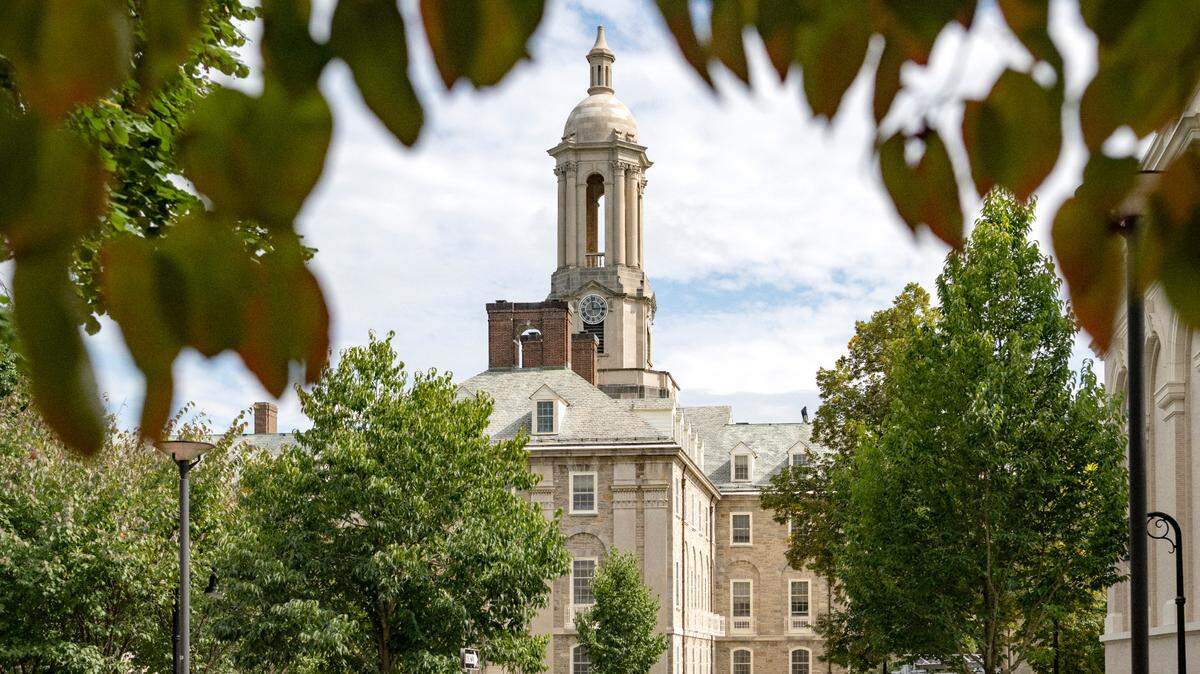
Penn State has fielded criticism from around the country for hosting an event involving the Proud Boys founder, with multitudes questioning the university’s assertion that it cannot cancel Monday’s presentation without violating the U.S. Constitution.
But the American Civil Liberties Union of Pennsylvania — and more than a half-dozen other First Amendment experts — say Penn State is almost certainly correct.
Because the university is largely public, and because a recognized student organization invited the speakers as all such organizations are permitted to do, it cannot make exceptions to its own rules because it finds the speakers’ rhetoric “hateful and discriminatory.” Penn State said as much last week, but that hasn’t stopped a 3,000-signature petition, online comments that have referred to PSU as “a terrorist organization” and overwhelming anger from many students and community members.
No expert or organization the CDT contacted agreed with the views of the Proud Boys. But, just as an accused white supremacist spoke on the campus of Indiana University, and “radical conservative” Ben Shapiro held an event at the University of Michigan, both Penn State and outside experts say the land-grant university is constitutionally obligated to follow suit.
“Penn State is a public university, so it is subject to the First Amendment,” ACLU PA Legal Director Vic Walczak said in a written statement. “Once (a recognized student organization from) the university has invited a speaker, cancellation because of disagreement with the speaker’s viewpoint or message raises First Amendment concerns, and could invite litigation and trigger liability.”
Added Ken Paulson, director of the Free Speech Center at Middle Tennessee State: “If a university empowers student organizations to invite speakers, it needs to honor its policy, regardless of the message. Under the First Amendment, a public university can’t discriminate against points of view.”
Granted, there are several exceptions to the First Amendment — such as incitement of violence — but several experts cast doubt on those coming into play here since they require such a high bar, legally. Although McInnes has been accused of promoting political violence, a university spokesperson also told the CDT there were no “credible” threats at this time.
Speakers & community response
Uncensored America, an official — or “recognized” — student group, announced earlier this month that it would host two controversial far-right speakers in Proud Boys founder Gavin McInnes and “professional troll” Alex Stein. They’re set to speak at Thomas Building on Monday night in an event titled, “Stand Back & Stand By,” a reference to former President Donald Trump’s response when asked to condemn the Proud Boys.
McInnes was banned from most social media for promoting violent extremist groups and/or hate speech, while Stein has described his video-streaming platform as “anti-gay, anti-woman, anti-Black, antisemitic.” The Southern Poverty Law Center also labels the Proud Boys a general hate group.
Anger in the community has mounted over the last two weeks. Understandably, many in the community have condemned the event and wondered aloud why it’s permitted to take place. How, some have asked, can a university that touts its commitment to diversity, equity and inclusion allow McInnes to speak?
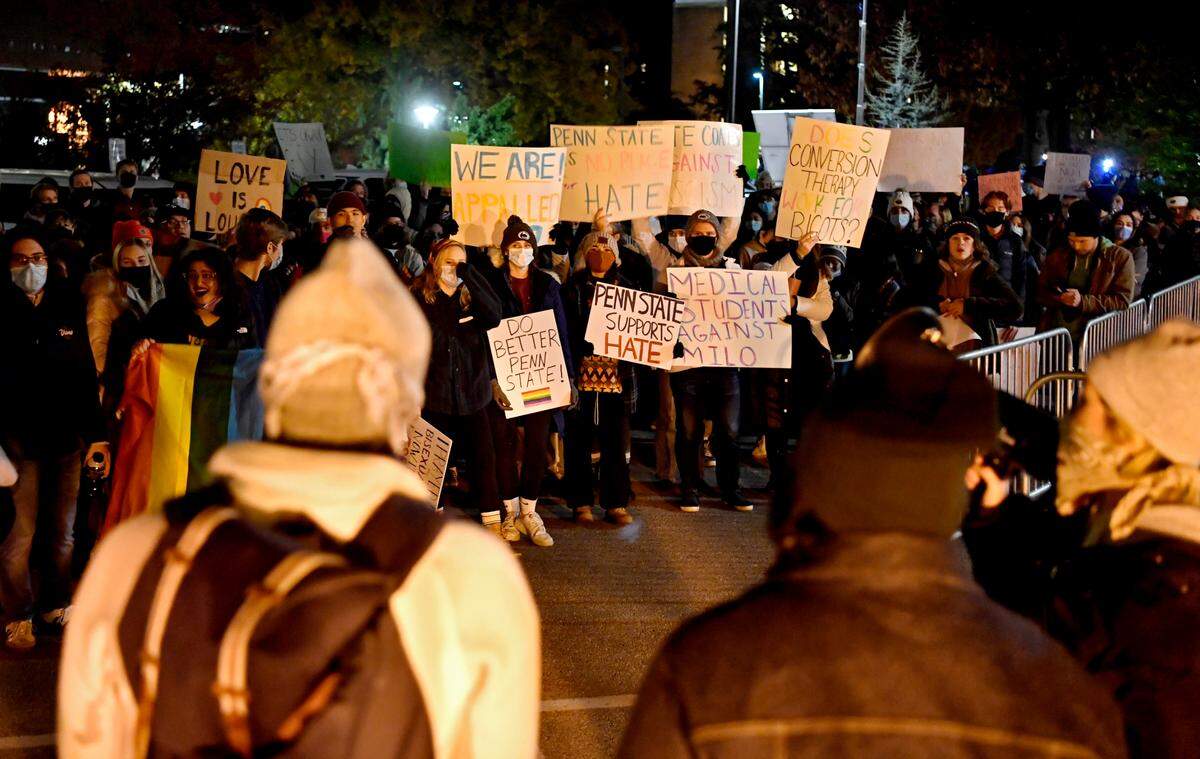
Local community group Alleghenies Abolition organized a “phone zap,” encouraging people to call Penn State administrators to demand the event’s cancellation. One student group organized a protest outside Thomas Building for Monday. Others came to this past Monday’s borough council meeting, where frustration boiled over during public discussion of council’s proposed letter to the university — which echoed Penn State leaders’ condemnation of the event while stopping short of directly demanding its cancellation.
“Whether you prioritize the risk of violence or prioritize the risk of censorship, by allowing these people to come here both will happen no matter what,” one animated Penn State student, sporting a black hoodie, told council. “If these people are allowed to speak, it sends a message to the entire community that this speech is supported, that this speech is allowed and permissible.”
But hate speech is permissible under the First Amendment, experts said, in part because — if it’s not — who gets to decide what hate speech is? Former ACLU President Nadine Strossen once opined that, worldwide, many human rights activists oppose hate speech laws because they’re often used to silence speakers who oppose government policies or advocate minority group rights. Some on the political right denounce Black Lives Matter as hate speech.
The First Amendment cuts both ways, experts said.
“The underlying idea is it’s better to tolerate that kind of (Proud Boys) thing because once you start down the slippery slope of government making the decision on what’s a legitimate idea and what’s not, that’s dangerous,” said Steve Sanders, a professor at IU’s Maurer School of Law. “Many of these same students if they were at public universities in deep red states and deeply conservative states, what if a group wanted to bring in a trans-youth advocate speaker and the university said, ‘No, we think that’s too dangerous’?”
Added Carlos Ball, a Rutgers law professor and nationally recognized expert on LGBTQ rights/constitutional law: “For better or for worse, the Supreme Court has made it clear that even hateful speech, which falls short of an incitement to engage in imminent violence or other forms of illegal conduct, is constitutionally protected.”
Violence vs. free speech
More than 40 members of the Proud Boys face charges from the Jan. 6 attack on the U.S. Capitol, and McInnes has often been accused by others of promoting political violence.
As a result, some community members have expressed concern over the potential for violence Monday night — and they say that should be reason enough to cancel Uncensored America’s event. But, again, experts say it’s not nearly that simple.
“We restrain conduct, not ideas,” said Gene Policinski, senior fellow for the First Amendment at the national nonprofit Freedom Forum. “So it’s criminal activity that’s not protected. ... That’s a very, very high bar with very limited circumstances.”
Incitement to violence is one of the few exceptions to the First Amendment. But, as the ACLU notes, it must intentionally and effectively provoke a crowd to immediately carry out violence. In other words, when a Ku Klux Klan leader suggested in 1964 of taking future “revengeance” on the government, that was allowed because it wasn’t immediate. Even when civil rights leader Charles Evers told colleagues in 1968, regarding a boycott of white merchants, “If we catch any of you going in any of them racist stores, we’re going to break your damn neck” — that was still permitted because of that high bar.
Even if there were threats of imminent violence against McInnes — and not coming from McInnes himself — Penn State is still obligated to act in good faith to carry out the speech.
“Typically, courts say that institutions have to protect the right to speak,” said Eric Berger, a law professor at the University of Nebraska who clerked for Merrick Garland. “So, if there’s a threat of violence, the institution might need to bring in police or security to make sure there isn’t violence. But the possibility of violence in reaction to a controversial speaker is usually not sufficient reason to deny that speaker a platform to speak.”
In 2017, Penn State did reject a request — from a student at another university — to host white nationalist Richard Spencer on campus. (No student fees were involved.) At the time it cited “imminent violence” as the reason for the denial, given the request came so closely after a violent rally in Charlottesville, Virginia. Spencer’s team sued, but never officially served the complaint to the university or responded to the judge, so the case was dismissed.
Despite also initially rejecting Spencer’s requests, Michigan State wasn’t so fortunate with the ensuing lawsuit. Spencer and the Big Ten school eventually reached a settlement that allowed him to speak there in March 2018.
Before the speech at MSU, fights broke out with bottles and rocks being thrown outside the hosting venue. Arrests were made involving both Spencer supporters and protesters, as more than 100 officers were on the scene with riot gear. The event still went on, albeit 30 minutes late and with about two dozen attendees.
“Usually in our system, prior restraints against speech are deeply disfavored,” Berger said. “So a prior restraint would mean prohibition on speaking before the speech is uttered, or permission to speak before you speak. And there’s some history to suggest that prior restraint is what the authors of the First Amendment were especially concerned about.”
Penn State has said that university police are “prepared to take every reasonable action to protect the safety of our campus.” Although it declined to provide staffing details for Monday, due to security reasons, it acknowledged it has been engaged with “external law enforcement partners,” and the State College Police Department is prepared to assist.
When asked why Penn State could cite “imminent violence” against Spencer but not McInnes, a university spokesperson responded, “We do not have knowledge of any such credible threats at this time but continue to monitor the situation.”
Did PSU pay for this?
Students and outsiders alike expressed disgust on social media that more than $7,500 in Penn State student fees went to speakers like McInnes and Stein.
“Filth,” said one. “Only thing anyone should pay for is Gavin McInnes’ deportation,” another said on Twitter.
But, as the student-run allocation committee explained last year, it is constitutionally obligated to remain “viewpoint neutral” when approving funds. It can’t just decline Uncensored America’s request for $7,522.43 — a $6,500 honorarium plus airfare — because it finds the views of McInnes and Stein hateful or abhorrent. Likewise, the reverse holds true: Allocation committees comprised of far-right members cannot simply reject liberal speakers either.
“The Supreme Court has decided that when universities collect student fees, the mandatory part of their tuition, and they distribute it to student groups through student governments or committees, it has to be done in a viewpoint-neutral manner,” said Zach Greenberg, a senior program officer at the Philadelphia-based nonprofit Foundation for Individual Rights in Education (FIRE). “So the student committee will not be able to take into account student groups’ or speakers’ ideology, mission or values when allocating funds.”
The allocation committee could deny the request for other reasons, like if the honorarium ate up a sizable chunk of the yearly budget. But, according to Penn State, the University Park Allocation Committee has been given $4.1 million this academic year for student groups’ events, travel experiences, equipment and other items.
At least one expert believed Penn State could avoid similar situations like this in the future by simply changing the policy of allowing recognized student groups to invite speakers. By forbidding any student group from doing so, it wouldn’t be discrimination. Every group would be treated the same.
“It may not be the best course of action but, yes, they could just say if we have to allow this person to speak then nobody gets to speak,” IU’s Sanders said. “It’d be sad if it came to that but, yes, that would probably be OK.”
Said a university spokesperson: “We believe that those ideas that are in conflict with our community ideals are best challenged and contrasted in the open with principled ideas and speech reflective of Penn State values. There are no plans to make changes to the university’s approach regarding speakers on campus.”
Fighting hate & looking ahead
State College Mayor Ezra Nanes spoke softly in addressing the public Monday night. He listened to an open discussion that took about 40 minutes, and he empathized with both pained students and university leaders.
“They really do care a lot about this,” Nanes said, referring to Penn State. “This is a very difficult spot legally for the university, and their words were very clear in condemning the message and intent of the event while saying we support First Amendment rights.”
Penn State wouldn’t be the first to condemn a message while defending a group’s right to say it. A Jewish lawyer from the ACLU once defended the rights of neo-Nazis to march through an Illinois town that was home to numerous Holocaust survivors. In the Supreme Court case ruling that the Westboro Baptist Church was protected under the First Amendment while picketing military funerals, Chief Justice John Roberts wrote that a commitment to free speech requires protection of “even hurtful speech on public issues to ensure that we do not stifle public debate.” He wasn’t alone either. Former ACLU President Nadine Strossen wrote a book titled, “Hate: Why we should resist it with free speech, not censorship.”
Most every expert the CDT interviewed echoed that theme, saying the best way to resist hate is through counterspeech and activism. Divine Lipscomb, the borough’s first Black councilman, might’ve summed it up best.
“Yeah, we can’t stop a student organization from inviting who they want,” he acknowledged Monday. “But we can stand together as a community and speak about what we don’t want.”
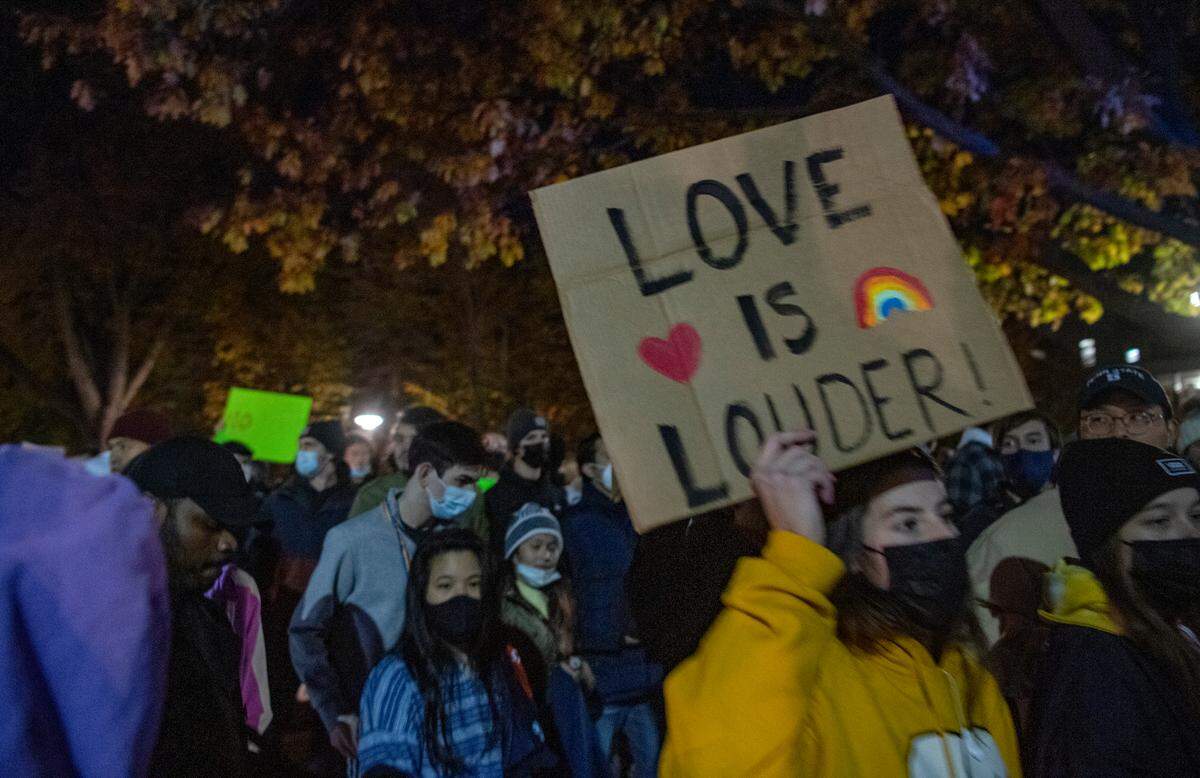
He encouraged students to attend the university’s counter-event, “Together We Are,” which will overlap with the event at Thomas Building. It will take place from 6-10 p.m. at Alumni and Heritage halls at the HUB-Robeson Center and feature activities that support belonging and community.
Last year, at the “Love is Louder” counter-event to Milo Yiannopoulos, attendees outdrew the “Pray the Gay Away” presentation by more than a 7-to-1 margin. “I needed that tonight,” one student told the CDT last year. Said another “As a transgender woman, it shows me that love is stronger than hate.”
“I think ‘Together We Are’ is a great way to unify,” Sydney Gibbard, president of the University Park Undergraduate Association, said Friday. “It’s not just a counter-event but an opportunity to celebrate different organizations on campus and show who allies are and be a support system for many people.
“And that mission, that purpose, doesn’t end on Monday night when it’s over.”