Penn State president discusses university budget, law school future and more
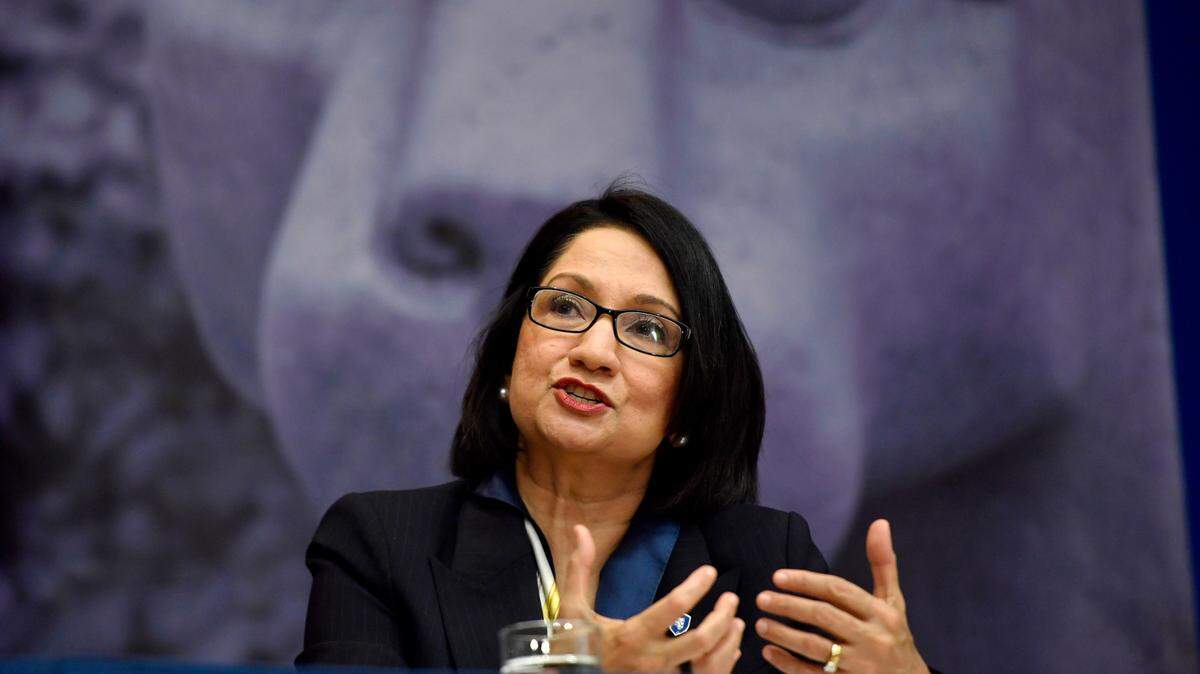
With Pennsylvania’s state budget at an impasse, Penn State President Neeli Bendapudi reiterated Tuesday that the university is still planning to have its own two-year budget introduced next week to the board of trustees.
Penn State’s budget will first be presented July 20 to the trustees’ Committee on Finance, Business, and Capital Planning. If passed there, it will go before the full board for a July 21 vote at the Behrend campus.
During a scheduled faculty senate meeting Tuesday, Bendapudi acknowledged it wasn’t exactly unprecedented for the Pennsylvania General Assembly to miss its budget deadline. And she said there would be “contingencies and scenarios” if the state funds the university is expecting wouldn’t become available.
“We’ll have to wait and see,” she added during a brief Q&A with faculty. “It definitely does put us at a disadvantage because we don’t know how we(‘ll) act.”
No funding has yet been passed by the state House for state-related universities such as Penn State, Pitt and Temple. Pennsylvania’s General Assembly did agree to an overall $45.5 billion spending plan, but the main budget bill still needs to be signed — and Senate Republicans aren’t eager to reconvene after they say Gov. Josh Shapiro backtracked on a deal involving a private-school voucher program. (Pennsylvania’s General Assembly is now on a summer recess, and the state Senate’s next session isn’t scheduled until Sept. 18. There are no plans — yet — to meet before then.)
Penn State operated at more than a $140 million deficit this past fiscal year, and Bendapudi promised to balance the budget by 2025. As a result, the university has made a number of changes to increase revenue and reduce expenses — from implementing a hiring freeze to adding corporate sponsorships — and will present a two-year budget to the board next week, followed by the usual single-year budget in the proceeding years.
“And I’m pleased to report that, thanks to all of you working as hard as you are, we are optimistic that we will be able to show the board we are making very good progress toward a balanced budget by FY 26, which will be critical to us,” Bendapudi told the faculty senate. “So we’re taking all the steps we can to show we’re being very good stewards to protect the access and affordability mission.”
Diversity remains a priority
Penn State issued a same-day response June 29 when the U.S. Supreme Court ruled against affirmative action in college admissions, with PSU stating that it remains committed to diversity.
On Tuesday, Bendapudi opened her comments by reiterating that commitment.
“I’d like to begin by reiterating to everybody that Penn State firmly believes — and I absolutely firmly believe — that the education experience for everybody is deeply enriched when we are in communities that reflect the broad diversity of identities and perspectives and life experiences, that we are better off when we are not just in echo chambers,” she said. “So our commitment to diversity, equity, inclusion and belonging is absolutely rock solid, and we will continue to pursue everything that we can, given the narrow ruling on admissions.”
No updates on PSU Law
Bendapudi announced in November that she was recommending a “reuniting” between Penn State Dickinson Law in Carlisle and Penn State Law at University Park. Others simply stated, whatever it was called, the university would essentially just shutter its UPark location.
Bendapudi had said that a panel would come up with a reunification plan by spring’s end. But, when asked Tuesday if she had any updates, she acknowledged she didn’t so much as have a timetable.
“I did receive a report. We are reviewing it,” she said. “Some of you already know how this is but, absolutely, will keep you updated as I have a chance to gather more information and share with you how it will move forward. ... I just ask for a little more time as we process this and say what the next steps are.”
Touting commonwealth campuses
It’s been difficult to ignore the news and numbers when it comes to Penn State’s commonwealth campuses and other institutions’ branch/satellite campuses. To sum it up: Enrollment doesn’t look good.
The Pittsburgh Tribune-Review reported that enrollment at PSU’s commonwealth campuses — outside of Harrisburg — declined an average of about 30% since 2010. But Penn State isn’t an exception. The University of Wisconsin System chancellor said in April that, due to shrinking enrollment, they would consider “everything,” including consolidating campuses. Ohio University is also exploring the potential sale of three buildings from their regional campuses.
On Tuesday, Bendapudi said Penn State remained committed to its commonwealth campuses.
“I wanted to bring that up because the tone of the coverage might give some anxiety to people about, ‘Are they truly committed to the commonwealth campuses?’” Bendapudi said. “And I just want to reiterate again that we go back to our values. I believe firmly that our commonwealth campus system is is a distinctive characteristic and a unique strength of Penn State University.
“When you think of the access and affordability mission; when you think about students’ success and interdisciplinary research; the land-grant commitment; diversity, equity inclusion; operational excellence — all of those are reflected every day in our commonwealth campuses.”
Moving up in QS rankings
The QS World University Rankings are designed to annually rank about 1,500 institutions internationally and, with a change in methodology for this year’s edition, Penn State found itself jumping up 10 spots to a No. 83 worldwide ranking.
“It’s a big deal because that means we are in the top 6% of universities in the world for our impact,” Bendapudi said. “It puts us No. 8 among public universities; that is in the United States.
“That is something that we would not be able to do without each of you as faculty. So I just wanted to say that I’m so grateful to you and so thankful and, one year in, I feel very optimistic about how we project.”
The QS World University Rankings — compiled by global higher education analyst Quacquarelli Symonds (QS) — grades schools on at least nine different criteria, such as academic reputation, faculty student ratio, citations per faculty, etc. Penn State fared especially well in two new ranking criteria, international research network (96.6/100) and sustainability (95.1/100).
Penn State ranked No. 24 among all U.S. universities and No. 4 among Big Ten schools.
This story was originally published July 12, 2023 at 7:30 AM.
CORRECTION: This story has been updated to reflect that Ohio University is exploring the potential sale of three buildings from their regional campuses.