After Penn State removes — then returns — student newspaper racks, concerns of censorship loom
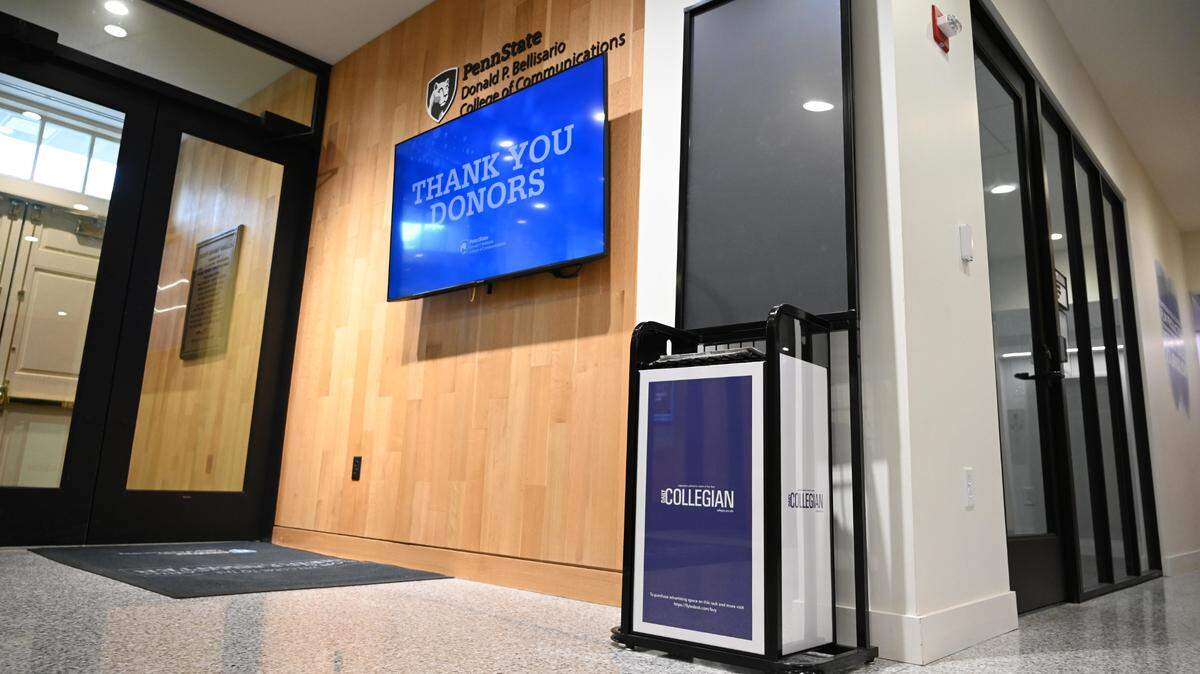
Penn State has returned the student newspaper news racks it removed from various locations throughout campus — a move that led to outrage from students and alumni — after the university said the paper violated a university policy.
The Daily Collegian, Penn State’s student newspaper at University Park, reported Thursday evening that approximately 35 racks with newspapers on them inside of campus buildings were removed without any prior notification from the university. Three of the racks had a Kamala Harris advertisement and six had voter registration ads on them, the article states.
In a statement, Penn State said the advertisements were in violation of the university’s policy.
“The University is not challenging the Collegian’s distribution of newspapers on the racks or otherwise; it is prohibiting the sale by the Collegian of advertising space on University premises that is occurring outside the actual publication of its newspaper. The Collegian’s use of advertising space within University buildings was a violation of two policies — AD27 Commercial Sales Activities at University Locations and AD02 Non-University Groups Using University Facilities. We would hold any organization to this standard,” the statement reads.
The Collegian reported it received feedback from alumni and students about the political ads. Amy Schafer, The Daily Collegian’s editor-in-chief, told the Centre Daily Times they received a few emails from people who were concerned about the paper running political advertisements on their newsstands, but she was never contacted by the university prior to removing the stands nor did they receive any official notice.
“Our general manager got a call on Tuesday from somebody at the university, just kind of expressing concerns about the advertising racks, but never said that they were going to take them down. Never asked us to remove them immediately. We never got any sort of like, official notice or anything like that. So we had no reason to think that the university was going to take any action or remove our newsstands or papers or anything like that,” Schafer said in a phone interview Friday.
The Collegian reported Friday afternoon that all of its newsstands and newspapers were returned without advertisements to their on-campus locations that morning, except for one that goes outside of its office on the second floor of the Willard Media Center.
In Penn State’s statement, it said the stands were taken to “remove the advertising and have been put back in place so that the papers can be easily accessed on campus.”
“The goal was to quickly rectify the situation and ensure that all advertisements in violation of University policies were removed. Our intention was never to stifle news delivery, and we value the service and mission of The Daily Collegian,” the statement reads.
Only 10 of the approximately 35 on-campus newsstands have a place for ads and of those, nine had advertisements up, Schafer said. They’ve used the stands for two years without any issues, she said.
Moving forward, Schafer said there’s a concern of censorship due to the incident. The concern was widely echoed on social media Friday by students, alumni and community members.
“Even if it wasn’t their intention to censor the paper, they still did. Even if it was only 24 hours, they still removed our papers,” Schafer said, adding that she questioned why the university removed all 35 indoor racks, rather than just the ones that had advertisements.
It would have been better, she said, if the university sent them an official notice prior to removing the stands. They also could have just removed the advertisements, she said.
“It’s partially an issue concerning censorship and taking away the opportunity for those students to get that paper for that time,” Schafer said. “...I just felt it was disrespectful not to communicate with the student leaders of the paper in any way before that decision was made.”
Penn State said the university “supports free news and information sources specifically for its students.”
Schafer praised the Collegian’s staff for their hard work and said the situation was “disheartening.”
“All of our journalists here work so hard and put 110% of their effort into what they do. So for something like this to happen, it’s very disheartening, and I’m really appreciative of all the staff kind of continuing to put effort into the journalism that they’re doing, and to keep working really hard here,” Schafer said.
The Collegian will now need to explore more innovative ways to fund its journalism, Schafer said. Advertisements play a huge role in its funding, especially after the university cut 100% of its funding last year.
The Daily Collegian previously received $400,000 from the university, which was cut in half last year. This is the first year it’s not receiving any financial support.
In the hours since the Collegian first published about the removal, Schafer said they’ve received tons of support, especially from its alumni. Many took to social media to support the newspaper and tell the university they were upset with the situation.
Many have donated to the newspaper, too.
“That’s definitely really inspiring to see that like, people are reading us, and they do really care about our work, and … even if the university is sending a message of disrespect and not communicating with us, that we still have the support of the student body and the alumni,” she said. “We’ve seen so many people kind of saying how much the Collegian means to them and how much they like to pick up our paper every week and read us on our social media and everything. So that’s definitely heartwarming to see that community response to it.”