
‘Epitome of an exceptional scientist.’ Penn State professor receives National Medal of Science
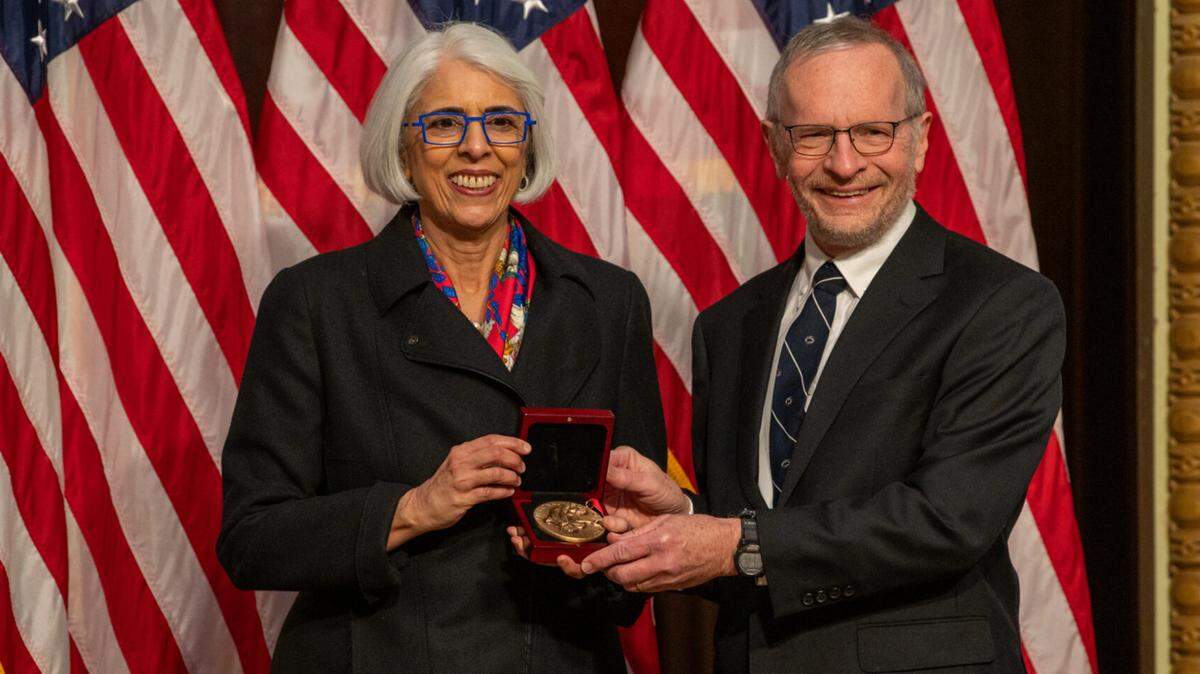
An esteemed Penn State professor started the new year by receiving a national honor.
Richard Alley, Evan Pugh University Professor of Geosciences, received the National Medal of Science at a White House ceremony on Jan. 3. He represented Penn State as one of 23 individuals and two organizations to receive the 2025 National Medals of Science and National Medals of Technology and Innovation.
Alley, who became a Penn State faculty member in 1988, studies Earth’s largest and oldest ice sheets to help predict changes in climate and sea levels. He led a team that discovered abrupt changes to Earth’s climate in the past and authored a study of two miles of ice cores from Greenland to Antarctica, ultimately raising the idea of “switches” and “dials” in the climate that represent slow or abrupt changes that can produce significant environmental effects.
“My piece of this story is small, but our community as a whole provides reliable, useful information that can help people, and I’m grateful for the opportunity to contribute to this important effort and to the National Medal of Science for highlighting it,” Alley said in a university statement. “The discoveries we have brought home, together with an immense amount of information from other scientists and engineers, show clearly that if we effectively use our knowledge on climate and energy, we can build a larger economy with more jobs, improved health and national security, as well as a cleaner environment for all.”
Across his career, Alley has authored or coauthored more than 300 peer-reviewed scientific papers, hosted a PBS special, “Earth: The Operators’ Manual” and served as an author on the United Nations Intergovernmental Panel on Climate Change, whose members shared the 2007 Nobel Peace Prize.
Penn State President Neeli Bendapudi said that while Alley’s Medal of Science offers new national recognition for his work and expertise, the university community has appreciated his efforts for decades.
“Dr. Alley is the epitome of an exceptional scientist,” Benapudi said in a university statement. “His career studying our planet’s ice sheets has shaped Earth science and climate policy throughout the world. He exemplifies the very best of our University, inspiring others through his pursuit of knowledge and his commitment to advancing solutions for a sustainable future. This honor reflects the profound impact of his research on our world and future generations.”
Alley is now the fifth Penn State faculty member to receive a Medal of Science. He joins Erwin Müeller, Evan Pugh Research Professor of Physics (1977, posthumous); Calyampudi Rao, Eberly Family Chair in Statistics emeritus (2002); Nina Fedoroff, emeritus professor of biology (2007); and Stephen Benkovic, Atherton Professor and Eberly Chair in Chemistry (2010).
“Those who earn these awards embody the promise of America by pushing the boundaries of what is possible,” according to a White House statement. “These trailblazers have harnessed the power of science and technology to tackle challenging problems and deliver innovative solutions for Americans and for communities around the world. Their accomplishments advance American leadership in science, technology, and innovation, and their work inspires the next generation of American leaders.”
%202.JPG)